

The opening of training camps across the country this week officially signals the return of football and for millions of people that also signals the return of one of their favorite pastimes, fantasy football. Wether you just play in one non-competitive league or will have already drafted six high stakes money league teams before the first preseason game even kicks off, most NFL fans now play fantasy football on some level. Over the next several weeks I’ll be previewing the different fantasy football positions here at FanSided and hopefully I can share a little insight that can help you come out on top of your league this year. We’ll start things off this week with the quarterbacks.
When looking at the fantasy football position groups, many of these preview posts will likely take on the familiar form of “players to target” and “players to avoid”, but for this first group I’ve got a little different approach. In simplest terms, my advice this season is to avoid drafting a quarterback early and instead double down on two solid QBs later in the draft. Before I get into how to go about this I’m going to need to talk some reason into some of you that are going to have a hard time with this strategy.
You know who you are.
You’re the guy that gets the first pick in the draft and takes Peyton Manning.
You’re the guy that curses under his breath when someone else beats you to Manning and then drafts Aaron Rodgers while Eddie Lacy and Matt Forte are still on the board.
I get it. The NFL has become a QB driven league. If you were drafting a real life fantasy football team that would actually take the field and play for you then of course you would draft your quarterback first, but fantasy football is different than real football.

Some of you are going to counter with what an astronomical season Peyton Manning had last year and how he almost single handedly won you your fantasy league. I can’t argue how impressive Manning’s numbers were last season. In fact, I would join you in pointing out that it was the single greatest statistical season ever put up by a QB in the history of professional football.
That’s the problem.
If you draft Peyton Manning for the numbers that he put up last season that means you are betting on a 38-year-old QB repeating a performance that was once in a lifetime. No QB had ever put up numbers like that and now you’re betting that one will be able to do it for two seasons in a row? You have to see the risk there.
After Tom Brady set the league on fire in the Patriots 16-0 regular season I’m sure many a fantasy football player drafted Brady in the first round the following year only to seem him injured right off the bat and he’s never put up numbers like that since. I’m sure that many people out there used a first round draft pick on Aaron Rodgers last season only to see their seasons dashed by his injury.
The next rebuttal from some of you fantasy QB enthusiasts will be that first round running backs can have disappointing seasons or get injured too. That is absolutely 100% correct, but here’s the difference, you can’t draft two RBs in the middle to late rounds and alternate them and get almost the same production as the elite RBs (same can be said for WRs). I believe you can do this with QBs.
There are three universally agreed upon star fantasy football QBs: Peyton Manning, Aaron Rodgers, and Drew Brees. Following this plan means that you won’t own any of them in any of your leagues. The reason this plan works so well this season is because after those three there is no wide consensus on the fantasy QB rankings after them. Depending on who you listen to, the order of these following thirteen QBs can be vastly different:

Cam Newton (12)
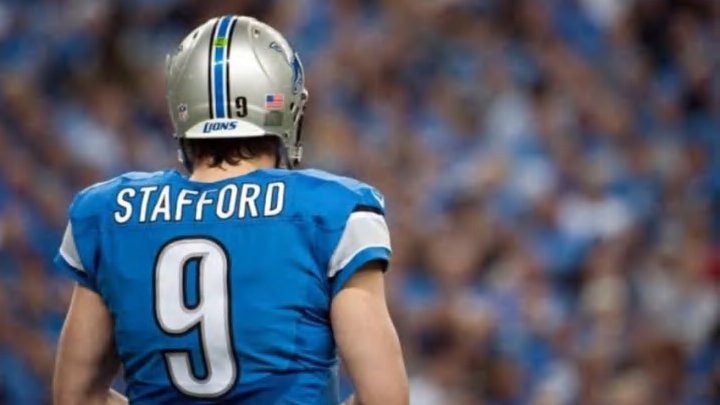
Matthew Stafford (9)
Andrew Luck (10)
Matt Ryan (9)
Tom Brady (10)
Robert Griffin III (10)
Colin Kaepernick (8)
Tony Romo (11)
Phillip Rivers (10)
Jay Cutler (9)
Nick Foles (7)
Russell Wilson (4)
Ben Roethlisberger (12)
We could literally fill a comment section with why we think certain QBs on that list will be better than others. So my question for you is, if there are that many QBs that are debatable on who would be better on your fantasy team, then why would you waste a high draft pick on one of them when a couple of them are bound to slip into the mid to late rounds?
Trust me, after those first big three QBs go off the board the others names on that list will soon begin to follow. That’s exactly what you want to happen. While your opponents are grabbing their QBs in the 3rd-5th rounds you are making sure you fill all your starting RB and WR slots and even adding some depth to your bench at those spots as well. When you combine the big three with the other 13 QBs listed that gives you 16 QBs in your possible starter pool. Given that the average fantasy football league has 10-12 teams that means you are safe to wait.
Now, I should probably point out that if you are playing in a league with a lot of teams (16+) or a league that starts two QBs then that obviously changes things, but in a standard league this strategy works. Just make sure you take into account that some of those teams that took a QB early could surprise you and grab an insurance policy before you expect. So don’t wait until only a couple of those guys are left. I generally strike when there are about a half-dozen guys left and then snatch up two in back to back picks. I included the bye weeks next to the players above to ensure you don’t double up on guys with the same bye week. You now have built in coverage on your bye weeks and you’ll have basically no drop off in performance if one of your QBs misses a few games.
In case you are wondering how effective this strategy really is, I have a couple of case studies for you. I took a couple of QB pairings that I believe you could have landed last season using this same approach. The first is Russell Wilson and Ben Roethlisberger, the second is Tony Romo and Phillip Rivers. For each pairing I looked at their 2013 weekly schedule and picked who I thought I would have played each week if they were my QBs last season. I didn’t look at the results at all so this isn’t me picking the highest scoring games as you can see. I used the ESPN scoring system because its pretty basic and easy to access. This first chart shows how my pairing of Wilson and Roethlisberger would have fared last season. It shows the opponent of each QB and how many fantasy points they scored. The bolded games are the ones I would have started that week.

So you can see that my combined duo of Wilson and Roethlisberger would have scored me a total of 286 points using the ESPN scoring system. That’s an average of 16.8 points per game. Not only is that 286 points 30 and 38 points more than either QB would have scored on their own, that 16.8 points per game would have ranked 7th overall amongst QBs and would have been within 0.8 points per game of every QB not named Manning or Brees.
One more example, here is the same thing done with Tony Romo and Phillip Rivers for last season.

So the combined duo of Rivers and Romo would have scored me a total of 310 points using the ESPN scoring system. That’s an average of 18.2 points per game. That average would have been good for third place amongst QBs last season behind only Manning and Brees. So using this draft strategy last season with Romo and Rivers would have basically given you the third best QB in the league even though you drafted your QBs after filling your RB and WR spots that always run out of consistent scorers before the QB position does.
So when you sit down to draft your fantasy football team this season, hold off on drafting a quarterback until your other key spots are filled and then double down on a couple of the guys listed above. If there is an unexpected run on QBs right before you execute this plan, don’t panic. Guys like Andy Dalton, Alex Smith, Carson Palmer, Ryan Tannehill, and Joe Flacco could also fill your second QB spot with little to no drop off. The point is, don’t use those valuable early picks on your QB when you can get comparable results by drafting a couple of guys later in the draft.
I hope that helps. Come back next Tuesday for your Fantasy Football Primer for the most coveted fantasy position, the running backs!