

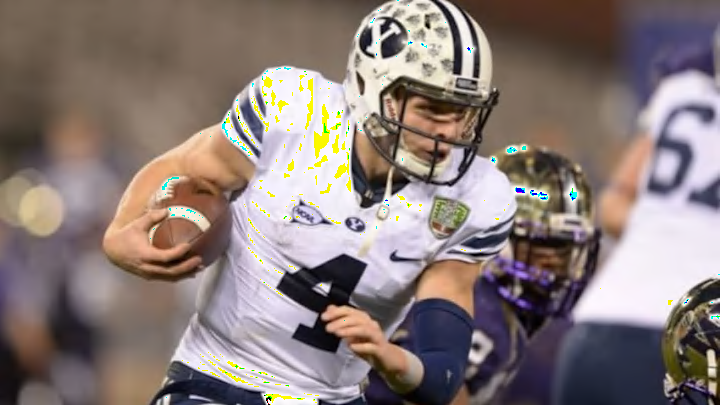
My assignment was to find five reasons why the BYU Cougars could upset the Texas Longhorns. After nearly a week of combing through stats, rosters and game tape, I had to settle on one: quarterback Taysom Hill.
In their 2013 matchup in Provo, Taysom Hill put on an absolute clinic on how to slice and dice the Texas defense. Some even foreshadowed Hill’s performance during the 2013 game as the catalyst that would eventually lead to the end of Mack Brown’s tenure in Austin.
Heading into the 2014 matchup, I don’t see any reason the outcome will be much different than the 2013 BYU romp. Hill is back and looks to be as focused and as dangerous as ever. While it was his legs that did most of the damage against the Longhorns last year, it’s his arm that turned heads last week against UConn.

Hill went 28 of 36 for 308 yard and three touchdowns against the Huskies. He looked comfortable and every bit as in control of an offense as you’d expect an upperclassman heading into his second year as a starter to be. The things that plagued him most in 2013 — interceptions — weren’t really an issue against UConn. Every pass had a purpose and it seemed as though every decision Hill made with the ball was the right one.
As far as his legs — well, he didn’t exactly abandon them. Hill also piled up 97 yards and 12 carries — punching it into the endzone twice. For my money, it was the best individual performance of the week across all of college football.
I’m not sure how Charlie Strong’s Longhorns are going to be able to slow down hill much more than UConn did. Texas was able to come up with four interceptions against North Texas a week ago. Those interceptions accounted four one score on their own and put the Longhorns in field position for two short drives where they’d score twice more. Texas got the win with just 353 yards of total offense.
I just can’t see Hill giving the Longhorns that many turnover opportunities. BYU’s passing game is much different that North Texas, as the Cougars usually only take to the air with high percentage throws. When that’s not happening, Hill is tucking the ball and running over or around opposing defenders.
Additionally, this Texas team may not be any better off from a talent standpoint to slow down Hill and the Cougars than they were in 2013. While I do believe Charlie Strong’s policies and subsequent dismissals of several players this offseason will eventually be a good thing for the program, the bottom line in 2014 is a serious hit to the Longhorn depth — especially on defense.
One of the players Strong dismissed was Chevoski Collins — an ultra-talented redshirt freshmen defensive back who some thought would be a serious contributor for the Longhorns this season. In addition to the loss of Collins, cornerback Leroy Scott — a key contributor in 2013 — was also shown the door. These dismissals caused some obvious shuffling on the Texas depth chart and were in part what led to the Longhorns having to start a freshman at strong safety — a key position in any defense that plans on slowing down Taysom Hill and the BYU attack.
To make matters worse for Texas, they’ll be without starting quarterback David Ash to counter Hill on the other side of the ball.
At the end of the day, all we really have to go off until these teams hit the field is the eye test. There’s no way we can predict a certain player or group of players stepping up or crumbling under the pressure and changing the outcome of the game. Judging from what I saw last week, however, I have to think the Longhorns are in serious trouble for a second consecutive year against BYU.
The Cougars posted a more impressive win over a better team a week ago than the one Texas faced. There is little doubt in my mind that when the two teams take the field Saturday night in Austin, Taysom Hill and BYU will look like the better team for the second straight year.