

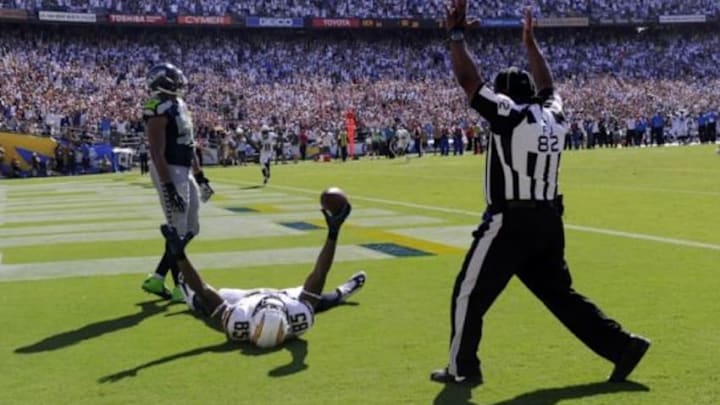
The San Diego Chargers, led by tight end Antonio Gates, put together a masterful performance last Sunday against the Seattle Seahawks. Gates finished the game with seven catches for 96 yards and an amazing three touchdowns.
What makes those stats even more impressive is that they came against a team that has been able to shut down the league’s best tight ends. New Orleans tight end Jimmy Graham had just four catches and 50 yards combined in two games against the Seahawks last season. Then, last February in the Super Bowl, Seattle held Denver tight end Julius Thomas to just four catches and 27 yards.
This is a Seahawks team that has dominated the league’s best tight ends. It is a new season, but the Seahawks return with the same group of safeties and linebackers that were able to shut down Graham and Thomas a year ago.
So how did the Chargers manage to get Gates free in the passing game with such regularity last Sunday? The coaches’ tape provides the answer.
Formation Emphasis
Here is the pre-snap formation on all three of Gates’ touchdowns:


The first two are almost identical, and the third is just flipped to other side of the field. San Diego set up with three receivers on one side of the field, and with Gates and running back Danny Woodhead on the other side.
This formation triggered the Seahawks to switch out of their standard cover-3 defense to avoid the zone on the side with three receivers from being flooded with more receivers than players in coverage. Seattle predictably ended up in man coverage.
San Diego was able to use Seattle’s defensive tendencies against them, and dictate which coverage the Seahawks were going to use. Since they knew what defense Seattle was going to run, they were then able to put together route combinations that would generate one-on-one matchups.
The First Touchdown
The first of Gates’ three touchdowns provides a blueprint that would be followed for both of the other two. The formation dictated man coverage for Seattle, with strong safety Kam Chancellor lined up against Gates, and linebacker Malcolm Smith lined up on Woodhead.

This route combination creates a high-low decision for middle linebacker Bobby Wagner, who is forced to play like a safety on this play. If Wagner helps against Gates, then the pass will go to Woodhead. Step up on the underneath route, and the ball will be thrown to Gates.

San Diego quarterback Phillip Rivers is able to freeze Wagner in place by looking first at the underneath route. This generates a one-on-one matchup on the outside with Gates on Chancellor.
With Gates being given outside leverage on the play, a perfectly placed pass by Rivers generates an easy touchdown.
The Second Touchdown
Gates’ second touchdown looks eerily similar to the first one, though this time Gates ends up matched up against linebacker Malcolm Smith.

Seattle actually has this play well covered initially, and gets pressure on Rivers. Rivers is forced out of the pocket, and that creates time for Gates to finally get free.

There is clearly contact between Gates and Smith, and Smith is called defensive holding (which is declined), but the call could have gone either way. Both players were a bit too grabby on the play, and in today’s NFL the call will almost always benefit the offense.

Gates isn’t yet open when Rivers throws the ball, but the pass is expertly placed where only his receiver can make a play on it. Rivers is able to throw Gates open with a great pass.
The Final Touchdown
The endzone angle shows what happens on this play best. Woodhead runs a quick out-route, while Gates clears the area by running deep down the field. This combination against this coverage suggests that the play is designed to get the ball to Woodhead.

Seattle breaks up the quick pass to Woodhead by getting very quick pressure on Rivers. Rivers has to step up and to his right to avoid the pass rush, which takes away the passing lane to Woodhead.
Gates is able to get an inside release against linebacker K.J. Wright, and then expertly widens his route to give Rivers more space to work with on the long pass.


Wright has excellent coverage here, but sometimes there is just nothing a defense can do. Rivers could not have thrown this pass any better, especially given the pressure from Seattle’s front four, and Gates makes a magnificent catch.
On this play, Seattle free safety Earl Thomas is on the sidelines getting treatment for cramps. Backup Deshawn Shead was late getting over to help on the play. Given his instincts and speed, it is possible that Thomas could have prevented this play. The Chargers did the right thing to take advantage of the backup’s presence here.
While it looks like Gates is pushing off of Wright from the endzone angle, he is just using his inside leverage to generate a better angle and generate more space between his route and the safety. It was actually a textbook-perfect route.
Putting it all together
This was a masterful coaching job by Mike McCoy, offensive coordinator Frank Reich and the rest of the offensive coaching staff in San Diego. They put together a game plan to attack Seattle’s vaunted defense that clearly worked.
Of course, no game plan works without the players successfully making the plays. Both Rivers and Gates played very well throughout the game, and executed these plays to perfection.
With that type of performance by both coaches and players, the Chargers were able to dominate against arguably the best defense in the NFL.
More From FanSided.com
NFL Rankings: Top 10 Hybrid Players
NBA: 2014-15 League Pass Power Rankings
MLB: Ranking the Top 5 Free Agent Catchers
The Armchair Quarterback’s Guide to the NFL Week 3