

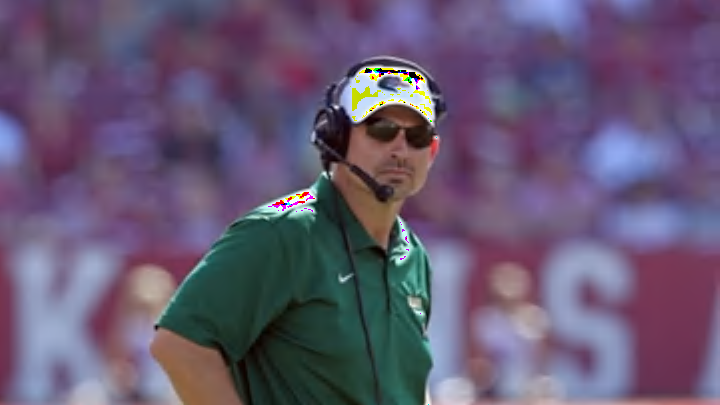
UAB football is shutting down after this season, and more programs could possibly be in danger of the same.
The college football program that gave us Roddy White and Bryan Thomas is closing up shop.
Not because they can’t find players or because the program can’t win games….no, because (supposedly) there’s no more money to fund a football program at the University of Alabama at Birmingham.
Barring a last minute stay of execution, the UAB Blazers played their final game on Nov. 29 — a 45-24 win over Southern Miss — to up their record to 6-6, making them bowl eligible, although no bowl game invited the Blazers to come.
CarrSports Consulting did a review of the numbers, the campus and the program, and came to the conclusion that keeping a football program afloat at UAB was not financially viable, and their recommendation to University President Dr. Ray Watts was to kill the program, and cut the school’s losses.
According to Watts, the program would have needed a $49 million infusion over a five-year period to meet the commitments needed and to keep things stable.
Many schools will spend and spend thinking some holy grail is going to come and it never will.
Supporters of the UAB program refute those numbers, and the school’s biggest donors claim that they were never approached and asked if they could help meet such a commitment – to which, per an ESPN report, some of them stated they would have done what was necessary.
But beyond the numbers being argued in Birmingham, this is the first Division I football program to be shut down in nearly two decades (the last being Pacific University in 1996), and the current climate and changes brought on by new postseason systems and conference autonomy could mean that we may see more schools pulling the plug before long.
As those in power at UAB struggle to justify the decision to end football at the school, the truth is that other FBS schools could be faced with the same rising costs and lack of funds that accompany running a D1 football program, and they may soon come to the same conclusion that UAB did.
Running a college football program isn’t worth the sometimes overwhelming cost.
Dr. David Ridpath, a sports management professor at Ohio University, stated that other schools “will be faced with the same kerfuffle sooner rather than later,”
“It is hard to say at this point what [UAB’s decision] means, but it is a huge step as someone had to open the door that others might consider….Many schools will spend and spend thinking some holy grail is going to come and it never will.”
So where do smaller programs like UAB get their money? Much of it comes from subsidies, and a portion comes from alumni and other donors. But large chunks of cash come from agreeing to become sacrificial lambs to Power-5 schools, traveling to the home stadiums of behemoth programs and taking one for the team, so to speak.
Herein likes the quandary. Those big schools are now going to begin to shy away from scheduling the likes of the UABs of the world, fearing that a ding in their schedule strength will keep them out of the new College Football Playoff format. Without those big time games and infusions of cash, some programs will have a harder time not only paying the bills, but in convincing donors to give.
But the autonomy of the Power-5 conferences, and the changes that are to follow will be as much to blame for some smaller programs folding up their tents as anything else.
One of the changes coming down the pike will be an increase in the stipend given to scholarship athletes, a measure that is expected to pass at the January NCAA convention. This much-debated change will allow schools to compensate athletes beyond a full scholarship in order to “meet the true cost of attendance of being a full-time student-athlete.”
The CarrSports review determined that it would have cost UAB $5,422 per scholarship athlete to pay for the expected cost of attendance stipend, as well as the unlimited meals and snacks for athletes rule, which was passed by the NCAA in April.
With 85 scholarships available at UAB, that $5,422 figure could have added up to an annual cost of $460,870 for the program.
The University of Alabama (the big boys) had $143,776,550 in revenue last year, so finding an extra half-million dollars is no big issue. But for schools that are basically working payday-to-payday like UAB and other small programs, they’re digging the change out of the sofa cushions and car consoles as it is.

Another cost that could be passed on to programs similar to UAB has little to do with them, but may greatly impact their bottom line. The landmark Ed O’Bannon vs. NCAA lawsuit ruling allows schools to set up trusts of no less than $5,000 per year for athletes in revenue sports, and also ruled that prohibiting athletes from financially capitalizing on their likenesses was illegal.
If the O’Bannon decision is upheld (the NCAA in all its wisdom is appealing the ruling) it will go into effect in 2016, and will create an even bigger divide between the haves and have nots in college football.
UAB may have been the first school to give up on football in nearly 20 years, but everything is pointing towards more programs their size and smaller having to come to the same grim conclusion…
The big boys have squeezed them out, and there will be no room for Division I revenue sports, especially one as expensive as football, at schools who aren’t included in the Power-5’s master plan.
So how do you eliminate the question of fair competition for the College Football Playoff?
By eliminating the competition…permanently.
Next: What are the greatest college football programs of all-time?