

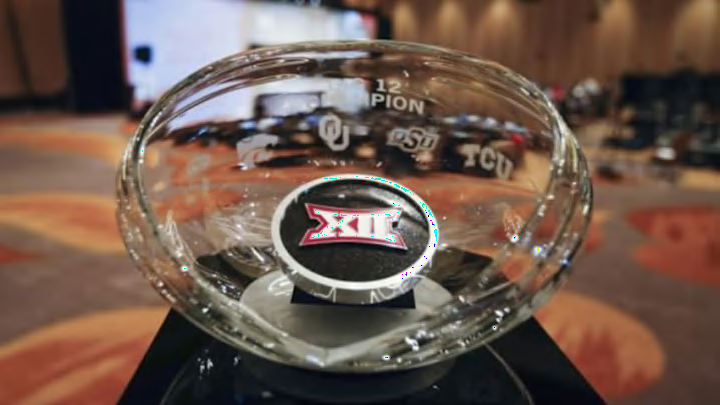
Big 12 Football has been dominated by a few traditional powerhouses for what seems forever, but has there been a long-term power shift in the conference of late?

Cincy on the Prowl
For many years when you thought about Big 12 football (or Big Eight and Southwest, for those of us old enough to remember), the names Texas Longhorns, Oklahoma Sooners and Nebraska Cornhuskers (until they high-tailed it to the Big Ten) would come to mind.
Those were the traditional powers that ruled the conference. Of course, there would be the occasional anomaly, when one of the other schools would play upstart and shake things up for a year or maybe two, but those were the exceptions.
With the departures of the Missouri Tigers, Texas A&M Aggies, and previously mentioned Nebraska, it seemed that the Big 12 was left basically in the hands of the Red River Rivalry. TCU and West Virginia joined the ranks to keep the membership at a respectable level of 10, but not much was really expected in terms of challenging the incumbent members.
But about five years ago, things started to shake up a little in the Big 12, and the two mammoth programs that had ruled the roost in the wake of desertion by others began to see some real competition.
In 2011, it was the high-powered Oklahoma State Cowboys, led by high-energy (and we’ve got the presser to prove it) coach Mike Gundy. The Cowboys were the first outright winners of the conference after the championship game was done away with, and have been a strong force each year since.
There was also the beginning of the emergence of Baylor, and a quarterback named Robert Griffin III that year.
In 2012, Bill Snyder and his Kansas State Wildcats were co-champions along with Oklahoma, and were considered one of the national title contenders. Since his return to Kansas State in 2009, Snyder has once again built the Wildcats into national power.
In 2013, quarterback Bryce Petty led the Baylor Bears to their first ever Big 12 title The notoriety and popularity of RGIII had led to impressive recruiting classes and more money flowing in to help build a state of the art athletic facility and stadium at Baylor.
In 2014, it was the ongoing battle between Baylor and TCU, ultimately co-champions and both basically shut out of the new College Football Playoff thanks to not having a conference championship game to truly decide the matter.
But lost in the shuffle of all this new blood rising to the top of the conference was what we saw happening to Texas and Oklahoma – the programs that had beaten down teams like Baylor and TCU for so many years.
Since winning their last conference title in 2009, Texas has finished no higher than 3rd in the conference and has suffered three overall losing campaigns, including last season under first-year head coach Charlie Strong.
As for the Sooners, their last outright conference title was in 2008, and since then they’ve had the single co-championship and then a decline from 2013 to 2014, when they finished with a 5-4 conference record, good for fourth in the Big 12.
It doesn’t look like Baylor and TCU are going away anytime soon, and Snyder’s Wildcats will also keep their foot on the gas. So have we reached a long-term shift in power, where Texas and Oklahoma are going to have to scrap, fight and struggle just to keep pace?
Conventional wisdom says that programs like Texas and Oklahoma are always going to be in the mix, both in recruiting and in the standings. For 2015’s recruiting classes, that has held true, with Texas coming in with the 11th ranked class in the nation, and Oklahoma with the 15th ranked.
Baylor and TCU came in at 37 and 41, respectively. And that’s where those two schools have hovered in the recruiting rankings for a number of years.
So how is it that these schools with supposedly much less talent coming in are beginning to rule the roost in the conference?
You could point to coaching, but then that would imply that Bob Stoops, Charlie Strong (and Mack Brown before him) weren’t good coaches or were being out-coached by their rivals on a constant basis, and nothing could be further from the truth.

If any one thing was contributing to some of these schools rising to power and challenging the traditional leaders, it would be the reduction in size of teams in the conference.
The SEC, ACC, Pac-12 and Big Ten have anywhere from 12 to 14 schools in their conference, while the Big 12 has only 10. Of those 10, only eight of them would be considered schools that draw recruits for football, with Kansas and Iowa State being more primarily basketball schools.
So really, if you’re a top football prospect who lives in the Western region of the country, and you don’t want to stray too far from home, you really only have eight schools to look at. The top talent is only being spread to those eight schools, rather than 12 or 14 schools. This is creating a bit more parity in the conference, and in turn, creating more competition for Texas and Oklahoma.
Until the Big 12 expands its membership (and returns to having a conference championship game) we may well see a wider variety of teams sitting at the top of the conference. It’s really been more a shift in how the power is distributed, rather than just a shift in power.
For Texas and Oklahoma fans, it means more competitive games and less chance of running away with the conference. For other fans, it’s a chance to see some new blood bringing home the trophies.
Perhaps the Big 12 has it right after all.
Next: Biggest Past National Signing Day Surprises
More from FanSided
- Caesars + BetMGM Promos: Four Chances to Win Betting on the Women’s World Cup
- MLB trade grades: Angels-White Sox deal takes Shohei Ohtani off the table
- Justin Jefferson taking on new role with Vikings offense
- Astros, Rangers benches clear after Adolis Garcia grand slam
- Jonathan Taylor’s agent shades Jim Irsay after Colts owner comments on RBs