

The national sports conversation is slowly becoming more tolerant and understanding. That’s undeniably a good thing.
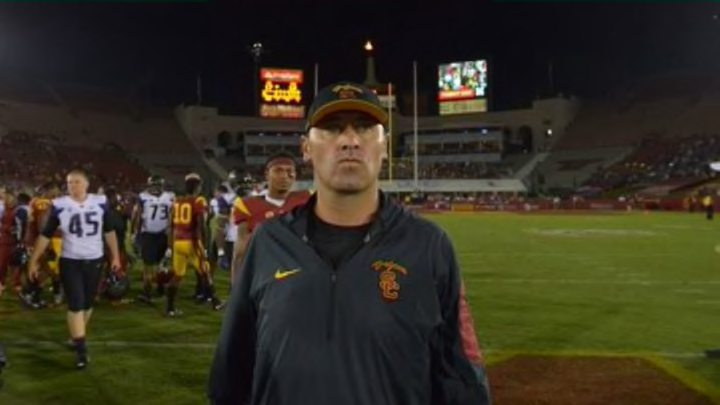
Within the past few weeks, two high-profile sports figures, pitcher C.C. Sabathia and football coach Steve Sarkisian, have entered treatment for alcohol problems. In Sabathia’s case, he stepped away from the game he loves in order to seek help. Sarkisian, on the other hand, was forced out of his job at the University of Southern California after his alcohol problem came to light.
In dark moments like these, moments in which we as fans see our heroes battle against tough personal demons, it’s important to search for any possible silver lining, any sliver of goodness. In these two instances, what’s been good, what’s been refreshing to see, has been the general response from sports media. Instead of being ridiculed, Sabathia and Sarkisian have been treated with empathy. Instead of being the target of cruel jokes, they’ve been presented as sympathetic figures. The rhetoric surrounding them has not been about “mental weakness.” Sports pundits from the blog-o-sphere to the mainstream have focused on addiction as a disease, not as a character flaw. Sarkisian and Sabathia have been supported, not derided. That outpouring of understanding has been wonderful.
To be clear, sports media aren’t deserving of a standing ovation for a basic understanding of the nature of addiction. How the conversations have gone around Sabathia and Sarkisian doesn’t mean some big, progressive leap forward in the sports discourse has occurred, forever leaving in the dust all offensive hot takes. Such hot takes might not have overwhelmed the conversation in these two instances, but there’s no doubt they will spring up again during some later “controversy.” The sports chattering class is still plenty retrograde, conservative, and unsympathetic.
So why feel good? Because what we’ve seen the last few weeks is proof that we can talk about sports in a way that foregrounds compassion, and that doing so doesn’t cause the competitive, cutthroat world of sports to collapse in on itself. What’s been shown is that there can be room for conversations that have nuance, that aim to find the human in their subjects, that keep perspective on what’s important in the big-picture sense. On the topics of Sabathia and Sarkisian, rivalries and blind hatred and contrarian nonsense were for the most part set aside; the pundits and writers and TV anchors and other such conversational leaders elected to humanize Sabathia and Sarkisian, to paint them as people in need of help as opposed to sports figures messing up at their jobs.
To understand why this is important, consider the antediluvian nature of most of the conversations in the sports world. The sports world, for the most part, celebrates the meat-headed, the black-and-white, the unsubtle. A player who passes up on making a potential game-winning play is not just a player who made a poor in-the-moment decision. He or she is a coward; the judgement is total. Fans, those invested enough to follow the national sports conversation on a daily basis, are used to hearing all sorts of unpalatable tripe. They are used to things like casual misogyny and racism. Yet they still participate in sports culture. They learn to tune out the objectionable, to instead focus on the joys of watching a game.
New fans, prospective fans, are in a different position. For them, such inflammatory, troubling rhetoric is not just some annoying bug that comes with being a sports fan. It isn’t some undesirable feature, easy to shrug off. It’s instead a big screaming neon sign that asks, “Do you really want to be a part of this culture?” Think about the “sportsball” memes and snarky comics and threadbare Facebook zingers you’ve seen from non-fans: the targets of the derisive jokes are rarely the sports themselves, but rather the culture surrounding them — the rituals of fandom, the inflammatory speech, the life-or-death seriousness. The world of sports, by dint of being so hostile and negative, comes across as entirely unappealing. From an outside perspective, sports culture is unattractive: Who in their right mind would put up with this crap?
It’s easy for longtime sports fans, desensitized as they are to the day-in-day-out inanities of sports media, to forget just how large a turn-off most of the rhetoric surrounding sports can be. Be it Sports As War metaphors or Real Men Don’t Have Feelings attitudes or any other such retrograde narrative frameworks, the sports world does a pretty solid job at turning away would-be fans, at making a tolerance to Fox News-levels of armchair psychoanalysis seem like a requirement for being a participant in the wider culture. For those who have grown up liking sports since childhood, since before they were cognizant of the problematic ways in which sports are often discussed, the repellent rhetoric is just par for the course, an ugly part of the overall package deal of sports fandom. It’s an inconvenience. But for new fans, for people lacking lifelong fandom, how sports are discussed can be a huge barrier to entry, not because of any sort of technical complexity but because, frankly, most of the ways in which sports are discussed tend to be pretty gross. New fans aren’t aware of the “smart” outlets to follow; they don’t approach their potential new fandom with a curated Twitter TL featuring only the best progressive sports voices. What lifelong fans are used to tuning out as obnoxious noise bellows loudly in new potential fans’ faces.
How sports media have handled the tribulations of Sarkisian and Sabathia is important not only because it represents some sort of “correct” view of addiction — although it does/is — but also because it presents a landscape of discussion that seems tolerant and empathetic. Again, that doesn’t mean folks deserve pats on the head for not taking cheap shots; there are no rewards for being a minimally decent, non-cretinous human being. The important point is that by removing the discussions from the arena of hot takes and macho-manliness über alles, from the realm in which all people are categorized as strong or weak, worthy or not, by instead keeping the conversations surrounding Sarkisian and Sabathia in the realm of understanding and compassion, the world of sports seems more inviting, more human than it usually does. There’s perspective and nuance and sympathy. It’s impossible to understate how far that goes toward making sports appealing to outsiders, to people who want to enjoy sports without being forced to simultaneously participate, even indirectly, in conversations that are troubling and cruel.
Reasonable people aren’t going to be drawn to a culture that seems unfairly judgmental and unsympathetic. People don’t want to be part of something they find problematic or irreconcilably morally repugnant. Hardcore lifelong sports fans want to bring new people into the fold — who among us hasn’t tried to “convert” a friend to sports fandom? — but then act surprised when those new people take a look at the sports landscape, at the national conversations, and recoil in disgust. While not proving some humongous evolutionary leap forward in consciousness, the coverage of Sarkisian and Sabathia has been representative of the small but noticeable shifts happening within sports media — the shifts that are moving sports conversations to a healthier place. How the conversations around Sarkisian and Sabathia have been conducted matters because — let’s be real — there are innumerable aspects of sports culture that are abhorrent, that are in need of, as they say, “getting with the times.” Any step forward is a good thing.