
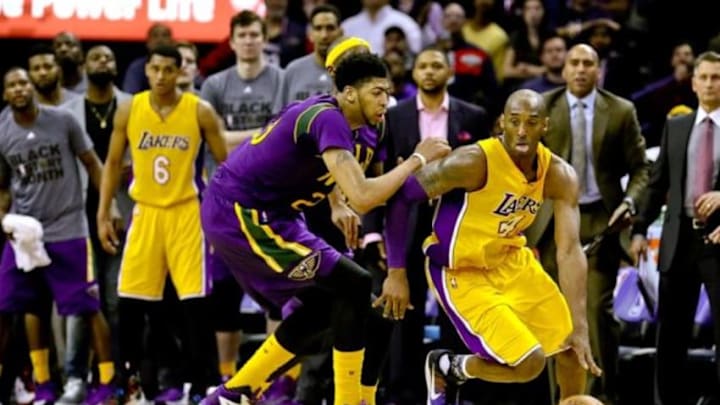

During our Upside & Motor Duke Week, we tried an experiment: If you took every NBA player who’d come out of Duke in the last 30 years, and lumped them together as if they were entering into the 2016 NBA Draft, how would that draft go down?
Well, now that we’re in the middle of 90’s Week for the Hardwood Paroxysm Network, it’s time to take that idea and apply it to a larger sample. What if every prospect, from 1990 Derrick Coleman, to 1996 Kobe Bryant, to 1999 Steve Francis, was in the green room at the 2016 NBA Draft? Who are your first rounders? Who goes much higher or much lower than they did in their actual draft? And of course, who goes number one?
If you need a refresher, we’re operating under certain restrictions and caveats here, just like the Duke mock draft.
Rules:
-We’re using the NBA standings as of March 9th, 2016 as a guide for the draft order. The Philadelphia 76ers are on the clock. We’re also considering team fit, so yes, theoretically we could see rookie Kobe attempting to replace current Kobe.
-We’re drafting based on the players as draft prospects, not their NBA careers. We know Keith Van Horn flamed out and Tim Duncan is Tim Duncan, for example, but as collegians they might be closer to the same level.
-We’re drafting based on fit in the modern NBA. Guys like Steve Nash and Marcus Camby will be valued higher than guys who don’t fit pace-and-space and modern NBA defense, like Allen Iverson and Shawn Bradley.
1. Philadelphia 76ers – Kevin Garnett, PF, Farragut Academy (5th overall in 1995)
Shaq’s probably the best prospect on the board. However, we are considering fit, and the 76ers and Kings, to me, are the only two teams who can’t get away with picking Shaq at one. That’s fine though, because KG’s not exactly a bad option. Austin Peters broke down Garnett’s high school tape, and watching that, you can see how Garnett does a little bit of everything well on both ends. Even though he’s probably a power forward, Garnett can play some small-ball five, and he’s a good enough passer and one-on-one defender that you can maybe even get away with him playing small forward in a terrifying lineup with Nerlens Noel and Jahlil Okafor. Shaq’s probably the most sure thing in this class, but Garnett’s potential is very easy to realize too, and he could be even better in Philly.
2. Los Angeles Lakers – Shaquille O’Neal, C, LSU (1st overall in 1992)
Almost 20 years after he came to L.A. the first time, Shaq’s still an obvious strong fit for the Lakers. We know he can handle the spotlight, and I don’t know if there’s anyone in the league outside of Andre Drummond and DeAndre Jordan who can handle his size down low. He already has strong post skills and will be a dominant rebounder, and while he needs some technical improvement in the pick-and-roll, he’s mobile enough to be very good, and I have no idea how to stop him and D’Angelo Russell attacking off a pick-and-roll without using “Legends of the Hidden Temple”-level traps. Shaq could step in right away and give you consistent interior scoring and rebounding, and is a near-lock to be the Lakers’ next big star after Kobe Bryant.
3. Phoenix Suns – Chris Webber, PF, Michigan (1st overall in 1993)
It’s hard to find a 90s forward who fits the modern NBA more completely than Webber. He’s not the defensive prospect Garnett or Duncan are, but he still projects to be pretty darn good, and his scoring and passing ability are strong enough that he should have a ton of success as the focal point of an offense. Basically Webber is what would happen if you could take Draymond Green’s game and give him Blake Griffin’s athleticism, size, and off-the-dribble game. For Phoenix, who has to basically start over this offseason, Webber is a great building block, and you can definitely play him next to Alex Len or by himself as a small-ball five with success. And with his passing ability bending the defense, I love his fit next to Eric Bledsoe as a cutter and Devin Booker as a kickout option. This is a great marriage of need and skill set, and I could see Webber’s career being wildly different in this setting.
4. Boston Celtics (From Brooklyn) – Tim Duncan, PF, Wake Forest (1st overall in 1997)
Boston’s frontcourt depth features a lot of guys who are good at a few things but have serious flaws as well. Duncan, on the other hand, appears to be a master of all trades, and his one weakness as a prospect is probably that he isn’t going to be a 30 point per game scorer. Boston’s done pretty well defensively this year with a defense built around Amir Johnson and Kelly Olynyk, and injecting Duncan into that gives Brad Stevens the potential to produce a truly elite defensive squad. Duncan projects as a mistake-eraser on both ends, he’s got a veteran’s mentality even as a youngster, and he even addresses Boston’s team-wide size issue. He’s a fantastic fit here.
5. Minnesota Timberwolves – Alonzo Mourning, PF, Georgetown (2nd overall in 1992)
Karl-Anthony Towns and Zo. In the same frontcourt. In their primes.
I’ll give you a minute to fully process that. I certainly needed it.
Mourning is an amazing fit next to KAT. He’s another guy who can play the four or the five, he’s a great rebounder, and he’s going to create havoc on the defensive end with his shot-blocking ability and quick hands. KAT’s ability to hit outside shots also opens things up for Mourning in the pick-and-roll, and that combination presents the opportunities for some lethal double-high screen actions with Zo going to the hole and Towns flaring out to 18 feet. Plus, you can almost always have an athletic five on the floor this way, and that helps the Timberwolves build their identity as what looks to be an athletic, chaos-creating defense-oriented team.
6. New Orleans Pelicans – Kobe Bryant, SG, Lower Marion HS (13th overall in 1996)
The wing positions have been a constant struggle for New Orleans, even going back to the Chris Paul days. The Pelicans need a sidekick for Anthony Davis, and Kobe appears to be that guy. While he’s a lesser known quantity, and we don’t know whether he can consistently be a three-point threat, his potential as an off-the-dribble creator and as a wing defender are off the charts. Bryant can get to the rim on anyone, and once he learns NBA defense, he should be able to defend four positions comfortably. Plus, Bryant appears to have a bit of a mean streak, and that compliments Davis, a seemingly pretty laid-back guy, pretty well. Kobe might take a couple of years to adjust to the NBA, but this pairing appears to be one that could be the SG/PF version of Kevin Durant and Russell Westbrook in three years.
7. Sacramento Kings – Gary Payton, PG, Oregon State (2nd overall in 1990)
Sacramento has Rajon Rondo coming up as a free agent, and his fit with the Kings this year has not been the best. So if they plan to let him go this summer, who better than Proto-Rondo to take his place? Payton has immense defensive potential, and he’s a very solid distributor who should be a very good fit for the George Karl offense. He needs to develop a three-point shot, but you can compensate for him by surrounding him with shooters and running him off high screens. And he fits well next to Darren Collison, a good tutor who should be able to help him keep his head on straight and can play off of him, too. Of all the point guards available, Payton’s the best two-way prospect of the bunch, and I like him next to DeMarcus Cousins.
8. Denver Nuggets (From New York) – Dirk Nowitzki, PF, Germany (9th overall in 1998)
Dirk got drafted ninth because he was thin, a hardly scouted international player, and there were questions about his defense. That sounds like every international player, really, and outside of the Spurs, no team works better with international prospects in today’s NBA than the Denver Nuggets. Nowitzki has a silky shooting stroke and he has shown potential for a solid if unorthodox post game, and Denver lacks both things in the frontcourt. Nowitzki could open things up offensively and be another option for Emmanuel Mudiay to create for, and a front line of Danilo Gallinari, Dirk, and Nikola Jokic is about the most diverse offensive set-up I can think of. I don’t think there’s a question that Denver can work with Nowitzki and develop his game into a very difficult offensive force to stop.
9. Toronto Raptors (From Denver) – Ray Allen, SG, UConn (5th overall in 1996)
Shooting guard is a spot that’s up in the air for Toronto, and they could definitely use a boost in three-point shooting. Allen’s stroke is the best in the draft, and he projects as a very solid outside shooter with a quick release and who can hit shots off screens and in catch-and-shoot situations. Allen also has potential to be a very solid ball-handler, and while his shooting is what gets him in the top 10, it’s not hard to see how the Raptors could let him have the same freedom they have allowed Demar DeRozan when it comes to attacking the basket because Allen’s a strong finisher and has good potential as a slasher, too. If DeRozan leaves in free agency, Allen’s a great pick to replace him.
10. Milwaukee Bucks – Jason Kidd, PG, Cal (2nd overall in 1994)
Milwaukee needs a point guard now more than ever with Michael Carter-Williams spending the summer recovering from a labral tear in his hip. And while Kidd also can’t shoot, he’s a fantastic playmaker who is a better fit for the type of offense Milwaukee wants to run than is Steve Nash. While Nash is well suited for the pace-and-space game, Kidd’s better in the slower style the Bucks roll with, and he should be a solid choice to work entry passes with Greg Monroe and hit Giannis Antetokounmpo and Jabari Parker on slashes to the rim. Kidd’s also a much better defensive prospect, something I worry about with Nash and we know that the Bucks want from their backcourt.
And if all else fails, I guess we know the Bucks’ head coach will know how to use Kidd to his full potential.
11. Orlando Magic – Marcus Camby, C, Massachusetts (2nd overall in 1996)
Nikola Vucevic is a solid player. He’s one of the best rebounders in the league and he’s a versatile offensive weapon. However, he’s not the best at defense, and neither is Ersan Ilyasova. The Magic could use a frontcourt player who can block shots and cover up mistakes defensively, and Camby’s definitely that guy. He’s laterally quick, he’s an excellent shot blocker, and he can finish inside and off the pick-and-roll, so he should be able to coexist well with Vucevic on the offensive end. Camby never really lived up to the second overall pick in 1996, but people don’t remember that he was the third-best defensive center of the mid-00’s behind Dwight Howard and Tim Duncan. Imagine him in the modern NBA with the athleticism he had at 24, and suddenly this pick doesn’t seem so farfetched.
12. Utah Jazz – Steve Nash, PG, Santa Clara (15th overall in 1996)
Utah’s in a great spot here. Nash basically fell into their laps after Milwaukee took Kidd, and there’s no better fit for young Nash to develop in than as the Jazz’s point guard of the future. This position has eluded the Jazz for some time, and Nash is the perfect answer. He can spread the floor with shooting, he will work fantastically with Derrick Favors and Rudy Gobert in the pick-and-roll, and he’ll be able to catch-and-shoot in those instances where the Jazz want Gordon Hayward or Rodney Hood to initiate offense. Also, with Gobert and Favors up front, defense is less of a worry for Nash because he has two good mistake-erasers behind him.
13. Phoenix Suns (From Washington) – Vince Carter, SG, UNC (5th overall in 1998)
With Webber in tow, the Suns can use their second pick on a strong wing scorer, another position they’ve lacked recently. Carter falls a bit here because of attitude concerns, but he’s an extremely talented scorer who can play either wing position successfully. He’s the best athlete left on the board, and that’s what Phoenix needs right now. Knight, Bledsoe, Booker, Carter, Webber, and Len is a great core to start over with for the Suns.
14. Detroit Pistons – Anfernee Hardaway, PG, Memphis (3rd overall in 1993)
Detroit’s a hard team to pick for, but Hardaway is an underrated nice grab for them. The Pistons lack a quality third guard behind Reggie Jackson and Kentavious Caldwell-Pope, and Hardaway’s size and playmaking ability makes him ideal for the role. Much like the other point guards in this draft outside of Nash, he’s not the best three-point shooter, but he does have good mechanics and that can be something he works on. In the meantime, he can likely guard any perimeter player one-on-one, and he’s going to be hard to stop going to the rim, especially if he’s running a pick-and-roll with Andre Drummond.
15. Denver Nuggets (From Houston) – Grant Hill, SF, Duke (3rd overall in 1994)
More forward depth isn’t a bad thing for the Nuggets, who do have to account for Gallinari’s long injury history. That, and Hill being the best player on the board, make him a no-brainer for Denver at 15. Hill’s a solid defensive player and has the tools to be a versatile scorer, and while he’s older than many of the prospects taken so far, that means he should have an instant impact. The Nuggets are basically filling out their rotation in this draft, and Dirk and Grant Hill is a nice combination to be able to do that.
16. Boston Celtics (From Dallas) – Tracy McGrady, SG, Mt. Zion Academy (9th overall in 1997)
Boston grabs the two best prospects from the 1997 draft by getting McGrady. A solid athlete with great scoring potential and good size, McGrady can fill either wing spot for the Celtics, who lack a go-to wing scorer. Boston also has the luxury of still being a young team, so even though they’re set up to compete in the East, they still can take a flier on a very young guy like McGrady and let him develop. Duncan will help the Celtics now, and the hope would be that as he hits his prime, McGrady makes the leap to give the Celtics an excellent star tandem.
17. Chicago Bulls – Allen Iverson, PG, Georgetown (1st overall in 1996)
The Bulls need an infusion of life after a very challenging season that saw them lose their emotional leader and completely fall apart defensively. Derrick Rose has looked decent this season, but the Bulls do face some long-term questions about where they’re going as a team. Grabbing Iverson is a decent possible solution. He’s a bit of an outdated player type because he’s an isolation machine and he’s undersized for the modern NBA, but you can’t doubt his ability to score, and he’s the type of emotional warrior that’s become synonymous with Bulls basketball over the last decade. Sure, he’ll get killed on defense, but the Bulls have bigger issues than point guard defense right now. Iverson can be a breath of fresh air for Chicago and potentially grab the torch if the team decides to move on from Rose.
18. Denver Nuggets (From Portland) – Manu Ginobili, SG, Argentina (57th overall in 1999)
With Dirk and Hill on roster and a bunch of young talent already in tow, the Nuggets probably don’t need another young guy on the roster. So rather than make a trade, drafting Ginobili makes sense. The Argentine shooting guard’s a strong slasher and quirky ball-handler who could fit well as a secondary playmaker behind Emmanuel Mudiay. They can let him continue to develop for a few years and then decide to bring him over when the team has a better idea of what talent it has.
19. Indiana Pacers – Paul Pierce, SF, Kansas (10th overall in 1998)
If the Pacers are serious about Paul George playing power forward minutes long term, Pierce is a great player for them to grab. A diversely talented and athletic forward who projects as able to play minutes at the two, three, or even as a nominal four, Pierce is the type of dirty work player who can give Indiana the roster versatility to make that plan successful. Pierce can fill holes defensively for the Pacers (i.e. guard the best wing scorer while Monta Ellis is on the floor), and he’s likely going to be a strong three-point shooter and ball-handler, which gives Indiana another versatile offensive skill set to play with.
20. Charlotte Hornets – Dikembe Mutombo, C, Georgetown (4th overall in 1991)
Charlotte might lose Al Jefferson this summer, and even though they just spent a first-rounder on Frank Kaminsky, they probably still need more help on the interior. Steve Clifford’s a defense-first guy, and even though Charlotte’s transformed a bit into a wide-open offensive team, the backbone of the squad is defense. Mutombo would give the Hornets a solid rebounding presence and a legit rim protector, and while he’s limited offensively, he can be a game-changer even in the modern NBA. Adding Dikembe to the group of MKG, Nicolas Batum, and Courtney Lee sounds terrifying if you’re trying to score on Charlotte.
21. Atlanta Hawks – Shawn Marion, SF, UNLV (9th overall in 1999)
Versatility is the name of the game in Atlanta, and Marion’s someone who can step right in and lock down the perimeter, rebound, and finish on the break. He can play the four in small lineups or the three very comfortably, and the Hawks’ shooting in the frontcourt allows them to compensate well for Marion’s lack of shooting stroke. Marion can provide what the Hawks have missed this year in DeMarre Carroll, and that makes this a no-brainer.
22. Philadelphia 76ers (From Miami) – Chauncey Billups, PG, Colorado (3rd overall in 1997)
Best point guard on the board makes sense for Philly especially when it’s someone who looks as versatile and disciplined as Billups. Billups has a solid outside shot and with time should develop into a nice playmaking point guard. He probably needs some time to develop, but what does Philly have if not time to develop young guys? This is an easy decision for the Sixers.
23. Memphis Grizzlies – Rasheed Wallace, PF, UNC (4th overall in 1995)
In 2004, Zach Randolph got his big break when he got to step into the Portland Trail Blazers lineup after Rasheed Wallace was traded. Now, the Grizzlies need a heir apparent for Z-Bo…..so why not Sheed? Wallace is skilled as a passer and has a strong perimeter presence, and would allow the Grizzlies to play a little more of a spread-out style. He looks like a solid defender as well, and learning from Marc Gasol will be good for his development on that end. Sheed fits the mentality in Memphis well.
24. Boston Celtics – Elton Brand, PF, Duke (1st overall in 1999)
Brand’s a bit undersized, but he makes up for it with solid wingspan and excellent mobility. He projects as a good rebounder and acceptable defender, and he can fill in the gaps for Boston next to Duncan and Olynyk. I’m not high on Boston’s frontcourt right now (as evidenced by the fact that I’ve given them two former number one picks that play PF), and I think a versatile youth infusion would be good for them. They can build around Brand, Duncan, and Olynyk with Amir Johnson as veteran leadership.
25. Los Angeles Clippers – Keith Van Horn, SF, Utah (2nd overall in 1997)
As I mentioned earlier, Van Horn probably fits much better in 2016 than he did in 1997. A 6-10 scoring forward who can stroke it from outside is much more valuable today than it was when Van Horn was coming out of Utah, and for the Clippers, who have a gaping hole at small forward, Van Horn makes sense on paper. Van Horn needs some development in a few aspects of his game, such as defense and off-the-dribble moves, but he’s a good shooter and passer, and he won’t get exposed defensively as much with DeAndre Jordan behind him. It sounds absurd to include him in this draft, but the matchup of the Clippers’ fit and Van Horn’s skill set makes me think he’d do pretty well in Los Angeles.
26. Toronto Raptors – Jermaine O’Neal, PF, Eau Claire HS (17th overall in 1996)
Toronto already plugged their biggest hole, and they can afford another development project, especially one with as much potential as O’Neal. He’s very raw, but O’Neal has the length to be a solid shot-blocker and he has some solid raw talent on the offensive end. Power forward has been an inconsistent spot for the Raptors this year, and while he’s probably not ready to go immediately, O’Neal is a nice long-term solution.
27. Philadelphia 76ers (From Oklahoma City) – Stephon Marbury, PG, Georgia Tech (4th overall in 1996)
Point guard is that much of a problem in Philadelphia, and because Billups has good size and can potentially play the two, getting the 76ers a definitive scorer to also develop might be a nice idea. Marbury definitely has scoring chops, and he has the competitive nature that will make him and Billups better as they get to compete with each other for playing time. Overall, this is a solid infusion of talent for the 76ers to grab in this draft.
28. Phoenix Suns (From Cleveland) – Antonio McDyess, PF, Alabama (2nd overall in 1995)
The Suns round out their solid-looking rotation with a power rebounder who can play next to Len and Webber comfortably. He’ll need some development as an offensive player, but as a future energy guy off the bench, you can’t go wrong with McDyess.
29. San Antonio Spurs – Baron Davis, PG, UCLA (3rd overall in 1999)
A solid drive-and-kick point guard who needs work on his shooting form, Davis sounds like a nice weapon for the Spurs development staff to get their hands on as a potential Tony Parker replacement.
30. Golden State Warriors – Zydrunas Ilgauskas, C, Lithuania (20th overall in 1996)
Festus Ezeli might not be around much longer, and Andrew Bogut’s getting up their in age. The Warriors getting a mobile center with a nice mid-range jumper and solid shot blocking ability would be a good way to address what might be a big need in the middle.
 Add us as a preferred source on Google