
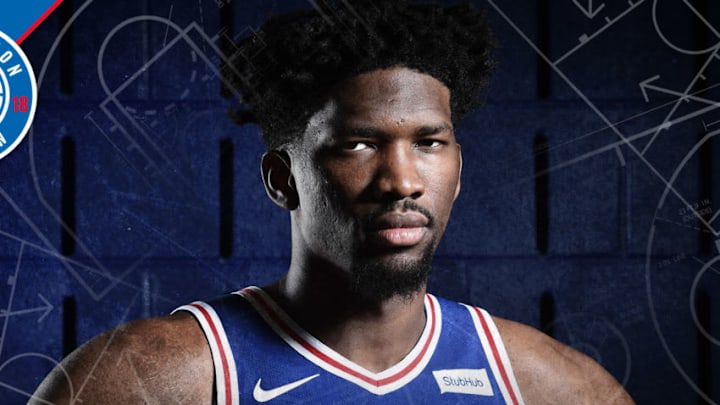
Only two players averaged at least 6.0 points per game out of the post last season. One was Karl-Anthony Towns. The other was Joel Embiid.
Those possessions made up more of Embiid’s scoring than it did for Towns. According to NBA.com, Embiid generated 32.2 percent of his offense as a rookie in the post compared to 25.5 percent for Towns as a sophomore. In fact, only three players — Zach Randolph (32.3 percent), LaMarcus Aldridge (32.7 percent) and Al Jefferson (46.2 percent) — scored in the post with greater frequency than Embiid last season.
Towns was a more efficient scorer in the post than Embiid, but Embiid had him beat in several categories. Most notably: Embiid was a foul drawing machine. He drew a shooting foul on 20.3 percent of his post-ups and stepped to the free throw line 22.6 percent of the time. There weren’t many players who could match those numbers on the season. On the flip side, however, he turned the ball over on 21.7 percent of his post-ups. Once again, he was almost in a class of his own in that regard.

Those numbers speak to both Embiid’s potential as a low post scorer and the need for improvement. Even so, the positives far outweigh the negatives at this stage of his young career because he’s showcased the ability to score in a variety of ways with his back to the basket. Not only is he comfortable shooting midrange jumpers on face-ups, Embiid has a unique blend of power, speed and athleticism for a 7-footer. In theory, the combination gives him all he needs to develop into one of the best post scorers in the league as his game continues to mature.
When defenders back off of him, for example, he can simply use his height and soft touch to shoot over them as he does against Marc Gasol on this possession:
If they play up on him to prevent those sorts of looks, Embiid has the skills to take them off the dribble for layups and hook shots. According to NBA.com, he made 13 of the 24 hook shots he attempted last season. He also shot 64.0 percent at the basket, where almost a third of his shot attempts came from.
If they take his primary option away, he is nimble and coordinated enough to get them out of position with a variety of Hakeem Olajuwon-like fakes. It’s these sorts of plays which make Embiid’s potential as a post scorer so intriguing.
The same goes for his ability to react to the defense with spin moves and crossovers.
When he is presented with a mismatch, Embiid can overpower opponents with his strength and size for easy looks at the rim as well. It’s important he knows how to use his strength when he matches up against the Hassan Whitesides and Rudy Goberts of the NBA, as well as when teams choose to downsize against the 76ers.
Embiid even has the rip-through in his arsenal for when defenders reach on his face-ups. It’s just another element of his post game that shows how advanced his skill set is for his age. It also helps that Embiid is a great free throw shooter, making 78.3 percent of his attempts last season to rank No. 8 amongst centers.
The next step for Embiid is becoming more efficient with those moves. He did only rank in the 51.6 percentile with 0.88 points per post-up possession last season and he struggled with certain types of shots like step backs. If he can continue to fine-tune the skills he already has in the post while continuing to add to them, it will only help him reach his full potential as a volume post-up scorer.
Next: Towns, Embiid and Jokic are guards in disguise
If he can then become a more comfortable facilitator out of of the post when teams double him — something that will happen with greater frequently as he becomes more a reliable scorer — Embiid’s value as a go-to option will increase tremendously, especially when he’s surrounded by three shooters in J.J. Redick, Robert Covington and Markelle Fultz. He’s already proven to be one of the best roll men in the league as a rookie, so being able to consistently manufacture his own shot would set the wheels in motion for the 76ers to become playoff contenders.
 Add us as a preferred source on Google