
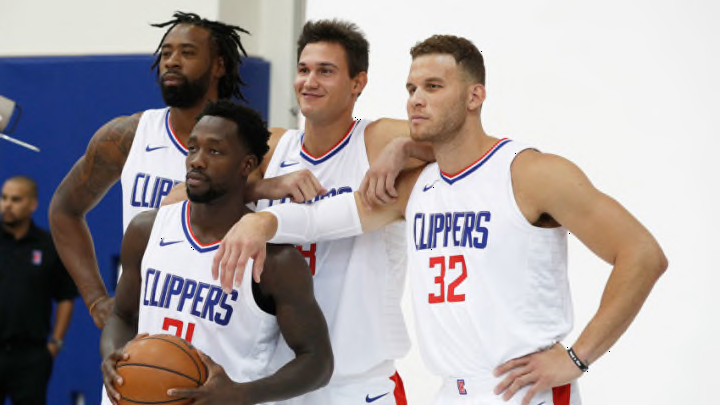
In a league where everyone either seems to be tanking or going all in, the Los Angeles Clippers find themselves somewhere in the middle. After running the same team back for years on end, the Clippers suddenly pulled one of the biggest roster overhauls in the NBA and must now search for direction in a post-Lob City era.
The losses of key players like Chris Paul, J.J. Redick, Luc Mbah a Moute and Jamal Crawford leave the Clippers with vastly different personnel than they had a year ago. Paul, the best point guard of his generation now paired with James Harden in Houston, provided an element of safety and certainty that all but ensured a playoff spot and a top-5 offense. Those are no longer givens, and the Clippers will have to find a way to reroute the offense created by Paul through other sources.
More than ever, the team will lean on Blake Griffin, who will now have to be a consistent force in all facets of the game for L.A. to survive. He’ll score plenty with more touches going to him, but he’ll also be asked to defend, rebound and facilitate, duties of which he’s proven capable but not always reliable. Clippers brass made a $173 million bet this summer that Griffin could not only stay on the court, but become a transformational star as well.

Griffin is a gifted passer, and allowing him to make plays with the ball in his hands more often may be the first step in redesigning the Clipper offense. He posted one of the best assist rates in the league last year among players 6-foot-10 or taller, and no big man matched his high-usage, low-turnover production. Griffin made the Draymond Green passes off the short roll cool before Green did, and established a dynamic partnership with DeAndre Jordan on short lobs inside the paint.
That combination might hook up more often without Paul generating so many of Jordan’s looks. Griffin ranked in the 94.4 percentile as a pick-and-roll ball-handler — a better mark than Paul — but those plays only accounted for 7.2 percent of his possessions. 4-5 pick-and-rolls with him and Jordan could aid the Clippers’ floor spacing, which enters the season as an unknown.
Griffin can exploit any mismatch generated via switches with his passing, size, athleticism and skill. For the Clippers to approach their offensive output from a year ago, Doc Rivers has to unleash Griffin as a playmaker more often.
There is significant positional overlap on this roster, especially in the frontcourt, where the front office has over $260 million tied up between Griffin, Jordan and Danilo Gallinari. The plan is to start all three, and it’s not completely clear how those pieces will fit together.
Gallinari is a highly efficient offensive player due to his accurate jumper and knack for drawing contact. Though the Clippers will mostly struggle to generate the same gravity Redick possessed, Gallinari canned 41 percent of his catch-and-shoot 3s last year, a mark that instills fear in defenses.
He shot over 90 percent at the stripe in 2017 and draws fouls at one of the highest rates among non-bigs, using the threat of his jump shot to get defenders off their feet and into his body. But those flailing drives cut both ways: when Gallinari topples to the ground and doesn’t get the whistle, he leaves his teammates susceptible to transition buckets. With the league cracking down on BS foul drawing, especially in the playoffs, Gallinari’s paint ventures can often do more harm than help.
The Italian turned 29 this summer and has played more than 63 games once since 2010. There will be nights when he just doesn’t have the juice, and he’ll struggle to keep up with wings on defense. It’s difficult to see Gallinari, Griffin and Jordan all closing games together.
Gallinari’s off-nights could trigger more minutes for Sam Dekker, who came over in the Paul deal and projects as one of the team’s only combo forwards (along with Wesley Johnson, who Rivers has always been hesitant to trust). Mbah a Moute’s role was understated but necessary for a team already thin at his position. Without him, they’re even thinner; Johnson and Dekker will have to contribute.
Rivers didn’t hesitate to roll out three-point-guard lineups last year; he could configure those looks around Beverley, Austin Rivers, Milos Teodosić and Lou Williams. League Pass junkies will immediately love Teodosić, and Williams is the league’s closest facsimile to Crawford; Rivers is fine for 25 minutes a night; Beverley’s defensive tenacity should translate well. Those groups will be fun offensively, but will bleed points, especially if Jordan isn’t in the game to cover for his teammates at the rim.
None of this matters if the Clippers can’t stay healthy. Jordan is an ironman, but Gallinari misses time every year, Griffin hasn’t approached a full season since 2014 and there are questions about whether Teodosić can hold up for an entire season. All three, especially Griffin and Gallinari, are key pieces with specific roles and skill sets. The Clippers aren’t prepared to lose either for more than a few games.
Next: Five big questions from the craziest offseason in NBA history
For the first time since Paul was traded from the Hornets, the Clippers are a relative mystery heading into the season. L.A. actively went against the grain this summer in attempt to remain competitive. The talent is there. The next challenge will be forming an identity.
 Add us as a preferred source on Google