
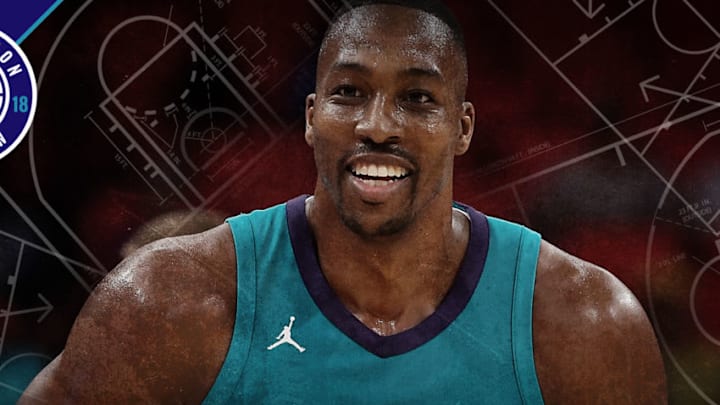
The Hornets have had the best defensive rebounding rate in the league in four of the last five seasons. They haven’t, however, been a dominant offensive rebounding team. Only three teams averaged less offensive rebounds per game than them last season and the same teams were the only ones to post a worse offensive rebounding rate.
The addition of Dwight Howard could change that entirely. For as much as Howard’s game has changed since he was last named an All-Star in 2013-14, he’s still one of the best offensive rebounders in the NBA. He finished second behind Andre Drummond in offensive rebounds per game last season, the majority of which were contested. Howard also finished second behind Hassan Whiteside in points per game created off of putbacks. Those plays made up 21.9 percent of his offense in total and he ranked in the 78.4 percentile with 1.23 points per possession.
Howard’s offensive rebounds usually come in one of two ways. First and foremost, Howard was one of the league leaders scoring off of cuts. He is used to making himself available on the baseline for passes from drivers, which naturally positions close to the basket. If a guard or forward can draw Howard’s defender away from the rim, he can slide in for a second chance opportunity if they miss.
The other way is out of the pick-and-roll. Although Howard doesn’t operate in the pick-and-roll as much as many would like him to — they made up 10.1 percent of his offense last season for an average of 1.6 points per game — a lot of good comes from those possessions, especially if he’s paired with a dominant pick-and-roll scorer like Kemba Walker.

Walker puts an incredible amount of pressure on defenses in those situations because of how comfortable he is shooting off the dribble. He finished behind Russell Westbrook, Chris Paul, DeMar DeRozan, James Harden, Kyrie Irving and CJ McCollum last season in points created per game off of pull-ups. Out of the same group, Paul and McCollum were the only ones to make pull-up 3-pointers at a higher rate than Walker and only Harden made more pull-up 3-pointers per game.
Walker can therefore knock those opportunities down as well as anyone in the league when he’s given the slightest bit of daylight as he turns the corner.
More importantly as it pertains to Howard this season, Walker was far better than Dennis Schroder — who made only 28.7 percent of his pull-up 3-pointers — in those situations. While Howard isn’t a threat to pop in pick-and-rolls like Karl-Anthony Towns, Joel Embiid or Kristaps Porzingis, Walker’s shooting ability forces opposing centers to step up higher than they’d like to. Howard can then roll to the basket and establish deep rebounding position against a smaller defender to achieve similar success as he has in the past.
What’s interesting about the Hornets is their “problems” on the offensive glass over the last few seasons is by design. Michael Kidd-Gilchrist was the only player on the Bobcats in 2013-14 who was allowed to pursue offensive rebounds. The reason why? “If you study the numbers, you find that offensive rebounding just isn’t important in winning big,” Steve Clifford told ESPN’s Zach Lowe.
Even so, Howard’s volume on the offensive glass completely changed the Hawks last season. In the four seasons Paul Millsap and Al Horford were teammates in Atlanta, they ranked dead last in the league in offensive rebounding rate three times. In the one season Howard spent in Atlanta, the Hawks finished No. 15 in offensive rebounding rate. According to NBA.com, they grabbed 26.3 percent of available offensive rebounds when Howard was on the court compared to 20.4 percent with Howard on the bench. The former was equivalent to the Suns and Knicks near the top of the league whereas the latter put them near the bottom of the league once again.
Perhaps Howard won’t have as great of an impact on the offensive glass in Charlotte due to Clifford’s system, but offensive rebounding is in his DNA. The Hornets averaged 8.8 offensive rebounds per game as a team last season and Howard has averaged 3.6 offensive rebounds per game by himself over his career. With it being arguably his greatest strength at this stage of his career, maybe Clifford will make an exception for Howard like he did with Kidd-Gilchrist in 2013-14.
Next: Every NBA team's Mount Rushmore
Or maybe Clifford will spot an opportunity to buck a league-wide trend now that he has one of the league’s most dominant offensive rebounders on the roster. Either way, there’s no doubt Howard will single handedly make the Hornets more of a presence on the offensive glass this season as their starting center. He has done it before and he will almost certainly do it again.
 Add us as a preferred source on Google