
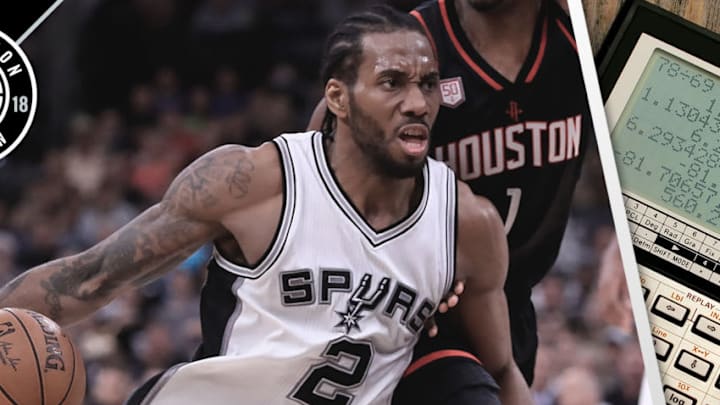
Two seasons ago, Kawhi Leonard gave a summer interview where he professed his desire to win MVP. At that point, it seemed a little far-fetched. Leonard already created an on-court impact similar to other MVP candidates but the majority of that impact came at the defensive end. He hadn’t even made an All-Star team at that point and, as a general rule, dominant offensive players become MVP candidates and dominant defensive players are relegated to Defensive Player of the Year Award.
Two years later, Leonard is coming off a third-place finish in the 2016-17 MVP voting and, at least by some models, is seen as an MVP favorite this year. Leonard has done this by improving his offensive game each and every season, bringing his production on that side of the ball into balance with his dominant defense.
Last season, he averaged a career-high in points, assists and free throw attempts per 100 possessions, shooting 38.0 percent on a career-high 8.0 3-point attempts per 100 possessions. He finished in the 72nd percentile as an isolation scorer, the 79th percentile on post-ups and the 93rd percentile as the ball-handler in the pick-and-roll, showing that he’s more than capable of creating efficient offense for himself, even at a high volume.

If you look at Leonard’s development over the course of his career the most striking thing is the relationship between his usage — which has increased every season, peaking at 31.1 last year — and his true shooting percentage which has climbed and stayed at an elite level.

The last number, however, is the one I find most interesting. For the first four years of his career, more than half of Leonard’s impact came on the defensive end (as estimated by Box Plus-Minus). Two years ago, after making his MVP remarks, his offensive impact upset the balance. Last season, nearly 80 percent of his impact was on offense.
Obviously, this is a rough estimate shaped by the particular metric. Box Plus-Minus does a much cleaner job of measuring offensive impact than it does on defense and Leonard’s defensive numbers were famously down last year, largely because of some unsustainably hot shooting by opponents. There’s a good chance that the numbers in the table above are overestimating his offensive impact, relative to defense, to some degree.
Next: 25-under-25 -- The best young players in the NBA
Still, we’re clearly past the point where Leonard can be characterized simply as one of the best defenders in the game, or even the unintentionally pejorative characterization of being among the best two-way players in the game. He is an elite defensive player who also happens to have made himself into an elite offensive player as well.
 Add us as a preferred source on Google