
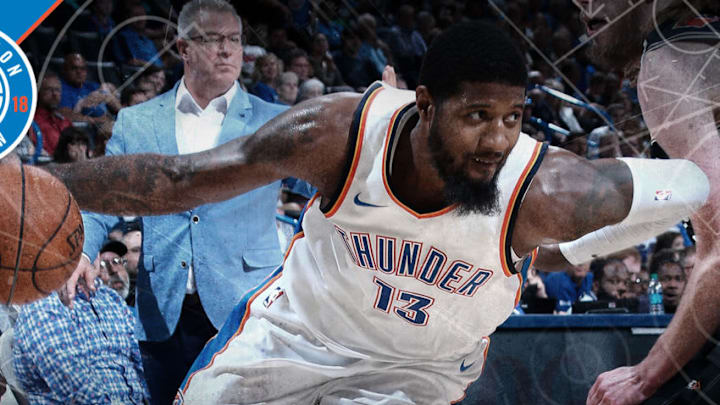
The new trio in Oklahoma City is the most fascinating storyline going into the new season. How will they play together? How will Billy Donovan work his rotations? How will he deploy his new team to get the most out of each guy?
Russell Westbrook is still the engine that makes the team go, but the additions of Paul George and Carmelo Anthony will make things significantly easier for him, especially on the offensive end of the floor. Westbrook is one of the game’s best drivers and both George and Anthony are high-level spot-up threats, in addition to being able to handle the ball themselves and run a variety of different actions.
One such action in which Indiana had success putting George in was running him off screens, which put all of his abilities on full display — he can sprint out to the 3-point line and make a jumper on the move, he can curl into the paint and finish, and at worst, the offense has put the ball in George’s hands to let him create in isolation or pick-and-roll. If Indiana was able to have so much success with George in these sets, imagine how well they’ll do when the defense has to worry about Westbrook and Anthony at the same time.

The Pacers ran a variety of plays to get George open on the perimeter. The simplest of these is a screen-the-screener set run by almost every team in the league at this point. Watch how George sets a cross screen before running off a down screen in this classic flex offense action:
George’s defender is put into an impossible situation since he has to take a beat to help on the big man coming across the paint to give his teammate a chance to recover. By the time the defense is reset, George is already gone, popping up behind another screen for an open 3-pointer. Teams run this sort of set all the time to get their best players the ball, from high-volume 3-point shooters like J.J. Redick and Kyle Korver to all-around offensive superstars like Stephen Curry, Damian Lillard and Kyrie Irving.
Another example of the screen-the-screener action is when George will set a back screen for a wing cutting to the rim, then sneak around another down screen for an open 3. He can also pivot into the lane for a short jumper or finish around the rim if his defender chases him around the screen.
George begins the play in the corner, steps up into a screen and then receives a screen himself to get open right around the top of the key. It’s very similar to the previous flex action, just with a little more movement from everyone involved, leading to more switches for the defense. This allows George to exploit mismatches in isolation situations once the defense has been forced to switch.
These screen-the-screener sets are great, but they’re so commonplace throughout the league that teams are getting better at defending them. At some point, Oklahoma City will need to get creative and they can draw inspiration from some innovative sets Indiana ran last year for George.
This is perhaps the most beautiful play Indiana ran last season. George begins on the opposite wing from the ball, cutting toward the baseline with the aid of a slight up screen from Thaddeus Young. George then sets the same cross/flex screen we saw earlier for Jeff Teague, who feigns as though he’s going to cut through to the other side. Watch George’s defender, P.J. Tucker, while George sets the screen for Teague — he’s already set up for the eventual down screen for George to complete the standard screen-the-screener action we discussed above. But instead of cutting through to the other side of the floor, Teague turns back around, setting a screen on Tucker and allowing George to instead leak out to the opposite corner, where he gets another screen from Myles Turner just for good measure, then knocks down the 3-pointer.
What happens when his defender sniffs out that cross screen for George and cuts him off? No problem — the down screen is still right there for an open 3-pointer. Watch Rudy Gay as George makes his move. He moves as though George is going to go to the other side of the court, so George simply runs up the wing behind a Turner screen into a wide open 3-pointer.
George’s prowess in multiple facets of the game is what makes him such a threat in these situations. Not only can he rise up for the jumper or curl around the screen into the lane, but it doesn’t take much for him to take advantage of his off-balance defender once he has the ball in his hands. The Pacers run a relatively simple floppy action for him in the below clip, but while LeBron James was able to stay with George through the screen and catch, he wasn’t able to stick to him once he put the ball on the floor, which differentiates George from other shooters for which teams run this type of play.
These are just a sampling of the wide variety of sets Oklahoma City can run for George. He’ll bring a different dynamic to their offense and give the Thunder the diversity they sorely missed last season after the departure of Kevin Durant. George’s abilities as a secondary pick-and-roll ball-handler, shooter and isolation threat make him the perfect partner for Westbrook, who is a particularly difficult point guard to match — his star partner has to space the floor around his rumbling drives to the rim as well as be able to run the offense himself when Westbrook is out of the game.
Next: PG and Melo will help Steven Adams reach a new level
George fits both criteria, and thanks to plays like these that Indiana ran for him last season, Donovan and his coaching staff already have a slew of ideas for how best to use George to get the most out of the Thunder’s stars.
 Add us as a preferred source on Google