
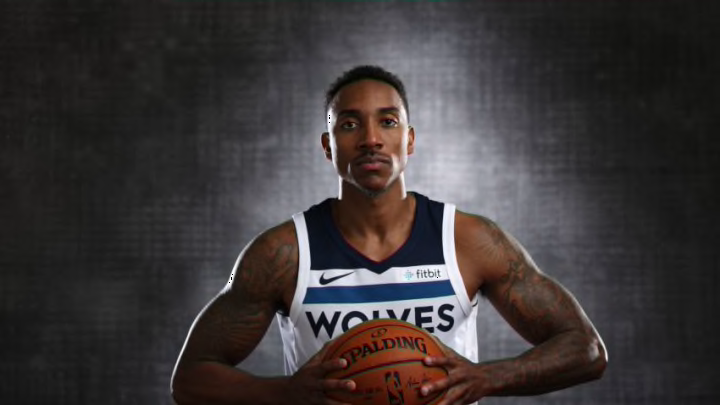
This may come as a surprise, but there’s only one basketball in play at any given time during an NBA game. As far as I know, the Timberwolves still have to follow this rule, even though it would probably suit their players better if each of them could always have the ball in their hands.
Each of Jimmy Butler, Karl-Anthony Towns, Andrew Wiggins, Jeff Teague and Jamal Crawford ranked in the top-30 last season in isolation possessions used across the entire league, and only Wiggins and Towns were on the same team. Now that they’re all in Minnesota, something’s got to give.
Isolation possessions aren’t necessarily bad if the player with the ball is a willing and capable passer. However, Minnesota doesn’t employ a ton of those either. Of the above list, only Butler passed on more than 30 percent of his isolations. Wiggins, Towns and Crawford all passed on fewer then 15 percent of their isolation tries. Teague, nominally the point guard in the group, finished almost 74 percent of his isolation possessions on his own last year in Indiana, despite having the shooting of Myles Turner, C.J. Miles and Paul George on the court with him in a lot of lineups.

Butler, Wiggins and Teague will split the primary ball-handling duties for Minnesota. On the topic of passing, Wiggins told reporters during the Timberwolves’ media day that “[Butler] likes to pass the ball and I like to pass the ball.” If the second half of that sentence is true, we certainly haven’t seen it manifest itself on the court during the first three seasons of Wiggins career. The young Canadian’s isolation passing is almost non-existent, passing out of just 32 of his 231 isolation possessions last year. His pick-and-roll passing is somehow even worse — of the 63 players who ran at least 250 pick-and-rolls last season, nobody passed the ball less than Wiggins, who gave up the rock just 30.4 percent of the time.
You know, despite the fact that he played with Towns, who’s only one of the most efficient offensive players in the league.
For comparison’s sake, Butler finished 41st and Teague finished 22nd in the same metric. Ricky Rubio, whom the Timberwolves jettisoned to Utah for the opportunity to sign Teague to a three-year, $57 million contract, finished second, passing the ball on 63 percent of his pick-and-roll possessions.
The Timberwolves may find a way to make it work on the perimeter, dividing up touches between Butler, Wiggins and Teague, but what does all this mean for Towns? Despite Butler’s star power and all-around game, Towns remains Minnesota’s best offensive weapon. Will he have to sacrifice touches and opportunities to grow his game while the team tries to placate their new perimeter trio? He’s already one of the best big men in the post, but previous seasons saw him surrounded with much more capable shooters than the Timberwolves now deploy since Wiggins is still a minus shooter, and Butler and Teague are average at best.
Combine that with head coach Tom Thibodeau’s insistence on playing two traditional big men — a decision that helps Minnesota defensively — and there isn’t a lot of room for Towns to go to work in the paint.
The Timberwolves have a lot of questions to answer offensively and while they have the individual talent to be a high-level offense, the fit issues are real and will need to be worked out before they’re truly a top-tier playoff contender. They’ve got time to do so — none of their four main pieces will be free agents after this season. If Wiggins can take multiple significant steps forward as a playmaker and the four of them can split the touches without complaining about a reduced role, the Timberwolves can push their way up the standings.
Next: How Jeff Teague can make Karl-Anthony Towns even better
It’s certainly not unheard of. Plenty of teams have had multiple high-level guys who need the ball and worked it out for trips to the NBA Finals in the past. But until we see it on the court, it remains an open question.
All stats provided by Synergy.
 Add us as a preferred source on Google