
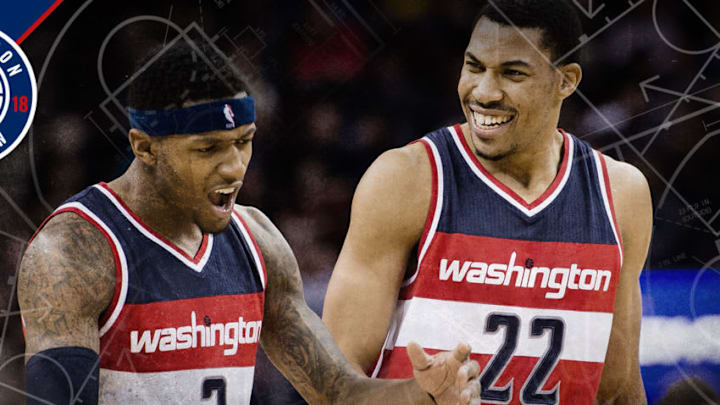
A point guard like John Wall needs shooters to open up the floor for him to get to the rim. The Wizards have therefore surrounded him with two of the game’s best: Otto Porter Jr. and Bradley Beal.
Porter broke out last season (just in time to get a max contract!) as an elite spot-up threat, scoring more total points in spot-up situations than anybody else in the league and doing so on the fourth-best field goal percentage. Beal offers the Wizards a more dynamic option, excelling on the move and with the ball in his hands, operating at his best when running around screens from the Washington big men.
One such play the Wizards like to run for Beal is a misdirection set. Beal and Marcin Gortat act as though they’re going to set staggered down screens for Porter, but after coming off the first one, Porter turns and either cuts through to the other side of the floor or sets a brief screen of his own on Beal’s man. The sequence allows Beal to come around the Gortat screen and get the ball from Wall.
Even though Beal’s defender, Tim Hardaway Jr., is all over him initially, there isn’t enough help from Taurean Prince and Dwight Howard, both of whom are back in the paint, to deter Beal from sprinting around both screens to hit the 3-pointer.

Even if the defense is up on the perimeter, the Wizards usually don’t have a problem getting a good shot.
As Porter comes around Beal’s screen, his defender jumps past Ian Mahinmi, guessing that it’s Porter who’s coming around for the shot. Once Porter cuts off his run and curls to screen for Beal, the Lakers are in scramble mode with everybody just trying to keep up with their own assignment. Jordan Clarkson tries to follow Beal around and runs him off the 3-point line, but Beal is just as capable of catching and stepping in for a midrange jumper or getting to the basket — a rare skill for such a high-level shooter. Beal’s ability to put the ball on the floor and create in these situations opens up more options for Washington and makes this sort of action almost unguardable.
The Wizards run a variant of this screen-heavy set on out of bounds plays, where Beal will initially screen for Wall, to whom the defense assumes the ball will go.
The Knicks actually do quite a good job of defending this, but Beal’s off-the-dribble creation comes to the rescue and he’s able to get around his defender for the layup. Defenders recovering after being hit with two screens have a very hard time toeing the line between contesting Beal’s shot and closing out too hard and leaving him to blow right by to the basket.
Finally, the Wizards will also break out a variant of this set, throwing in an extra screen for good measure.
Beal sets the screen for Porter, as he always does, and Porter curls and sprints through to the opposite corner, occupying two defenders while he does. Beal then sprints around screens from both Washington big men and gets into the lane for an open layup as the Magic defense is still recovering from all the prior action. This is yet another example of Beal’s ability to get to the rim — Terrence Ross plays this about as well as anybody could expect, tracking Beal’s every movement and not being fooled by the initial dummy screen for Porter, but it doesn’t matter because Beal has the awareness to curl around the final screen and go to the basket.
Next: Nylon Calculus: The Almost Stat Line All-Stars
The Wizards do a great job capitalizing on the attention paid to their two best shooters by defenses rather than simply putting them in opposite corners to space the floor around Wall-Gortat pick-and-rolls. While Washington would undoubtedly be successful with this strategy due to Wall’s individual brilliance, mixing in sets to get Beal the ball on the move and leveraging Porter’s breakout shooting season adds another dimension to their offense that Wall doesn’t bring to the table, as good as he is at everything else.
 Add us as a preferred source on Google