
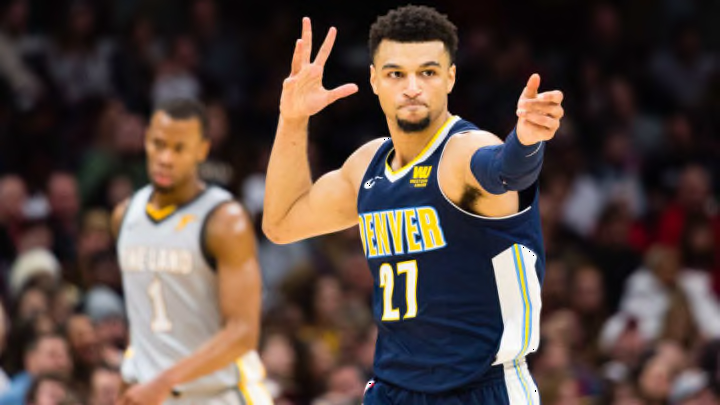
From year one to year two, Jamal Murray executed the leap every organization hopes to see from second-year players who flash signs of brilliance during inconsistent rookie seasons. His efficiency as a scorer ticked up across the board, he continued to look more comfortable in a lead guard role and was more aggressive hunting for his shot.
Throughout the NBA blogosphere, Murray is a trendy candidate for the 2018-19 Most Improved Player of the Year award, including from yours truly. The strides he made were obvious and while his growth curve is likely to decelerate a degree, this could be the season he becomes a full-blown star.
Some of the improvements he’ll need to make are obvious and can be discerned purely from the numbers. He struggles to shoot off the dribble, netting just 38.9 percent of his pull-up jumpers (32 percent from 3) last season; his finishing around the rim is pedestrian (59 percent, 50th percentile among combo guards in 2017-18); his defense is still a project, with his Defensive Player Impact Plus-Minus regressing from minus-0.7 as a rookie to minus-2.3 last year.
But that’s not going to be the focus today. Instead, it’s identifying the spots that are more challenging to glean from those types of numbers and are born out through on-court play and tendencies.
While the Nuggets are a favorite among many circles — hipster (read: analytics-founded) analysts are enamored with the under-25 triumvirate of Murray, Nikola Jokic and Gary Harris (I’m guilty here, too) — there are legitimate concerns about their playoff ceiling, given the defensive deficiencies at the point of attack with Murray and on the interior with Jokic, the two most important regions of defense.
Out top, Murray is akin to a yellow light for daring drivers. Most players who are prepared for resistance zip right by, unfazed by his presence. Those shortcomings are enabled by an inability to succinctly navigate screens. He’s paralyzed by them and exhibits poor technique while tilting through:
Unlike many offensively inclined players, Murray’s issues aren’t the result of poor effort. He plays hard and isn’t an apathetic defender. Rather, they’re technique-based, the result of a fundamental defect in how he wiggles through screens. On each of those clips, he attempts to slither around the pick by leading with his outside foot, which leaves him a step behind from the moment his man begins to attack.
Couple Murray’s trials at the point of attack with Jokic’s inability and unwillingness to defend in space and Denver’s pick-and-roll coverage could be mincemeat against maestros in the playoffs. And, if Jokic isn’t directly involved in the action, Murray still compromises plus defenders like Paul Millsap and thrusts Jokic into vital rim protection scenarios — a context which he doesn’t excel in.
In order to offer more resistance, he’ll need to retool his approach and lead with his inside foot, allowing him to stay chest-to-chest with the ball-handler. It won’t be easy, though, as altering a habitual practice is challenging, especially when pressed into quick decision-making.
Offensively, Murray has hinted at signs of becoming an elite scorer. He’s already one of the league’s savviest off-ball players, can generate space off the bounce and boasts an array of crafty finishing moves. Even if he’s still looking to master the latter two weapons, he’s previewed a certain level of comfort in executing them that signals omnipotence is nigh.
As a distributor, he’s learning the ropes, having earned a D- (2016-17) and F (2017-18) playmaking grade among guards with 1,000-plus minutes in each respective season, according to The Bball Index. For most of his basketball career — including both high school and college — he was a shooting guard as his silky stroke made for a hand-in-glove fit. So, as he’s slid over to the 1-spot during his formative NBA years, there’s been a dearth of passes that alter the calculus of the floor.
Without that tool in his belt, teams can blanket him and mitigate his holistic offensive impact. Too often, he doesn’t puncture defenses, simply missing high-level reads or is late identifying creases on the court:
Murray, much like his development as a scorer, has already proven to be an above-average pick-and-roll conductor. As a rookie, he finished in the 62nd percentile (0.84 points per possession on 230 possessions) and last season, maintained positive efficiency on increased volume, ranking in the 64th percentile (0.86 PPP, 341 possessions). Although, when passes are factored into those numbers, he’s ranked in just the 59th (2016-17) and 44th (2017-18) percentiles.
He’s prone to using his big man as a crutch — generally pocket passes to Jokic — and can fall short in being the dynamic pick-and-roll asset that many of the league’s top guards are. At times, his lack of aggression off the bounce derails possessions or leads to turnovers — the product of poorly timed reads or axing of a live dribble:
When Murray does knife into the lane or preserves a live dribble, juicy outcomes follow:
Some of his flaws are schematic as many of the pick-and-rolls were initiated right at the top of the key. Without the requisite passing chops to squeeze feeds into tight angles or the 0-60 burst to scoot by big men, he was regularly forced to retreat to the perimeter and reset the offense.
Allotting more high ball-screen action closer to halfcourt could stretch the floor and encourage Murray to get downhill. If he isn’t able to create for himself, he could slow down the tempo and surrender control to Jokic, Millsap or Mason Plumlee — all talented facilitators — letting them mobilize possessions from the top of the key or, in Jokic and Millsap’s case, hoist open triples.
There isn’t much left for Murray to reveal on his path toward elite scorer status. As he accumulates more NBA experience, he’ll download the reps and IQ to manipulate defenders and emerge as a bucket-getting titan. To ascend the offensive hierarchy and counter oppositions who sell out to limit him, he’ll need to improve his passing. Defensively, he can’t just be a traffic cone clad in blue and yellow.
It’s fair to assume some of these weaknesses can become merely league average in the near future after the leap Murray made last season. And, if that’s the case, hipster analysts will soon be lauding him as more than just a Most Improved Candidate.
 Add us as a preferred source on Google