
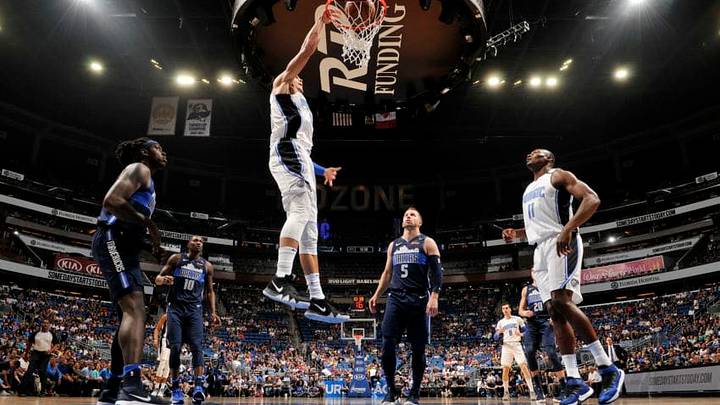
No team in the NBA has made so many moves and so little progress over the last six years as the Magic. Since trading Dwight Howard in 2012, the team has employed five different coaches, repeatedly traded former first-round draft picks, and unintentionally leaked its free agency plans, all without eclipsing 30 wins in a season. Despite constantly finishing at the bottom of the standings, Orlando has yet to land a surefire franchise cornerstone, and the current roster makes little sense when taken as a whole.
And yet, the Magic figure to be one of the NBA’s most fascinating — if unsuccessful — teams in 2019. They are a test case for the limits of the modern game and for basketball’s new frontiers. Depending on one’s viewpoint, Orlando is either shrewdly anticipating where the league is moving or grounding themselves in antiquated philosophies. The front office has prioritized length and athleticism recent drafts, assembling a supersized core teeming with potential. Aaron Gordon, Jonathan Isaac and Mo Bamba all have considerable upside in their own rights, but whether they prove to be a tenable foundation for a championship contender remains unknown. The upcoming season will be a matter of finding out who fits and who doesn’t.
Orlando’s promise is rooted in defense. Bamba has the tools to become a staunch rim protector and Isaac profiles as the sort of dynamic and versatile frontcourt partner to complement him. Gordon, now playing for his fifth coach in five seasons, isn’t quite as raw, but his best-case scenario would unlock a tantalizing ceiling for the Magic. In theory, Gordon should be a vigorous five-position defender capable of switching on the perimeter and turning away shots at the rim. The reality has been less rosy. Gordon has flashed some ability to do those things, but as energy and commitment have waned, hasn’t executed them consistently enough to instill real optimism for that sort of role.
With Isaac healthy and Bamba in line for major minutes, finding space for Gordon to fully blossom could be a challenge for Steve Clifford, and lineups featuring all three will present its own set of constraints. Gordon has played out of position before, to the detriment of the Magic’s success and his own development, and while he fits more cleanly with Isaac than he does with Serge Ibaka, he will likely be shoehorned into an uncomfortable role again. He and Isaac might have the athleticism and versatility to make that pairing work, though likely not right away. If the future of the NBA is positionless athletes, Orlando may already be ahead of the curve. Both Gordon and Isaac have the physical capabilities to consistently guard on the perimeter, even if consistent discipline and alertness are still lacking.
The success of that pairing will also depend largely on whether either can develop into a consistent offensive threat. Gordon made meaningful improvements as a shooter last season, but still doesn’t have enough gravity to earnestly space the floor; his 17 points per game came on below-average efficiency. Isaac has yet to amass enough of NBA minutes for any sort of judgment to be made. Neither projects as a first option on a team with serious championship ambitions, and Bamba doesn’t profile as much more than a rim-runner and floor-spacer on offense. All should serve perfectly fine roles but will require specific types of players around them to preserve any sort of offensive structure.
Playmaking will be difficult to come by for Orlando, and the primary initiator on the next Magic playoff team likely isn’t on the roster yet. That will bog down the offense on its own. The lack of shooting could slow it to an insurmountable degree. Orlando ranked 28th in 3-point percentage last season and 25th in offensive efficiency. Neither mark appears due for much improvement if any at all. The Magic have no reliable source of offense, save for Evan Fournier and Nikola Vučević, who can only carry a team so far.
Those limitations will make for, at best, a cluttered and disjointed offense. Even the most well-designed actions have little hope of success without the requisite spacing and wherewithal to let them breathe. Clifford will need to keep veterans like Fournier, Vučević, and D.J. Augustin on the floor for the team to have any semblance of shot creation, an obligation that could cut into the minutes available for younger, more intriguing lineup combinations.
The possibility for experimentation makes the Magic more alluring than its raw talent suggests, and units built around Bamba, Isaac and Gordon could overwhelm certain teams with sheer activity and length. All three should be given the freedom to explore the extremities of their games, with winning coming secondary to self-discovery. With something of a workable core finally in place, Orlando may be ready to make real progress at last.
 Add us as a preferred source on Google