

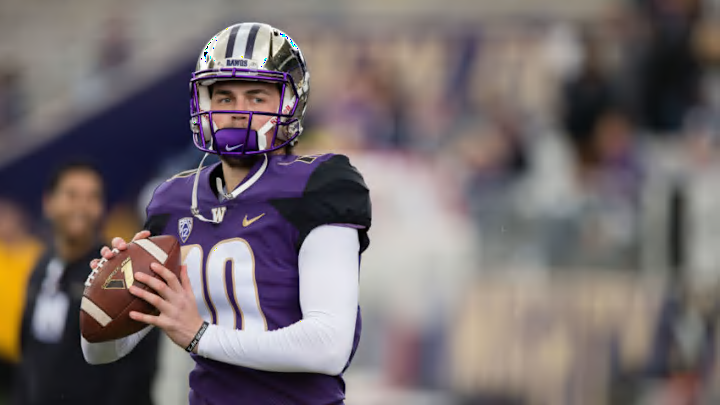
Washington loses nine starters off their stout defense and four-year starters at quarterback and running back, so will the Huskies be rebuilding or reloading?
Under head coach Chris Petersen, Washington developed a positive model of consistency. Starting with the 2016 run to the College Football Playoff, they amassed three straight 10-win seasons. Not bad for a program that had not won double-digit games in a year since 2000.
A theme through this run: consistency. Well, for the most part. They had players jump to the NFL or graduate, but quarterback Jake Browning and running back Myles Gaskin headlined these years. As recently as 2018, they combined for nearly 4,500 yards of offense and 32 touchdowns, and both were once Heisman-caliber players in their respective collegiate careers.
Now, the last parts of that vaunted Huskies offense will join Dante Pettis and John Ross in the NFL — officially ending this school’s most successful era since the early 1990s. They’re losing 22 seniors off the 2018 roster.
That sounds like doom and gloom for a head coach that’s not used to that, after a historic run at Boise State and what he’s done in Seattle. Losing landmark talents can take years to replace, especially at quarterback. Cal has struggled since Jared Goff’s departure; Oregon is just 29-22 since the Marcus Mariota era; Josh Rosen and Sam Darnold leaving UCLA and USC, respectively, contributed towards two down seasons in Southern California.
Unlike them, Washington might be okay for 2019 and maintain its 10-win streak.
Losing a four-year starter like Browning, who seemingly played forever, is a difficult blow for any team to take. He totaled 12,296 passing yards and 94 touchdowns, albeit with questionable accuracy (completion percentage dropped four points) and becoming turnover prone (10 interceptions).
Browning’s replacement is arguably an improvement, however, in Jacob Eason, the long lost transfer from Georgia who once tossed 2,430 yards and 16 touchdowns as a freshman, before Jake Fromm stole the show via injury and took the Bulldogs to the National Championship Game.
Entering as a junior, Eason has a leg up over his younger competition, including newcomer Dylan Morris. He has a year practicing in Petersen’s system — except traveling for road games — allowing an extensive look at who this player is and how he acclimates to everything. It was redshirting without actually redshirting.
Washington defensive coordinator Jimmy Lake saw plenty of Eason, who worked on the scout team and against the defense in practice. According to The News Tribune, there was nothing but positive remarks for this fresh face:
"“He’s been around. He’s a veteran. So he’s like: You know what? I know this is going to make our team better. And sure enough, he made us better. He’s a big-time talent. Great kid. Great command of the scout team.”"
It’s easy to forget how touted Eason was out of high school. He ranked second among pro-style quarterbacks in 2015 and fifth overall nationally. At 6-foot-5, the Lake Stevens, WA native is three inches taller than Browning and may have a stronger arm. Along with adequate mobility, he can shuffle around the pocket if needed. And, if all goes well, he has the package to become a top pick in the 2020 NFL Draft.
That’s just one position, but the most important one on the football field. Eason needs someone to hand off to, and there are no running backs to scoff at, especially after Salvon Ahmed’s quiet 608 yards and seven touchdowns as Gaskins’ backup, and only as a sophomore. A former four-star prospect, he’s the favorite for touches. That’s while Kamari Pleasant stands ready to build off 214 yards.
The most fascinating part of Ahmed’s likely rise, though, is his dual-threat ability from the backfield. He was a third-down back, with 21 catches for 170 yards in 125 plays. Gaskins had 21 catches of his own — a career high — but on 280 plays. Maybe a one-year anomaly, but Ahmed did more with less, despite praise the player formerly above him on the depth chart received.
Joining Eason and Ahmed, a loaded group of receivers will return, headlined by Aaron Fuller, Ty Jones and Hunter Bryant. They will add the talented Marquis Spiker to this group, providing more than enough playmakers to keep this offense explosive and able to keep pace with Oregon and Washington State’s high-powered systems. Their only loss is Andre Baccellia, although the second-leading receiver last season, at 584 yards.
While the spotlight shines brightly on the one-two punch, the defense has pieces to pick up, as well. Defensive backs Byron Murphy and Taylor Rapp may both become first-round picks in the 2019 NFL Draft. Murphy led the team with four interceptions and 13 pass deflections and Rapp not only picked off the ball twice but recovered three fumbles.
Leading tackler, Ben Burr-Kirvan is gone. So are the defensive front’s mainstays: Greg Gaines, Shane Bowman and Jaylen Johnson.
It’s a haul of quality talent to replace on a defense that allowed the 12th fewest yards in the nation, and that’s not even all the players leaving for the draft or graduating. Though as the Seattle Times noted, it’s not like inexperienced players will step up to take roles, with multi-year players in the Washington program taking charge.
They have a young defensive backfield taking over, headlined by former quality recruits, Kyler Gordon and Julius Irvin. Neither played in 2018 due to redshirting. The Rose Bowl-experienced Brandon McKinney also has an avenue towards playing time.
The attention goes to that depleted defensive front, however. With so many bodies to replace, it’s difficult to think they allow the 15th-fewest rushing yards per game in the nation, so a step back is possible. Benning Potoa’e and his returning 6.5 sacks could fill part of this gap, Josiah Bronson barely played in his first season post-transfer and one of their best 2019 recruits is a defensive tackle, Jacob Bandes. Talent is not absent here, but a question mark for how they play.
Coupled with what the offense returns and arrives, the potential defensive issues should not stand out as much, leading to another positive season for the Huskies. It may not be 10-11 wins, with Oregon’s Justin Herbert back, but there’s a foundation in place to make this team capable of eight or nine wins, garner experience and ascend in 2020 for another run at a top bowl game.