
Key Points
Bullet point summary by AI
- The WNBA Draft will be held just eight days after the National Championship game, giving prospects one last chance to raise their draft stock.
- Stars like Lauren Betts and Olivia Miles have rejoined the mix for the No. 1 pick, with others like Raven Johnson jumping into the first round.
- The Women's Final Four and National Championship Game could go a long way toward shaping the top of the WNBA Draft.
March Madness is more than big wins and serious upsets. It is the opportunity for eligible WNBA draft hopefuls to solidify, or elevate, their rank. High-stakes games, elite competition, and increased fan engagement give scouts the closest look into how prospects will perform at the professional level.
For top players, the tournament is less about statistical jumps and more about staying consistent from game to game as competition strengthens. For middle and lower tier players, statistical jumps increase visibility and signal a capacity to deliver at a high level. As we head into championship weekend, here are five WNBA Draft prospects that have raised, or solidified, their stock.
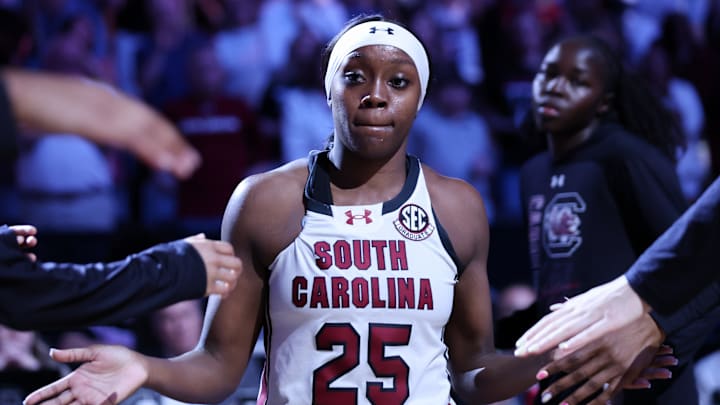
Raven Johnson, South Carolina
Raven Johnson entered the tournament averaging 10.2 points, 4.0 rebounds, and 5.3 assists. In South Carolina’s most recent win over TCU, Johnson had 10 points, 8 rebounds, and 6 assists, reinforcing her reliability against high caliber opponents. Her play throughout the tournament has signaled that she is a dependable leader and playmaker. She stabilizes possessions and maintains defensive discipline, which is especially important late in the game.
Because of her low-volume scoring and a deep point guard class, Johnson entered the tournament looking more like a second-round pick. But as the reigning SEC Defensive Player of the Year and recent recipient of the Sacramento 4 Regional Most Outstanding Player (MOP), Johnson may have moved to a mid-to-late first-round selection, particularly for teams seeking depth and defensive flexibility in the guard rotation.
Lauren Betts, UCLA

Lauren Betts finished the regular season averaging 17.2 points, 8.6 rebounds, and 2.0 blocks per game, already having established herself as a defensive anchor and consistent offensive producer for UCLA. Betts' dominance in the paint continued into the postseason. In her lowest scoring game against Minnesota, Betts’ still managed to put up 16 points. Her other performances include 23 points against Duke, 35 against Oklahoma State, and 22 against Cal Baptist. Across the postseason, Betts has effectively shattered her own offensive ceiling, signaling to scouts that she is a top scorer against higher competition. If that weren’t enough, Betts recorded 10 blocks across her two most recent games.
Based on her current trajectory, Betts projects as a top-three selection, with a legitimate chance to challenge for the No. 1 overall pick depending on team needs and draft positioning.
Olivia Miles, TCU

For Olivia Miles, March has reinforced what scouts have seen throughout the regular season: a top lead guard capable of managing momentum, generating offense, and staying calm under pressure. Miles entered the postseason averaging 19.6 points, 7.2 rebounds, and 6.6 assists. She has continued to produce through March, with one triple-double and two double-doubles across her four game tournament run.
She projects as a top-five selection, particularly for teams seeking long-term stability at the point guard position.
Nyla Harris, North Carolina

Among mid-tier prospects, Nyla Harris may have generated some of the most meaningful stock movement through efficiency rather than sheer volume. Prior to March Madness, Harris averaged 11.4 points, 6.9 rebounds, and 0.9 assists. During her three game tournament run, she averaged 13 points, 8.3 rebound, and 1 assist, effectively raising her output against better competition. Harris capitalized on high-percentage looks, maintained strong rebounding positioning, and limited wasted possessions.
Harris was a fringe prospect coming into the tournament and not guaranteed to be selected at all. But she may have played her way into the third or even second round with a realistic opportunity to secure a roster spot as a depth frontcourt player.
Azzi Fudd, UConn

Before the tournament began, Azzi Fudd was projected as a top three draft prospect. Her postseason performance has reinforced this prediction. Fudd concluded the regular season averaging 17.7 points per game while shooting 48.9 percent from the field and 45.5 percent from 3-point range, establishing herself as one of the most efficient perimeter scorers in college basketball. During tournament play, she elevated her impact with multiple high-scoring games, including a standout 34-point performance featuring eight three-pointers against Syracuse.
Given her scoring versatility and efficiency, Fudd currently projects as a top-three selection, keeping her firmly in contention for the No. 1 overall pick.
More WNBA news and analysis:
 Add us as a preferred source on Google