
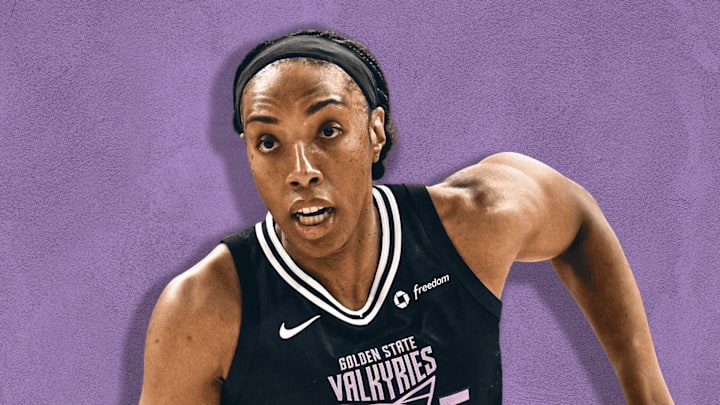
This story is part of FanSided’s Fandoms of the Year, a series spotlighting the teams, athletes and cultures that defined sports fandom in 2025.
As a basketball-obsessed kid in Oakland, Calif., during the late 90s, I’d end my days by whispering to an imaginary Lisa Leslie, who was smiling from a poster over my bed. The WNBA’s “We Got Next” campaign was brand new, and it felt both improbable and destined that one day, the lineage of professional women’s basketball would pass on to me. For just a few years, when my age was still a single digit, I was allowed myself to believe. It was the only time in my basketball career that I was — temporarily — unafraid.
As it turned out, playing elite basketball was not for me, and I quit all together after high school. Eventually, self-doubt crept in off-the-court as well. I began to see the WNBA as deeply “uncool,” a result of misogynist tropes and internalized homophobia. I shied away from following the league. Finally, over the years, both the WNBA and I evolved to become more queer and self-accepting. But without a team in the Bay Area, this all took place after I moved to Chicago in my 20s, far away from my hometown of Oakland. It wasn’t until the summer of 2025, while witnessing the Golden State Valkyries’ inaugural season, that I once again felt that same revolutionary belief that first fueled my love for the WNBA.
An expansion team with nothing guaranteed
This spring, buzz around the Valkyries was mounting as the WNBA season approached in May. Ten thousand season ticket holders had signed on immediately, and fans took to the team’s colorful marketing like bees to sunflowers; in this case, rocking the official “violet” (though clearly lavender) team merch across the Bay. And yet, as the actual games approached, a sense of unease set in.
Expansion teams are notorious underdogs, rosters built from unprotected players, like strays, lucky to find a home. When I interviewed fans taking public transit to the first Valkyries home game of the season, they had classically low expectations. “I know it’s like the first game ever, so I don’t have high hopes for the season,” said one guy on BART, while a friend of mine recorded a voice memo from the ferry, wind blustering in the background: “We have really crappy odds to win. I don’t care, I’m just gonna have fun.”
But a mediocre season was not where the Valkyries were headed.
Natalie Nakase and a team built to battle

The Valkyries’ boldest leader has always been its shortest member: head coach Natalie Nakase.
Nakase embodies the grit of an underdog. At just 5-foot-2, she’d walked on to the UCLA women’s basketball team in 1998 only to become its three-year starting point guard. After climbing the ranks from video intern to assistant coach in the NBA, she joined the Las Vegas Aces under Becky Hammon to play a huge role in both of the franchise’s WNBA championships, in both 2022 and 2023. Now, in leading the Golden State Valkyries, she was the first Asian-American head coach in the WNBA. But what became evident, early on, is that Nakase doesn’t walk in others’ shadows: She determines the spotlight.
Nakase, alongside general manager Ohemaa Nyanin, had a vision for choosing every Valkyries player. They also arrived to the Bay Area with past reputations: a defense-minded, low-scoring point guard in Veronica Burton who was cut during the 2024 season by the Dallas Wings; a once-undrafted veteran turned essential “role player” for the New York Liberty in Kayla Thornton, who’d developed a cult following in Brooklyn; and a 35-year-old franchise player in Tiffany Hayes, whose career was so battle-tested she’d actually retired in 2023, only to get lured back to the W by the Aces in 2024.
The women of the Valkyries’ front office didn’t shy away from WNBA-untested international talent either, bringing both 21-year-old Carla Leite and 23-year-old Janelle Salaün from France to play professionally for the first time on American soil.
“What excites me about building a team from scratch is that we get to intentionally pick our players,” Nakase told the press, months before the season began. “I’m not inheriting anything."
Her players, Nakase made it clear, would approach each game as a “battle,” defined above all by defense, tenacity and willpower. Her recruits embraced this “win or die” mindset. "We're killers," said second-year guard Kate Martin during training camp. "We want to be gritty; we want to be relentless. We want to be the ones diving on the floor for loose balls … we want to be playing together and work our tails off."
The Valkyries’ first regular season test came on May 16 against the Los Angeles Sparks. In front of a sold-out Bay Area crowd, the brand-new team suffocated their opponents for three scoreless minutes to kick off the game.
In the third quarter, when Julie Vanloo (who would later be waived from the team and signed by the Sparks, much to Valks fans’ chagrin), used her signature off-kilter shot to hit back-to-back 3-bombs, the sold-out crowd exploded. In that moment, the berserk ecstasy of WNBA fandom arrived completely to the Bay Area. The Valkyries couldn’t hold on, and the Sparks prevailed, thanks to Golden State’s 22 littered turnovers and Kelsey Plum’s season high 37 points.
But in this scrappy team of defensive predators and fearless shooters, we saw ourselves: people of a region marked by clear potential that others deemed largely improbable.
A fanbase shaped by what was taken away

The thousands of people who filled Chase Center to the brim for each Valkyries game were overwhelmingly diverse in terms of race, ethnicity, age, gender and sexuality. Crowds took to the savvy marketing of Golden State, who re-branded the arena as “Ballhalla,” complete with soaring ravens and violet-tinted clouds and mythological swords — a fantastical departure from the known dominance of the men’s Warriors team.
But the truth is that Ballhalla, unlike the Valkyries roster, was not built from scratch. Because just beneath the surface, there’s a deeper history that runs through women’s basketball fandom in Northern California. In fact, it’s the collective trauma of past franchises' collapses that binds us.
All three of the area’s former pro teams — the WBL’s San Francisco Pioneers (1979-81), the ABL’s San Jose Lasers (1996-1998) and the Sacramento Monarchs (1997-2008) — folded so suddenly that neither players nor fans could gather to say goodbye. And there’s an awareness that in the San Francisco Bay Area, a region with proud LGBTQIA+ heritage, queer fans provided a strong base for each of these teams. Valkyries fans know that for years, tens of thousands of women’s basketball fans have not been afforded the experience they always deserved.
Throughout the summer at Ballhalla, I spent hours talking to strangers descended from this lineage, who greeted me with warm familiarity. I ran into dozens of friends and former teammates that I hadn’t seen in years. I met old-school WNBA fans from Oakland who described hours-long carpools to Monarchs games in the late 90s and early 2000s as “lesbian caravans.” I witnessed a queer couple get engaged, in the middle of Chase Center, after putting a message up on the jumbotron. I chatted with countless folks who’d never before been to a professional sports game, of any kind. They spoke about feeling excluded from mainstream masculinist culture.
One lesbian in her 70s, my friend’s mother, put it perfectly. “Here, dykes are the stars,” she said. “It’s intoxicating.”
When belief turned into momentum

Opening night, May 16, would be the last time the Valkyries lost to our cross-state rivals from Los Angeles. We’d clobber the Sparks three more times during the season, along with a string of thrilling homecourt upsets against teams like the Indiana Fever, New York Liberty and even the future-champion Las Vegas Aces. Ultimately, we’d secure the final spot in the 2025 WNBA playoffs, falling by just one point in the final first-round standoff to the Minnesota Lynx.
None of these successes were expected. Throughout the games, the crowd remained rapt, full of visceral appreciation for each momentum-shifting defensive rebound or clawing scramble for a loose ball.
Meanwhile, the Valkyries embraced their power as a collective of players that other franchises didn’t want. “We’re a team of Sixth‑Women,” said center Temi Fágbénlé. “We’ve come from different teams around the league… and we know what it takes to step up and do what we need to do for the team to succeed.”
Temi was right: Every game, it seemed, a new player took charge, willed forward by extraordinary conviction — not only from their teammates, but propelled by the roars of the crowd as well. Our Bay Area crowd loved the entire cast.
Ballhalla howled for the surprising offensive prowess of Veronica Burton, who burst downhill as a real scoring threat and organized her team with the secure attachment of a vet. We delighted in the energy of Temi Fágbénlé and Monique Billings, their blend of graceful agility and dominant physicality, combining for over 100 offensive rebounds during the season. We screamed as the team’s youngest player, Carla Leite, shimmied through the defense for high-arcing layups, some kind of French wizardry. The Valkyries' home court even seemed to break Caitlin Clark, who shot a season-worst 0-7 from three on June 19.
Ballhalla was starting to feel truly magical, beyond the action on the court. After that win over the Indiana Fever, Nakase told reporters, “Our fans are kind of like our superpower.” As fans, we’d become part of the story.
Why Valkyries fandom feels different

The secret sauce of Valkyries fandom is that it’s not another fast trend, but a deep-rooted community of generations of historically excluded fans. You can see proof of our fandom’s distinction in the numbers: Reports confirmed that only 5 percent of Valkyries season ticket holders also had season tickets to the MNBA (as we call it.) Gone from Chase Center were the sunken, quiet tech vibes of white men with money and little to say. Back in their seats were the queer-led women’s basketball fans who’d yearned for a team for so long.
Just as the players broke through to untouched new ceilings, so too did Valkyries fandom disrupt reputation. In fact, when San Francisco’s arena was built in 2019, many saw it as a reflection of growing wealth that, like much of the gentrification across our region, often disregards those who built the culture in the first place.
But what fans brought to Ballhalla was a refreshing declaration of the kind of Bay Area we want to live in. Valkyries fandom proved itself as valuable to the Golden State franchise as its fancy arena is to the 18,000 fans who fill its seats.
There’s no way to know what’s to come in the second season of the Golden State Valkyries. Perhaps ticket prices will skyrocket, the team will draw in a singular superstar, the energy will shift. What I know is that the Valkyries’ first season proved that the Bay Area is still unmistakably collective. We became enthralled by this scrappy team of “Sixth Women,” unlike any other in the WNBA, and they embraced us right back. Together, we breathed new life into the potential of what professional women’s basketball can be. We returned to something the WNBA offers, at its core: belief.
During the team’s exit interviews, Most Improved Player Veronica Burton talked about her gratitude for Natalie Nakase. “She chose us for a reason, and she believed in us,” she said. But her statement wasn’t just about a basketball team. It was a reflection of Ballhalla, and of the Bay Area, taking a leap of faith as the first franchise during this new era of WNBA expansion. Perhaps that’s why I’m finally packing up my apartment in Chicago right now, to move home full-time to Oakland. I can’t miss the rise of the Valkyries. And I can’t miss being part of it, either: the moment when Bay Area women’s basketball fans can finally choose each other.
More FanSided Fandoms of the Year:
 Add us as a preferred source on Google