
How one family is changing basketball in Australia with Unified Sports
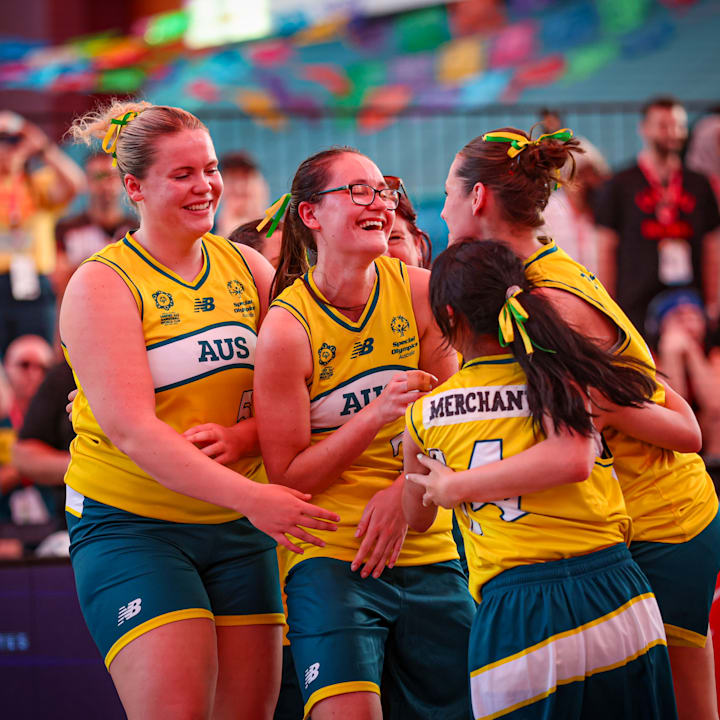
Chloe Symington was quite literally born into Special Olympics. At two weeks old she was in a Baby Bjorn on her mother, Naomi's, chest as she coached her high-school age athletes in the multi-sport program she helped found. By the time Chloe was eight, her mom had her coaching shot put with athletes who were years older.
"So Chloe, at eight-years-old, was the head throws coach, because she's a really good athlete herself," said Naomi. "And when I look back on it, she was literally eight, and one of our athletes, he was, I'm going to say 7-feet tall, and his shoes were custom made. And I would just send her off at eight over to do shot-put coaching."
What started as an extension of Naomi's work as a physical education teacher in Australia became a family affair. Naomi's husband Mark and her two other daughters have all worked with Special Olympics as coaches and Unified partners.
"It began as a school thing that I did in my own time, and then it became just something that our family fell in love with," said Naomi. "Our family values volunteering really highly, our family values inclusion."
And what the Symington's have done for their community goes well beyond just coaching and playing — Chloe and Naomi has been integral in establishing the first Unified Sports basketball program in all of Australia.
Bringing Unified Basketball to the Eltham Wildcats

During COVID in 2020, Chloe stumbled across a video about Unified Sports — a Special Olympics program that has athletes with and without disabilities competing side-by-side. At that point, her family has been involved in Special Olympics for longer than she'd been alive but she couldn't believe that there wasn't any Unified Sports programming available in their area. She encouraged her mom to look into it and together they got permission from Special Olympics Australia to start a Unified pilot program with the support of their local basketball club, the Eltham Wildcats.
Australia is a famously hoop-obsessed nation and their basketball programs are organized differently than in the US. Local basketball clubs like the Wildcats offer facilities and run programs and leagues for all different skill levels and ages — from youth learning the game all the way up to semiprofessional teams that play in the NBL1. Blending this new Unified program into what the club was already doing was a natural fit and provided a powerfully inclusive experience for everyone.
"Junior domestic is the main kind of competition and then they have rep basketball, which is higher level," explained Chloe. "So there's all kinds of different competitions within the one club. So it's just another division of competition within our club. So that the refs just roll straight on. They might be doing a midweek men's, refereeing, then they step across to unified, they ref our three games and then the mixed games. We are just another division of competition within our club rather than a stand-alone special day on a Sunday night for people with disability or unified competition."
Same refs. Same courts. Same jerseys. Same club. It's all Eltham Wildcats — that's inclusion.
The benefits of Unified Basketball

Australia has offered robust basketball programs through Special Olympics for years but the Unified model was something new, an opportunity to support more athletes with different needs and abilities.
Naomi used the example of an athlete in their Unified program who also competes in the Ivor Burge Championships, the National Basketball Championships in Australia for players with an intellectual disability.
"She thrives in Unified competition, just with the social part," shared Naomi. "She's really good friends with Chloe, she can learn the structures and the plays and all of that sort of thing. But in the Special Olympics, I went to the Nationals, and I just watched her shrink socially, you know? So I'm like, it [Unified] provides meaningful inclusion and the right place for certain athletes. But, I still believe in the traditional pathway really strongly, though, as well."
As of this writing, Naomi and Chloe have about 50 athletes (players with intellectual disabilities) and 20 partners (players without intellectual disabilities) in their program, from age 16 all the way up to 60.
Unified also provides an opportunity for athletes to branch out and fill new roles. Last year, Chloe started a pilot program for kids who weren't old enough yet to participate in their existing program. Right now it's 18 kids, from age 5 to 15, and she was able to use experienced Unified athletes to help launch and support this new initiative.
"It was really cool because I was able to build like a coaching staff of my own with some of our Unified athletes who were in our program already," said Chloe. "So they come and coach with me and some of our other partners. And for some of them it's their first job or like first experience being able to use what they've learned at Unified to help other kids."
Unified Sports open the door for more people to interact, compete side-by-side, develop skills on and off the court and build connections. Sometimes those connections are new friends and teammates. Sometimes it's with someone a little closer.
"One of our athletes in Puerto Rico, her brother is a, partner within our program. And they weren't super close as siblings. But they've been involved in the program for four years, they now have such a close sibling relationship, a friendship, and they're going into adulthood really connected. And it's brought that whole family unit together, that strength to their family. I think being a coach in Unified is, is truly life-changing, not just for yourself, but for the athletes and the community that we serve."
What the Symingtons are building is bigger than a sports program, it's a community and a culture. And they're hoping it grows beyond their little corner of the country.
"I think it takes a change in thinking from within the existing clubs and within the employees," said Naomi. "I met with all of the state managers, and I think that the change has got to happen from top up and from bottom up as well. You need to provide resources and information and support to local clubs within your communities, and it can be in the middle of the outback of Australia. You don't have to physically be there, but just provide them with the resources of how to get going, and just have people like us. We're not like the only people who love sport, love inclusion!"
The Special Olympics Unified 3x3 Basketball World Cup

Chloe and Naomi were able to take their budding basketball community on the road last year, bringing both men's and women's teams to compete at the Special Olympics Unified 3x3 Basketball World Cup in San Juan, Puerto Rico in December.
Teams from 27 countries competed at the event and the Symingtons were inspired by the deep roots of some of the other programs. Teams like the USA and Paraguay pulled athletes from numerous existing Unified Sports programs around their countries, with tryouts and training to build rapport. As the only program in Australia, Naomi and Chloe just brought the 10 athletes they knew would be available and travel well. (It took them 55 hours of travel to reach San Juan).
That's not to discount the talent or preparation the Australian athletes put in. No other team traveled as far to be there and for many of their players, 3x3 was a largely new experience. At home, their Unified program is essentially all 5x5 and so preparation for this tournament meant learning new rules and strategy.
"It was still really meaningful for us to be there," said Naomi, "because the athletes did train really hard.. They've been committed to the program for 3-5 years, depending on the athlete and the partner. They had earned their spot to be there. And we don't play 3x3 in Australia in our competition, we do 5x5. So we actually had to start by teaching them the rules of 3x3, and that was really complex, because one of our athletes didn't cope that well in Puerto Rico. She needs the full court to kind of build into her shot ... It was just too quick for her. The concept was too quick. So, yeah, we've got a long way to go."
The Symington family has been a part of the Special Olympics movement for more than two decades but what they're building with Unified Basketball is something new, something that's still evolving and growing. Competing against the rest of the world in San Juan showed them just how far they've come and how much farther they'd still like to go.
More programs in more places in Australia would be a dream but for right now the focus is on the athletes right in front of them and spreading the message of how Unified Sports can change your life.
"What you should know about Unified is that it ends up being a community," said Chloe. "Like, for us, we don't know what our week would look like if we didn't have it. Once you start, it just becomes part of your week, part of your life, and the people that you meet there become your friends. It brings families together, it brings people of all ages together."
Why We Play features stories about the power of sports to bring us together, overcome obstacles, make positive change and reach everyone. Read more here.
 Add us as a preferred source on Google
Ian Levy is creative editorial director for FanSided and helps direct coverage of the NBA, soccer and women’s sports. He’s been working at FanSided since 2015, working in numerous roles and on projects as diverse as the launch of Nylon Calculus, Fandoms of the Year, Fan Voices, FanSided FORE, Why We Play, The Whiteboard and more. Before joining FanSided, he wrote about the NBA for multiple outlets including FiveThirtyEight, The Washington Post, Rolling Stone, VICE Sports, ESPN, Bleacher Report, The Sporting News and The Cauldron at Sports Illustrated.
Follow HickoryHigh