
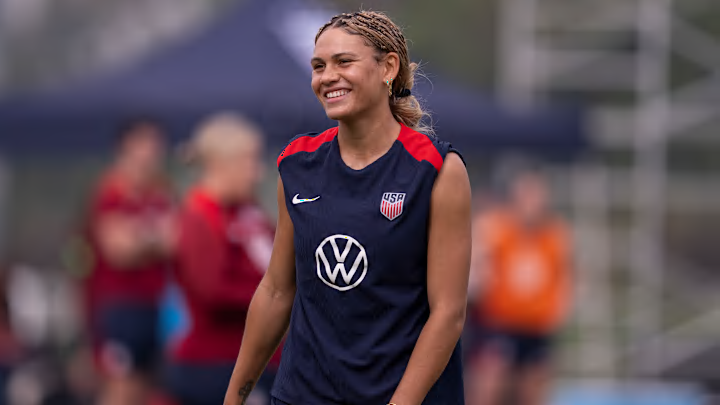
On Thursday, U.S. Women’s National Team player Trinity Rodman, daughter of basketball legend Dennis Rodman, signed a deal with the Washington Spirit that spans three years and guarantees Rodman at least $2 million per year. The deal makes Rodman the highest-paid player in the National Women’s Soccer League (NWSL) and the highest paid female athlete in the world.
The deal is the product of the NWSL’s new High Impact Player (HIP) rule aimed at keeping top talent in the league. The rule allows teams to pay $1 million above the established salary cap for a single player or players that meet at least one of the High Impact Player criteria.
NWSL, Washington Spirit set a women's sports standard with Trinity Rodman contract

As Washington Spirit president of soccer operations Haley Carter told ESPN, it's a measure in place to avoid losing stars to other leagues, overseas and otherwise.
“We've already lost multiple players this year in two transfer windows overseas for massive transfer fees," Carter said. "So, it's really about retaining those athletes, building a roster that can compete sustainably, keeping our best players, attracting even more elite talent, and also creating an environment where world-class athletes want to be.”
For the NWSL, ensuring player retention is a top priority, so much so that teams may spend up to $115 million to pay players on top of the salary cap established under the current CBA, which runs through 2030. Though the rule does not go into effect until July 1, 2026, teams are allowed to sign players in advance.
What Rodman's deal and NWSL structure could mean for WNBA CBA negotiations

Meanwhile, the WNBA and its players have been sparring about details of the latest CBA for almost four months and have yet to reach a deal.
Earlier this week, the league released their regular season schedule, a move many interpret as a means to pressure players into agreeing to league terms. The biggest point of dispute continues to be revenue sharing, with the league offering players 50% of net revenue (revenue after expenses are covered) compared to the players’ ask for 30% of gross revenue (revenue before expenses are covered). The WNBA has stated that the player proposal will lead to $700 million in losses over the span of the deal, while players dispute the accuracy of the claim.
While the WNBA is paying players what the league can afford while it expands, the NWSL is shifting towards a model where elite players are paid based on their demonstrated economic potential. The NWSL has effectively reframed league sustainability around players, rather than profit protection.
The WNBA is no longer negotiating in a vacuum. The NWSL’s HIP rule, Unrivaled and Project B’s pay and equity packages, and college athletes’ NIL contracts all point toward a growing recognition that talent sits at the center of league engagement and growth. Talent is an investment, not an expense.
Arguably, women’s sports have entered a new era, one where leagues can negotiate using a player-centric rather than league-survivalist approach to growth. As both the NWSL and the WNBA position themselves as the top leagues in their respective sports, North America has the potential to become the place to play and to watch women's sports. If this goal is a priority for both leagues, the NWSL has put their money where their mouth is. The WNBA has yet to do the same.
 Add us as a preferred source on Google