
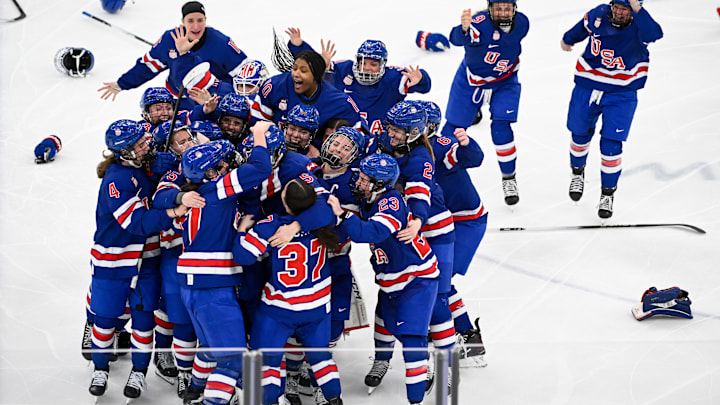
There was never any doubt the gold medal game would come down to the United States and Canada. There was doubt, however, about how women’s hockey itself would look when they got there.
When Megan Keller ripped home the overtime winner 4:07 into 3-on-3 overtime to give Team USA a dramatic 2-1 victory over Canada at the 2026 Winter Olympics, the moment instantly joined the long list of iconic chapters in the sport’s fiercest rivalry. Hilary Knight’s late equalizer, Kristin O’Neill’s shorthanded breakaway goal, and another overtime thriller between the sport’s two superpowers delivered exactly what Olympic hockey fans have come to expect.
But beneath the drama — beneath the rivalry, the medals, and the national pride — was a different story unfolding. For the first time in Olympic history, women’s hockey wasn’t just shaped by national team programs. It was shaped by a professional league.
Welcome to the Professional Women’s Hockey League.
PWHL was as big a winner as Team USA in the Winter Olympics
TOSS THOSE GLOVES @megan_keller4 YOU JUST WON A GOLD MEDAL 🥇
— Boston Fleet (@PWHL_Boston) February 19, 2026
Fleet Captain, Megan Keller, scores the game-winning goal to secure the gold medal victory for @usahockey! pic.twitter.com/GcoP9YWlUw
Founded in 2023 before its inaugural season in 2024, the PWHL is a first-of-its-kind women’s hockey league in North America featuring the best players in the world. It started with six original teams — the Boston Fleet, Minnesota Frost, Montréal Victoire, New York Sirens, Ottawa Charge and Toronto Sceptres — before expanding in 2025-26 to include the Vancouver Goldeneyes and the Seattle Torrent.
The PWHL has shattered attendance records for women's hockey and established a stable and financially supported model for players. It is considered the first true, professional women's hockey league. This league is owned by Mark Walter, the billionaire owner of the Los Angeles Dodgers, and its advisory board includes Dodgers president Stan Kasten, tennis legend Billie Jean King and her partner Ilana Kloss.
The PWHL features a season-long Takeover Tour with stops around North America that allows fans outside of the eight team markets to enjoy women's hockey. Game broadcasts are produced by the PWHL and available on YouTube in the United States and internationally.
The PWHL provides a new pathway to the Olympic Games

For decades, Olympic women’s hockey preparation followed a familiar formula. National teams centralized months before the Games, pulling players out of scattered leagues or semi-professional environments to train full-time together. Players often waited years for roster spots to open, and development outside of national team pipelines could feel like a gamble.
The PWHL changed that almost overnight. Instead of disappearing into centralized camps, the world’s best players now compete against each other nightly in a fully professional environment — sharpening skills, facing elite competition, and forcing coaches to evaluate players based on real-time performance rather than reputation.
The result was impossible to ignore in Milano Cortina, where a staggering 61 PWHL players represented 10 different countries at the 2026 Winter Games.
Perhaps the most fascinating wrinkle of these Winter Games was how blurred the traditional lines became. American and Canadian stars face off in a battle for Olympic gold — and a week later, they're professional linemates again. Or teammates. Or linemates sharing locker rooms and travel schedules.
The PWHL has created a reality where the fiercest Olympic enemies know each other’s tendencies intimately because they see each other every week. And familiarity breeds contempt.
The United States and Canada delivered another instant classic because both teams arrived sharper, faster, and more tactically refined than ever before — products of a league that demands elite execution every single night.
The PWHL provides unprecedented level of visibility for women's hockey

Women’s sports have long waited for the kind of momentum that comes from consistent visibility. The PWHL is providing exactly that.
Fans no longer see Olympic stars once every four years before they fade back into obscurity. Instead, they watch Hilary Knight, Marie-Philip Poulin and dozens of other Olympians compete weekly in packed arenas and nationally televised games.
Young players now have something previous generations didn’t: a clear professional destination. And Olympic success feeds directly back into that ecosystem.
Moments like Keller’s overtime winner or Knight’s last-minute heroics don’t end when the medals are handed out. They become marketing engines for the league itself — viral highlights that drive curiosity toward where fans can watch these players next.
The answer is no longer complicated. They can watch them tomorrow night.
The PWHL has had a global impact that extends beyond North America
While the league’s foundation is rooted in North America, its Olympic footprint showed just how quickly its influence has spread. Players representing Finland, Sweden, Switzerland, Czechia and Germany all arrived at the Games with PWHL experience, bringing higher levels of pace and structure back to their national programs.
The dominance of the United States and Canada has defined women’s hockey for decades, but a stronger professional ecosystem raises the competitive floor worldwide. And that ultimately makes Olympic tournaments — and women's hockey as a whole — better.
Women’s sports often grow in bursts — moments that capture mainstream attention and permanently expand audiences. The 1999 Women’s World Cup did it for soccer. The NCAA women’s basketball boom has done it recently on the college stage. Olympic overtime gold between the United States and Canada might become that moment for professional women’s hockey.
This time, fans don’t have to wait four years to see these athletes again. The stage already exists. And after dominating Olympic rosters in Milano Cortina, the PWHL isn’t just part of the women’s hockey ecosystem anymore — it’s becoming the center of it.
 Add us as a preferred source on Google