
Key Points
Bullet point summary by AI
- The Cardinals' young slugger, Jordan Walker, is showing dramatic improvements in contact quality and plate discipline through three games.
- Cleveland Guardians rookie Chase DeLauter made history with multiple first-at-bat homers while maintaining strong minor league strikeout control.
- These performances will be judged against their Triple-A metrics, where consistency could determine true breakout potential.
Baseball is brutal to early narratives. A player goes 4-for-10 with two homers over three games and suddenly he's fixed, he's arrived, he's the answer. Then April happens. The sample evaporates. The pitcher finds the hole in the swing and the conversation disappears until next spring.
The fastest way to separate reality from fantasy this early isn't watching more games. It's checking what these players were doing before they got here. Minor league production is an imperfect tool but it's the best one available when the MLB sample is three games deep. A player posting a 156 wRC+ in Triple-A before his call-up is a different conversation than a player who barely hit his way out of Double-A.
With that, here are the most interesting performances from opening weekend, starting with two names that deserve more attention than they're getting.
Sal Stewart, Cincinnati Reds

Stewart leads every meaningful leaderboard from opening weekend and almost nobody is talking about him. Through 13 plate appearances his slash line is .700/.769/1.300 with a wRC+ north of 440. His xwOBA, the expectation of what the results of his batting results should be, of .754 is the second highest mark in baseball.
That alone would be easy to dismiss. Thirteen plate appearances is noise. Except his Triple-A line from 2025 was .315/.394/.629, a 164 wRC+, the neutral measure of a player's results, in 165 plate appearances, with an 11.5% walk rate and a 15.8% strikeout rate. He was already doing this against the best pitching outside the majors. The MLB numbers aren't coming from nowhere.
Stewart is 21 years old and was not a widely-discussed prospect heading into this season. With what we saw, that is going to change. The combination of genuine plate discipline and real power in the minors makes him the easiest buy on this list. The opening weekend production confirmed something the data was already building toward.
Verdict: Buy. This is the name to know.
JJ Wetherholt, St. Louis Cardinals

Wetherholt's minor league line before his promotion is the cleanest projection in this group. In 221 Triple-A plate appearances in 2025 he hit .314/.416/.562, a 156 wRC+ with a 12.7% walk rate and 14.9% strikeout rate. He is not a prospect being pushed aggressively; he was already operating at a different level than the competition.
His MLB debut backed every word of it. He homered in his first game and walked off in his second, becoming the first player in MLB history to accomplish both in his first two career games. Through three games he carries a 140 wRC+ with a 6.7% strikeout rate, which is right in line with who he was against Triple-A arms.
The xwOBA of .362 is more conservative than his raw production, meaning some BABIP luck is present. That's fine. The underlying profile was already elite before he walked through a major league clubhouse door.
Verdict: Strong buy. The minor league numbers make this straightforward. The MLB performance is confirmation, not surprise.
Owen Caissie, Miami Marlins

Caissie arrives with the longest track record of sustained minor league production in this group. His 2024 Triple-A line with Chicago was .278/.375/.472, a 115 wRC+ in 549 plate appearances. After the trade to Miami, his 2025 Triple-A line was .286/.386/.551, a 139 wRC+. He got better. The walk rate held above 13%, the strikeout rate stayed around 28%, and the power jumped.
His three-game MLB line includes a walk-off homer and a .500/.500/1.000 slash in 10 plate appearances. The xwOBA of .407 is more conservative than the raw numbers, which is expected. It still represents a player who earned his way here.
Verdict: Buy. Two consecutive Triple-A seasons trending in the right direction, followed by a strong MLB debut. The power is real and the patience is real.
Colson Montgomery, Chicago White Sox

Montgomery homered on Opening Day and his three-game wRC+ sits at 184. The minor league context here is the most cautionary number in this entire piece.
His 2024 Triple-A line across 573 plate appearances: .214/.329/.381, a 79 wRC+. His 2025 Triple-A line in 242 plate appearances before his promotion: .218/.298/.435, an 82 wRC+. The strikeout rate in 2025 was 33.9%. Two straight seasons of below-average production against Triple-A pitching, with contact issues that never resolved.
A homer in his first game is exciting. It is also what happens sometimes when a player faces major league pitching for the first time and gets something he can handle. The minor league data does not support extrapolating anything from three games.
Verdict: Sell. The strikeout rate will show up. It always does.
Carson Benge, New York Mets

Benge homered in his first career game and generated real buzz. His 2025 Triple-A line in 103 plate appearances before his promotion was .178/.272/.311, a 53 wRC+. He was not hitting in the minors.
His MLB line sits at .100/.250/.400, the xwOBA is .350, and the opening day homer was the only meaningful offensive moment across three games.
Verdict: Sell. The debut homer was fun. There is nothing underneath it.
Chase DeLauter, Cleveland Guardians

Now we get to the names in the headline.
DeLauter's debut is one of the most statistically remarkable performances in recent memory. He homered twice on Opening Day, including in his first career at-bat, joining Trevor Story, J.P. Arencibia, Mark Quinn, Bert Campaneris, and Bob Nieman as the only players in MLB history to accomplish that. He finished the opening series with four home runs, a .353 average, a 1.059 OPS, and 18 total bases in four games, a Guardians franchise record.
The minor league context makes most of this believable. His 2025 Triple-A line before his promotion: .278/.383/.476, a 130 wRC+ in 149 plate appearances. He walked at a 14.8% clip and struck out at only 15.4% in the minors. That's the disciplined foundation you want to see under a power debut.
The one number that gives pause is his 35.3% strikeout rate through four MLB games, a significant jump from that 15.4% figure at Triple-A. His most impressive moment came in the 10th inning against Mariners closer Andrés Muñoz, when DeLauter was 0-for-4 with three strikeouts, worked a full count, and launched an opposite-field two-run homer on a 96.6 mph fastball located nearly a foot off the center of the plate. Under any circumstance, that is a professional at-bat. But the strikeout rate gap between his minor league and early MLB work is the variable that will determine everything about what this debut means.
Verdict: Cautious buy. The power is real, the poise is real, and the minor league profile gives his debut real credibility. Give the K rate three more weeks. If his approach in the minors shows up at the big league level, the ceiling is as high as anyone in the 2026 rookie class.
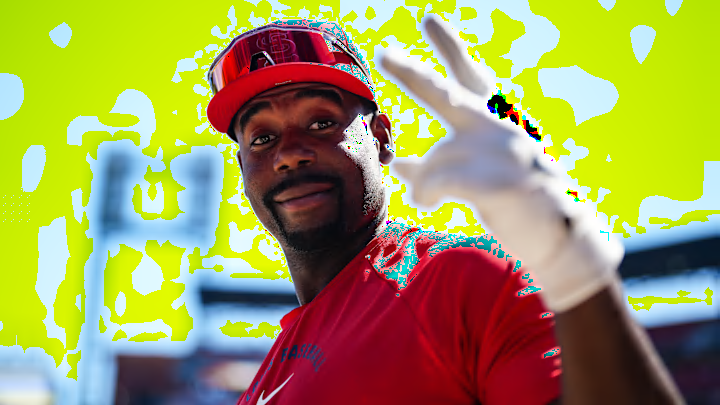
Jordan Walker, St. Louis Cardinals

Walker is the closer for a reason. There is more to say here than anywhere else on this list, and the data earns every word of it.
The surface numbers are remarkable: .400/.500/.900 through three games. The Statcast profile underneath them is what makes this worth taking seriously. Walker's early 2026 Statcast numbers show an 88.9% hard-hit rate, a 33.3% barrel rate, a 55.6% sweet spot percentage, and a 105.9 mph average exit velocity. His xwOBA of .688 actually exceeds his already extraordinary raw wOBA of .592, meaning the quality of contact is outrunning even the results he's producing. That combination is genuinely rare.
The skepticism coming in was completely legitimate. Since the beginning of 2024, covering 574 plate appearances, Walker posted a wRC+ of 66, ranking 270th out of 277 qualified players. His 2024 Triple-A line in 377 plate appearances was a .263/.326/.427 slash, a 94 wRC+, solid but not a breakout signal. Nothing in the minors suggested something was clicking.
So why buy now? Because this time there is a specific, identifiable mechanical explanation that is showing up in the data.
The most encouraging moment of the opening weekend, in Marmol's words, was how Walker stayed on an outside changeup from lefty Steven Matz and drove it 415 feet to left-center at 105.8 mph. "That's a big deal, just him not pulling off the ball," Marmol said. "When you looked at Jordan last year there were holes there. There was a certain way you could pitch him and when they would stick to it, he had a tough time solving it."
Staying through the ball on the outer half rather than flying open with the front shoulder has been the mechanical problem underlying every Walker evaluation since 2024. His ground ball rate at his worst sat at 60.4%, which would have been the highest in all of baseball. The three extra-base hits this weekend were all elevated contact. The sweet spot rate backs it: 55.6% of his batted balls landed in the ideal launch angle window.
Walker said his reworked approach now gives him the ability to stay back and adjust even when his timing is slightly off, and that he has been more aggressive on in-zone pitches as a result. His K rate this weekend was 8.3% through 12 plate appearances, two walks and one strikeout. His 2025 strikeout rate was 31.8%. Something is different.
The offseason work at Driveline Baseball gave him something specific to work with. The spring training numbers of .205/.255/.273 kept the skeptics justified. But the Statcast data from three games is not the profile of a player running hot on contact luck. It's the profile of a player hitting the ball correctly.
Verdict: Buy. The xwOBA doesn't lie. The mechanical explanation is specific and visible. The talent was always there. Monitor the K rate over the next two weeks. If it stays below 20% and the sweet spot rate holds above 40%, you are watching a real breakout from one of the most gifted pure hitters in the National League.
The through line
The players worth trusting this early are the ones whose major league performances match what they were already doing in the minors. Stewart, Wetherholt, and Caissie all clear that bar comfortably. DeLauter mostly clears it with the K rate as the open question. Walker clears it with a specific and traceable mechanical explanation for why the numbers look different from anything he's done in the past two seasons.
The players to walk away from are the ones where the MLB debut outperforms every relevant minor league data point. Montgomery and Benge both fit that description.
Three games is three games. Adding some pertinent data makes it a different conversation entirely.
MLB Data via Baseball Savant and FanGraphs. Minor league data via FanGraphs.
More MLB news and analysis:
 Add us as a preferred source on Google