
Key Points
Bullet point summary by AI
- The Chicago Cubs face mounting concerns as their rotation deals with multiple injuries, including Cade Horton, ahead of pivotal early-season games.
- The team should explore options beyond temporary fixes to stabilize their starting pitching depth.
- A strategic acquisition could be crucial for the Cubs to maintain playoff contention in a tightly contested NL Central.
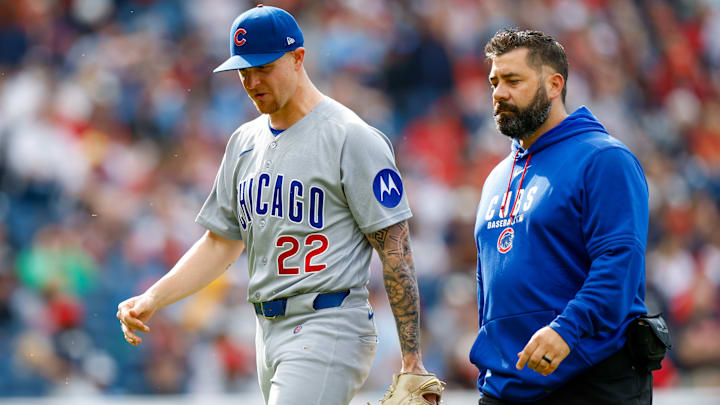
If there’s any consolation for Chicago Cubs fans, it’s that they’re not Boston Red Sox fans. Not that things are going much better on the North Side of Chicago, though. While the Cubs might not be 2–7, they’ve already lost starting pitcher Matthew Boyd to a left biceps strain, and fellow starter Cade Horton could be out indefinitely with a forearm injury.
ESPN Chicago reported on Tuesday morning that Horton’s MRI didn’t come back clean. The 24-year-old, who previously had Tommy John surgery in college, finished second in NL Rookie of the Year voting last year and was widely viewed as a dark horse Cy Young candidate entering the season.
If the Cubs intend to save their season before it’s too late, they may need to move fast and add another starter. We suggest they avoid signing the random journeyman pitcher who hasn’t been effective since 2022. A band-aid, stopgap solution isn’t the fix here.
Kyle Freeland, Colorado Rockies

At first glance, Freeland’s experience might appeal to the Cubs and other contenders. With that said, he turns 33 in May and isn’t your back-of-the-rotation workhorse, only averaging 145 innings from 2021 through 2025.
My primary issue with Freeland is the argument about him pitching in Colorado only goes so far. He’s 28–54 with a 4.20 ERA in nearly 650 career innings on the road, and his peripherals aren’t much different when you factor in Coors Field.
In fact, I’ll go so far as to say the Coors Field element doesn’t apply to Freeland the way one would immediately assume. You never want to hear something along those lines when discussing a Rockies pitcher.
The best thing Freeland has working for him, though, is his control. He only averaged 2.4 walks per nine during that aforementioned five-year stretch, which on its own warrants a call. If the worst-case scenario is Freeland doesn’t pan out, at least the Cubs could manipulate his playing time so he doesn’t meet the 170 innings needed for his vesting option.
Lucas Giolito, free agent

Giolito enjoyed a slight return to form for the Red Sox last year, finishing with a 3.41 ERA and 2.1 bWAR over 145 innings. Both marked his best totals since 2021, though he’s oddly remained unsigned all offseason.
Unless there’s something that we don’t know about, there is no reason why Giolito should still be available. It would be one thing if he had a poor spring training and a team released him during their final cuts, but he didn’t even get a minor-league contract this past offseason.
Even if Giolito likely won’t be a workhorse, he should still be enough to give the Cubs five innings every start — and, in the end, sometimes that’s good enough.
Luis Gil, New York Yankees

But wait, you say. Why would the Yankees, who are off to a scorching start and are widely viewed as a legitimate World Series contender, trade a proven middle-of-the-rotation starter who is under team control through 2029?
Easy: The Yankees have awful judgment when it comes to their young players.
The Yankees can say whatever they want about how much they believe in Gil. I personally wouldn’t be shocked if they view him as expendable. Ryan Weathers was awful in spring training and had a disastrous start against the Marlins last weekend, yet all we keep hearing is how great his stuff is and how the Yankees believe they can maximize his talent.
Blah blah, I’ve heard it all before. The Yankees mishandled the Jasson Domínguez situation, and I expect them to do the same with Gil. This would likely cost the Cubs at least one top-30 prospect, but all would be forgiven if Gil helps bring a title back to the North Side.
Mitchell Parker, Washington Nationals

Parker didn’t exactly turn heads during his first two MLB seasons, posting a 5.02 ERA and allowing 43 home runs in nearly 320 innings for the Nationals. Although he flashed at times in 2024, he was worth -1.2 bWAR a year ago on a 96-loss Nationals team. Exciting stuff.
So, why do I think the Cubs should target Parker? Remember, new lead baseball executives Paul Toboni and Anirudh Kilambi didn’t inherit Parker, who opened this year in Triple-A. That could pave the way for Washington to consider trading a 26-year-old left-hander who is under team control through 2030.
If you’re the Cubs, what do you have to lose by adding Parker? Washington doesn’t have much leverage, so it’s not like the Cubs would need to give up a top-30 prospect — or, at least, they shouldn’t need to do so.
More MLB news and analysis:
 Add us as a preferred source on Google