
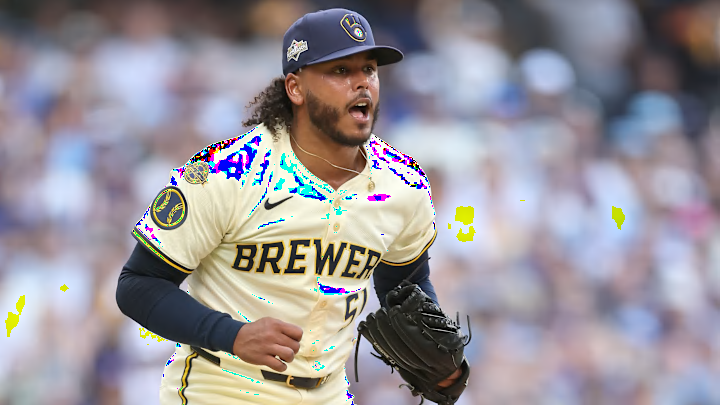
Two days, two big-time trades that have reshaped the present and future of the New York Mets. Just 24 hours or so after acquiring toolsy center fielder Luis Robert Jr. from the Chicago White Sox, David Stearns took an even bigger swing, sending top prospects Brandon Sproat and Jett Williams to the Milwaukee Brewers in exchange for Freddy Peralta and Tobias Myers.
Peralta put together the best season of his career in 2025, posting a 2.70 ERA with 204 strikeouts in 176.2 innings while making his second All-Star team and finishing top-five in NL Cy Young voting. If he's not an ace at this point, he's something very close to it. Unfortunately, he's also set to be a free agent next winter, and Milwaukee signaled early on this offseason that it would be open to moving him now rather than losing him for nothing in a few months' time.
Freddy Peralta trade grades: Did Mets overpay for their new ace?
Peralta's fit with the Mets is almost too perfect. Stearns entered this offseason knowing that New York desperately needed more depth in a rotation that fell apart down the stretch last season, and now he's reunited with a familiar face, the same pitcher he helped turn into a star in the first place. (Peralta represents arguably Stearns' biggest success story during his time running the Brewers front office, coming to Milwaukee from Seattle as a throw-in to a minor trade involving Adam Lind back in the winter of 2015.)
The Mets also gave up a lot for the privilege, moving two of their top five prospects by just about all evaluations. That's quite the price to pay for what is, barring a future extension, just one guaranteed year of Peralta's services. Then again, it's not hard to see how Peralta instantly vaults New York up a tier or two in the World Series conversation.
Mets trade grade: A-

Peralta overachieved slightly last season; his career 3.59 ERA is probably closer to his true talent level than the 2.70 mark he put up last season, and his strand rate was fluky high.
But he's also become an awfully well-rounded pitcher, developing a quality curveball, changeup and slider to go along with the four-seam fastball that remains his bread and butter. (He threw the heater over 53 percent of the time in 2025.) He misses bats and racks up strikeouts at excellent rates, and while walks are always a bit of an issue, his big-league track record paints the picture of someone who is at worst a quality No. 2 on a contending staff.
Statistic | MLB rank among qualified starters since 2020 |
|---|---|
ERA-: 79 | 20th |
Expected ERA: 3.26 | 13th |
K%: 29.4% | 13th |
K%-BB%: 20.5% | 23rd |
fWAR: 15.0 | 20th |
He's also thrown at least 165 innings in each of the last three seasons, the sort of durability that this Mets staff could desperately use given the question marks around Sean Manaea, Clay Holmes and youngsters like Nolan McLean and Jonah Tong. New York needed both innings and upside, and Peralta checks those boxes in a major way.
Of course, Williams and Sproat is a hefty package for just one year of Peralta. But given his prior relationship with Stearns, there's nothing saying that the Mets can't hammer out some sort of extension — or just let things play out in free agency next winter with the likes of both Peralta and Tarik Skubal. And while Williams and Sproat are both promising young players, well, that's the price you have to pay for true impact talent.
Besides, it's not like this leaves New York's cupboard totally bare. Sproat's bloom had come off the rose a bit as he struggled some against top-tier competition, and the emergence of both McLean and Tong as rookies last year made him more expendable. Losing Williams hurts, but guys like A.J. Ewing are waiting in the wings with potentially even higher ceilings, and Williams faced real questions moving forward as a smaller player (listed at just 5-foot-7) with hit tool concerns.
The bottom line is that the Mets are no longer in the rebuilding business. This is a team that should be competing for pennants starting immediately, and adding Peralta is a huge step in that direction without doing anything that seriously compromises their sustainability moving forward. There's still a ton of young talent coming through the pipeline, and now this rotation went from a major question mark to a potentially major strength. Adding Myers, who could serve as starting depth or slide into a bullpen role, is just the cherry on top.
Brewers trade grade: B

The song remains the same for the Brewers, who did with this deal the same thing they did in deals for Devin Williams, Corbin Burnes and other free agents-to-be before them: turn two quality players who didn't fit into their long-term plans into two quality players with years of team control remaining. And really, I do understand the reality here. Barring a drastic and unforeseen change to their financial situation, Milwaukee is operating on a strict budget, one that prohibits them from competing for guys like Peralta on the open market. In that context, you can understand why they're motivated to always stay one step ahead.
That doesn't make it any less of a bummer, though. The Brewers posted the best regular-season record in the NL last year, and seemed primed to once again contend for a pennant in 2026. Giving away their best pitcher for financial reasons is a hard pill to swallow, almost no matter what they're getting in return.
And I do have some questions about what they're getting in return. Sproat and Williams have each populated Mets prospect lists for so long that it's easy to not update your priors about either player, but both of them come with some red flags.
Sproat is ready to get outs in a big-league rotation right now, and Milwaukee is a good place for pitchers to make adjustments. But given his inability to generate whiffs, particularly with his fastball, it's fair to wonder whether his ceiling will ever be higher than an innings eater at the back of a rotation; while his slider remains a weapon, he's morphed into more of a ground ball pitcher as he's worked his way up the ladder. Williams, meanwhile, has racked up gaudy OBPs in the. Minors thanks to his diminutive strike zone and patient approach, but that won't fly forever — and we don't yet know how he'll adapt when he gets challenged by Major League pitchers.
Again, this is normal stuff for any promising prospect. The Brewers are a player development machine, and they've done good work with contact-oriented pitchers and spark-plug, athletic infielders exactly like Sproat and Williams in the past. I just can't help but be a little disappointed at a World Series contender taking such a clear step back in the near term, though, and I would've hoped for something more of a sure thing for giving away a player of Peralta's caliber in this hot pitching market.
 Add us as a preferred source on Google