
Key Points
Bullet point summary by AI
- MLB's combined no-hitter count has reached a historic milestone this week, ending the longest drought between such performances in league history.
- The last two combined no-hitters both occurred in the 2020s, signaling a clear shift in how teams approach pitching strategies and pitcher health.
- This trend raises questions about the future of solo no-hitters as pitcher workloads and injury concerns continue to reshape the game.
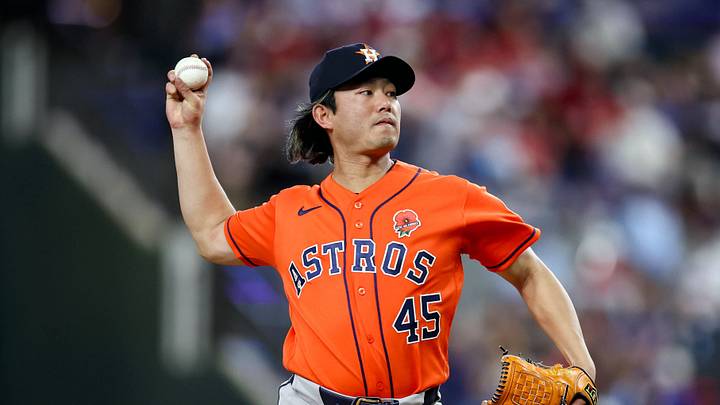
One of the longest gaps between no-hitters in MLB history finally came to an end on Monday night, when the Houston Astros held the Texas Rangers out of the hit column in a 9-0 win. But this wasn't just any no-hitter: While Tatsuya Imai threw the first six innings, he left after throwing 97 pitches, leaving two relievers — Steven Okert and Alimber Santa — to finish the job.
Alimber Santa completes the combined no-hitter for the @Astros!
— MLB (@MLB) May 26, 2026
This is the 18th no-hitter thrown in Astros franchise history! pic.twitter.com/XeHgqlOWZg
Here's how the final box score broke down:
- RHP Tatsuya Imai: 6 IP, 0 H, 4 BB, 2 SO, 97 pitches
- LHP Steven Okert: 1 IP, 0 H, 1 BB, 1 SO, 15 pitches
- RHP Alimber Santa: 2 IP, 0 H, 1 SO, 24 pitches
It's undoubtedly impressive, and it resets MLB's no-hitter clocker after almost two full years — the most recent no-no had been Shota Imanaga and the Cubs against the Pirates back in September of 2024. Solo no-hitters still far, far outnumber their combined counterparts, but the fact that the last two fall into the latter category is hardly a coincidence.
Every combined no-hitter in MLB history
Houston's no-hitter on Monday was the 21st combined no-hitter in Major League history. Here's the full list:
Date | Team | Pitchers |
|---|---|---|
May 25, 2026 | Houston Astros | Tatsuya Imai, Steven Okert, Alimber Santa |
July 8, 2023 | Detroit Tigers | Matt Manning, Jason Foley, Alex Lange |
November 2, 2022 | Houston Astros | Cristian Javier, Bryan Abreu, Rafael Montero, Ryan Pressly |
June 25, 2022 | Houston Astros | Cristian Javier, Hector Neris, Ryan Pressly |
April 29, 2022 | New York Mets | Tylor Megill, Drew Smith, Joely Rodriguez, Seth Lugo, Edwin Diaz |
September 11, 2021 | Milwaukee Brewers | Corbin Burnes, Josh Hader |
June 24, 2021 | Chicago Cubs | Zach Davies, Ryan Tepera, Andrew Chafin, Craig Kimbrel |
August 3, 2019 | Houston Astros | Aaron Sanchez, Will Harris, Joe Biagini, Chris Devenski |
June 12, 2019 | Los Angeles Angels | Taylor Cole, Felix Pena |
May 4, 2018 | Los Angeles Dodgers | Walker Buehler, Tony Cingrani, Yimi Garcia, Adam Liberatore |
September 1, 2014 | Philadelphia Phillies | Cole Hamels, Jake Diekman, Ken Giles, Jonathan Papelbon |
June 8, 2012 | Seattle Mariners | Kevin Millwood, Charlie Furbush, Stephen Pryor, Lucas Luetge, Brandon League, Tom Wilhelmsen |
June 11, 2003 | Houston Astros | Roy Oswalt, Pete Munro, Kirk Saarloos, Brad Lidge, Octavio Dotel, Billy Wagner |
June 12, 1997 | Pittsburgh Pirates | Francisco Cordova, Ricardo Rincon |
September 11, 1991 | Atlanta Braves | Kent Mercker, Mark Wohlers, Alejandro Pena |
July 13, 1991 | Baltimore Orioles | Bob Milacki, Mike Flanagan, Mark Williamson, Gregg Olson |
April 11, 1990 | California Angels | Mark Langston, Mike Witt |
July 28, 1976 | Chicago White Sox | Blue Moon Odom, Francisco Barrios |
September 28, 1975 | Oakland Athletics | Vida Blue, Glenn Abbott, Paul Lindblad, Rollie Fingers |
April 30, 1967 | Baltimore Orioles | Steve Barber, Stu Miller |
June 23, 1917 | Boston Red Sox | Babe Ruth, Ernie Shore |
You can see just visually how much this trend has shifted in recent years: Only four of the combined no-hitters in MLB history took place before 1990, and one of those (in 1917) was forced due to injury. Fully a third have come in the 2020s, including now three by the Astros alone.
Of course, solo no-hitters haven't fully gone the way of the do-do just yet; even now, they remain the more common version. But the trendline is clear, and it's not hard to see why.
Astros no-hitter is the continuation of a trend that's here to stay

Even 15 or 20 years ago, it would've been scarcely conceivable for a team to take out a pitcher with fewer than 100 pitches who was still working on a no-hitter. But times have changed, to say the least: These days, the cache of a no-no simply isn't what it used to be, and in this age of max velocity and pitcher injuries, all 30 teams will do whatever necessary to keep their starters as healthy as possible.
No longer will the New York Mets push Johan Santana beyond 120 pitches for a shot at immortality. There's too much invested in these pitchers, and they're too critical to their teams' success each season. Granted, we still know shockingly little about what causes pitcher injuries or how to keep them healthy over the long term. But it can't help to throw more pitches at max effort, let alone with fatigue affecting mechanics.
We haven't even seen a pitcher come particularly close to a one-man no-hitter in some time now. It's just too hard: Pitch counts are too tight, and the emphasis on swing-and-miss stuff means that pitchers move through games less efficiently than they used to. So we can celebrate Houston's achievement, certainly. But it also feels like a funeral of sorts, as one of baseball's most hallowed fraternities might close its doors for good.
 Add us as a preferred source on Google