
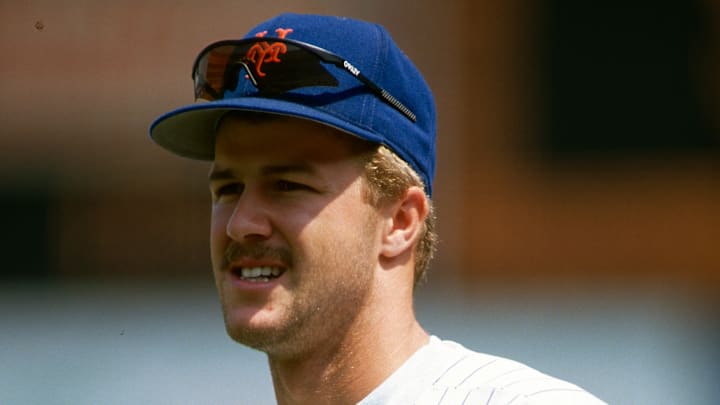
When the greatest living players in MLB history gather in Cooperstown, N.Y., next summer, they’ll do so honoring one of the premier players from the 1990s and 2000s. However, it won’t be Barry Bonds or Roger Clemens, unless they plan to attend as fans. Instead, the Hall of Fame will welcome former San Francisco Giants and Los Angeles Dodgers second baseman Jeff Kent into its ranks.
Kent’s election via the Contemporary Baseball Era Committee seemingly caught baseball fans on social media off guard. Although the five-time All-Star retired with the most home runs (377) by a full-time second baseman, he didn’t necessarily stand out as a likely Hall of Famer. The JAWS (Jaffe WAR Score system) lists his 44.4 bWAR considerably below the 69.5 bWAR that a Hall of Fame second baseman recorded. Kent averaged 3.9 bWAR over a 162-game season, while the other Hall of Fame second basemen averaged 5.1 bWAR.
So, why did 14 of the 16 voters believe that Kent was worthy of a Hall of Fame plaque? The numbers on the back of his trading card certainly helped.
Jeff Kent might be the final player elected to the Hall of Fame solely on counting stats
6/4/2000: In an 18-2 beatdown of the A’s, Jeff Kent homered twice for the Giants. He finished the year with 33 homers, 125 RBI, and the NL MVP Award. #SFGiants (via MLB) pic.twitter.com/qoeGuwM4MI
— MLB Daily Dingers (@MLBDailyDingers) March 21, 2025
We cannot stress enough that none of this is to say that Jeff Kent doesn’t deserve a spot in the Hall of Fame, nor are we saying that the committee got this one wrong. Typically, people aren’t elected to the Hall of Fame by accident. Yes, there are plenty of enshrinees whose inductions were questionable, but there’s a significant difference between “doesn’t deserve to be in the Hall of Fame” and “doesn’t meet most of the Hall of Fame standards.”
With that said, we feel that Jeff Kent was elected to the Hall of Fame largely because of his counting stats. That might be the same reason why Fernando Valenzuela, despite his unquestioned impact on the Dodgers and baseball as a whole, received fewer than five votes. The counting statistics simply weren’t there, and the voters likely felt that they couldn’t justify electing him for that reason.
Valenzuela retired with a 173-153 record, a 3.54 ERA, 41.4 bWAR, and 2,074 strikeouts in 2,930 innings. Let’s compare his case to that of longtime Seattle Mariners ace Félix Hernández, who is in his second year on the Hall of Fame ballot. When Hernández threw his final pitch in 2019, he had gone 169-136 with a 3.42 ERA and 2,524 strikeouts in 2,729 2/3 innings. Hernández might not have as many victories, and the ERA isn’t significantly better, but he recorded more strikeouts and a higher bWAR.

However, Hernández’s legacy is that he was among the first players to truly make voters reconsider the importance of counting statistics. Despite only going 13-12 in 2010, Hernández won the AL Cy Young Award because he recorded a 2.27 ERA in 249 2/3 innings and provided the Mariners with 7.2 bWAR. He earned 21 of 28 first-place votes, beating out Tampa Bay Rays ace David Price (19-6, 2.72) and New York Yankees star CC Sabathia (21-7, 3.18).
As of Dec. 9, 2025, Hernández had appeared on seven of the 14 ballots in Ryan Thibodaux’s Hall of Fame tracker. Keep in mind that Hernández appeared on 20.7% of ballots last year, nearly twice as many as longtime Chicago White Sox standout Mark Buehrle (11.4%), despite Buehrle recording 214 wins.
At some point within the coming years, the Contemporary Baseball Era Committee will be made up of Hall of Famers who primarily played in the era (1980 through now) that they’re voting on. When that time comes, we’d like to think that they’ll consider those who had a sustained dominant peak and played clean. Maybe someone like former New York Mets third baseman David Wright (who averaged 5.0 bWAR over a 162-game season, while the average Hall of Fame third baseman averaged 5.1 bWAR) will appear on the ballot, and the committee will evaluate his case with context and analytics rather than citing his six All-Star selections and 242 home runs.
More Houston Astros news and analysis:
 Add us as a preferred source on Google