
Key Points
Bullet point summary by AI
- John Sterling, the legendary Yankees radio broadcaster, passed away at the age of 87 on Monday.
- He called five World Series titles over his 36 seasons in the Yankees broadcast booth, becoming a voice for generations of fans.
- Sterling's infectious joy and iconic home run calls made him a beloved figure, even during the team's darkest eras.
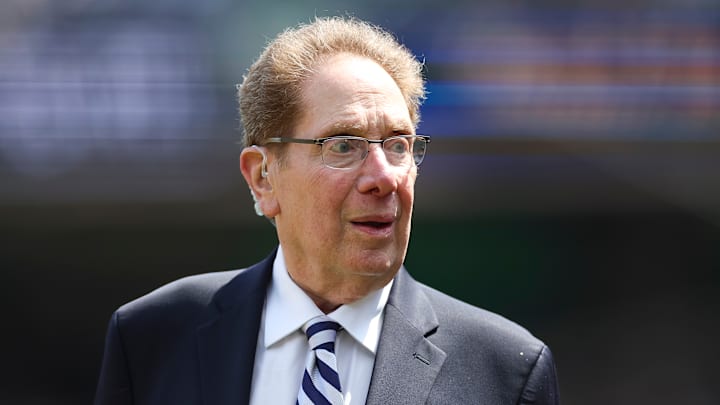
It's natural to want to start at the end. As remembrances pour in from around the baseball world for John Sterling, the legendary Yankees radio broadcaster whom the team announced on Monday had passed away at the age of 87, they'll understandably focus on the version of him that exists in everyone's imagination. The man with the booming voice, the dizzying array of bespoke home run calls — "Bern, baby, Bern" has always been and always will be at the top of my personal list — and the ability to fit a seemingly impossible number of syllables into "the Yankees win".
And for good reason; there are very few broadcasters who manage to worm their way into the public consciousness, and Sterling was one of them. But as I look back on the man who served as the soundtrack for my burgeoning relationship with baseball, as a kid growing up in suburban New Jersey, I'd like to start closer to the beginning.
John Sterling was more than a catchphrase — he gave voice to a generation of Yankees fans

Sterling rose to fame amid a golden age of Yankees baseball, calling five World Series titles in his 36 seasons — and some 5,631 games in all — in the broadcast booth in the Bronx. But it's worth remembering that, when he first took the job back in 1989, it wasn't a job that very many people actually wanted.
New York was in the midst of one of its darkest stretches in franchise history. The team hadn't reached the postseason since 1981, and the '89 campaign would mark the first of what would become four straight losing seasons. Just over a year after Sterling debuted, in July of 1990, his boss, owner George Steinbrenner, got permanently banned from the day-to-day management of his team after he paid a mobster some $40,000 to dig up dirt on Dave Winfield during a contract dispute. Once one of the sport's banner franchises, the Yankees had collapsed into dysfunction, a bloated mess both on and off the field.
But Sterling, who grew up on the Upper East Side of Manhattan listening to Yankees games on the radio, didn't much care. This was his dream job, the reason he'd gotten into broadcasting in the first place, and he approached it with a joy that was infectious — no matter what New York's record was. The home run calls and the postgame celebration are transparently silly, sure, but they took on a life of their own because they were organic, a natural extension of just how much he loved his team and how badly he wanted to see them succeed.
That was what drew myself and so many other Yankees fans to him in the first place, and that's how I'll remember him. Yes, he was hardly a technician in the booth; he would misidentify pitches and make routine fly balls sound like potential home runs, especially toward the latter stage of his career. But if that bothered you, you were focused on the wrong stuff.
Because Sterling was, in the best sense of the phrase, all of us; he sounded like what we would sound like if someone had stuck a microphone in front of us and asked us to describe Charlie Hayes squeezing the final out of the 1996 World Series — a moment at which "the Yankees win!" really did seem like a miracle worth stretching into infinity — or Bernie Williams walking off Game 1 of the 1999 ALCS. He got the big stuff, the emotional tenor of the moment, exactly right, and those championships of my childhood wouldn't have meant quite as much without him.
 Add us as a preferred source on Google