
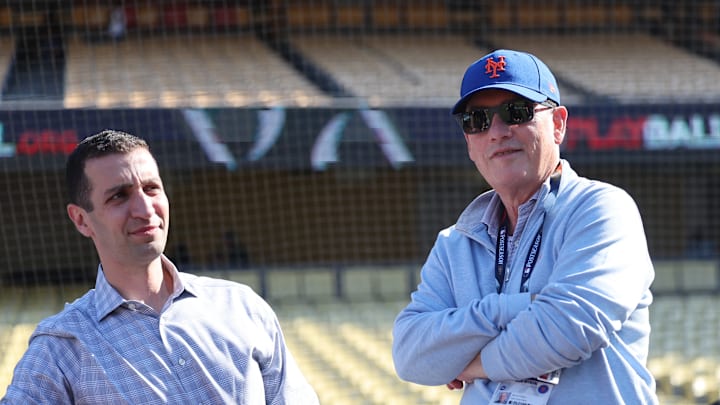
In the end, much like how leopards cannot change their spots, the New York Mets cannot change their nature. Only one year after breaking the bank for All-Star outfielder Juan Soto, the Mets allowed first baseman Pete Alonso — himself a five-time All-Star and the team’s all-time home run leader — and closer Edwin Díaz to depart in free agency, with the two agreeing to terms with the Baltimore Orioles and Los Angeles Dodgers, respectively.
Unsurprisingly, Mets fans are running out of patience with Cohen and president of baseball operations David Stearns. It was bad enough that the Mets pulled off one of the greatest collapses in recent memory, losing 13 of their final 20 games and missing the playoffs entirely. Now, not only are Alonso and Díaz gone, but the Mets previously traded longtime outfielder Brandon Nimmo to the Texas Rangers for veteran second baseman Marcus Semien.
Cohen arrived in 2020 with a vision for the Mets, one where the team would spend and do whatever it took to win after years of the Wilpons typically playing things safe. However, the past month could have significant ramifications on the Mets’ short- and long-term futures, and commissioner Rob Manfred should be concerned.
If Mets fans remain angry with Steve Cohen and David Stearns, attendance could suffer in 2026
Last season marked the first time since 2009 that the Mets drew at least 3 million fans, and it was hard to blame them. Soto joined Alonso, Nimmo, Francisco Lindor, and Jeff McNeil in an already-potent lineup. The Mets were fresh off an NLCS appearance and were considered among the top threats to dethrone the Dodgers.
It’s hard to see some of those same fans returning to Citi Field in 2026, at least if this week is anything to go by. WFAN’s Evan Roberts publicly called out Cohen and Stearns, warning them that attendance will suffer next year. Barstool’s Frank “The Tank” Fleming unleashed several rants, including an X/Twitter livestream that had over 34,000 viewers at one point.

Social media doesn’t always tell the whole story, and neither do WFAN callers, about how angry a fanbase is. At the same time, Mets fans are among those who have historically put their money where their mouth is. Throughout the 2010s, the Mets perennially ranked in the middle of the pack in attendance, which should never be the case for a team playing in the New York metropolitan area.
Keep in mind that the Mets, unlike the Brooklyn Nets, were never truly among the league’s worst teams in that time. Only once from 2010 through 2019 did the Mets lose at least 90 games. In fairness, the Mets certainly had their share of embarrassing moments in that time, as Mike Francesa will attest to, but things were never as bad as what Rockies and Pirates fans have endured. The bottom line is that Mets fans understandably didn’t go to games partly because they had lost faith in ownership and management.
Manfred has touted baseball’s strong attendance in recent years, especially after the pandemic. The idea of a team in a major market and with one of the sport’s highest payrolls potentially suffering a significant drop in attendance, partly because they didn’t retain two of their best players — and traded a fan favorite who had been in the organization since 2011 — is troubling to consider.

The irony is that I think the Mets were right to let Alonso walk. Teams will never learn the inherent damage in giving contracts exceeding four years to players in their 30s. The counter, as I’ve argued before, is that all is forgiven if the team in question wins a championship. However, the Mets still need to go through the Phillies in the NL East, not to mention the Dodgers.
Regardless, the Mets have clearly alienated a segment of their fanbase, and we won’t be surprised to see far more empty seats at Citi Field next summer. Add in the fact that a lockout is potentially on the horizon, and Manfred should keep his fingers crossed that other stadiums leaguewide see an increase in fans drawn and tickets bought. Otherwise, the league could have far greater problems than allegations of the Dodgers breaking baseball.
More MLB news and analysis:
 Add us as a preferred source on Google