

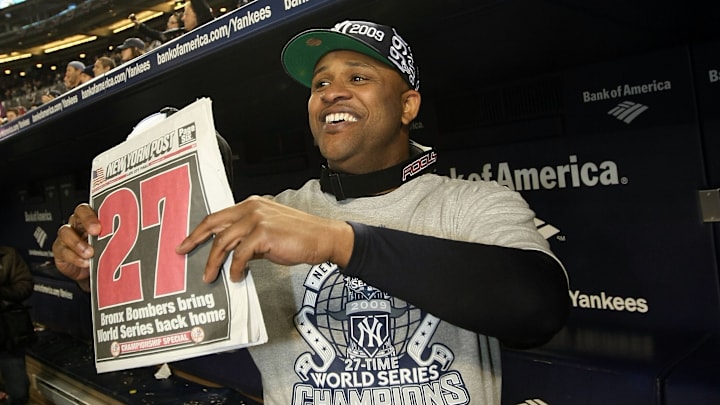
On Monday evening, the New York Yankees announced that they'd be retiring CC Sabathia's No. 52 jersey during the 2026 season. Sabathia will be celebrated during a ceremony on Sept. 26 that will also include his very own plaque in Monument Park.
For most franchises, this sort of thing is cause for celebration and the warm embrace of nostalgia. But this is the Yankees we're talking about, and so of course fans and media members managed to turn it into one more thing to yell at each other over.
CC Sabathia was a great player in NY, pivotal to 2009 WS title .. should be universally respected and praised for his time in NY .. but you can't convince me that his number should be retired
— Ian Begley (@IanBegley) February 26, 2026
I don't mean to pile on Begley specifically here, he's just a high-profile example of a sentiment that has been all too common since the announcement was made: that Sabathia, while no doubt beloved for his time in the Bronx, fell short of the greatness necessary to warrant this sort of honor. That while other franchises might treat number retirements casually, Monument Park — the eternal home of Ruth, Gehrig, Mantle, DiMaggio — was different.
To which I say: Can we please get over ourselves? Maybe I'm simply being a prisoner of the moment, or clutching my particular generation and my particular fandom too tightly. But as a Yankee fan for my entire 34 years on this Earth, it's hard to think of someone who more embodied everything I want this franchise to memoralize.
CC Sabathia's contributions to the Yankees go far beyond the box score

For starters, Sabathia's on-field contributions to the Yankees are being understated a bit in this debate. After signing with New York ahead of the 2009 season, he spent the next four years as one of the preeminent workhorses in the sport:
CC Sabathia stats, 2009-2012
- 905 innings (third among qualified starters)
- 3.22 ERA (16th)
- 3.28 FIP (13th)
- 21.2 fWAR (7th)
And on top of all that, he saved his best for the biggest moments, a prequisite for playing in New York. He posted five straight quality starts to help deliver the Yankees their most recent championship in first year with the franchise, then almost single-handedly carried the team to the ALCS in 2012.
From there, substance-abuse issues threatened to derail his career, and his performance declined dramatically across 2013, 2014 and 2015. But to his immense credit, Sabathia recognized he had a problem and did what he needed to do to get help and get better. And over the final stretch of his career, he turned himself back into an above-average starter (a 3.76 ERA and 115 ERA+ across 481.1 innings from 2016-2018) through little more than grit and gumption.
Four seasons as one of the very best at your position, plus three more good ones, is quite the resume, especially when you add a World Series parade to the equation. But anyone old enough to remember the Sabathia era knows that what he meant to the Yankees goes far beyond anything that can be captured on his Baseball-Reference page.
It's easy to forget now, but New York was in a bad way at the end of the 2008 season. They'd just missed the playoffs for the first time since 1993, and they hadn't won a postseason series since 2004. The Core Four was on the decline, and the half-hearted attempts to replace them had resulted in an aging team with a pitching staff on its last legs.
Into that mess stepped Sabathia, the first of the three big-ticket free agents (along with Mark Teixeira and AJ Burnett) to commit to New York that winter. And he brought much more than just his electric left arm: He brought a seriousness that had been sorely lacking, a reliability but also an intensity that left no doubt about who the leader in the clubhouse was. With Sabathia at the helm, everyone else fell in line, confident that the big man always had their backs.
Who knows what would've happened had he chosen to stay close to home in California and sign with the Angels? The other pitching options that winter were grim; it's more than likely that New York continued to slip further from the top of the AL. That, as much as 2009 or anything else, is Sabathia's legacy: He put a wobbly franchise back on firm footing. And that puts him right alongside plenty of the 23 other men who've had their jerseys retired in Monument Park.
Yankees fans need to adjust their understanding of Monument Park

I understand the appeal of Monument Park's mystique: The greatest players in Yankees history are some of the foundational figures of the modern game, a claim that few if any franchises can make. That's special, much as it might make other fans around the league roll their eyes, and it should be protected and cherished.
But it's also worth noting that Monument Park's reputation doesn't quite line up with reality — or at least it hasn't for a long time. Go back and look at that list of 24 names again: The 29.4 bWAR Sabathia accrued with the Yankees compares pretty favorably to guys like Paul O'Neill (26.7). Heck, it's not that different from the likes of Andy Pettitte and Ron Guidry: Each of whom threw more innings with the team but have comparable ERA marks (112 ERA+ for Sabathia vs. 115 for Pettitte and 119 for Guidry) and had similarly short peaks followed by years of being good but not great.
And no one is wringing their hands about any of the above names having a plaque of their own. Because what matters here is not some referendum on historical value. At the risk of lapsing into vibes-based thinking, what matters is how a player feels — what they meant, on a daily basis, to their team and the fans who watched them. By that metric, anyone who cheered on Sabathia in the Bronx would know that he passes with flying colors.