
While Spring Training continues to ramp up, extension season is in full swing around MLB, as all 30 front offices know they've only got a few weeks ahead of Opening Day to try and lock up their homegrown talent to potentially team-friendly deals. And with a new generation of young stars coming down the pipe, there are some big names who could be line to get paid.
Our MLB insider Robert Murray recently took a look at five of them, canvassing executives and agents around the league to get a sense of where their extension talks stand this spring. There's plenty of good intel about players like Nick Kurtz, Pete Crow-Armstrong and Konnor Griffin, but we thought we'd take it one step further: What would it actually take for teams like the A's, Cubs and Pirates to get a deal done before the season begins? Just how much money are we talking? Using Murray's info as a guide, let's dive in.
1B Nick Kurtz, Athletics
Potential extension: 10 years, $190 million (opt out after year seven)
Likelihood: 3/10
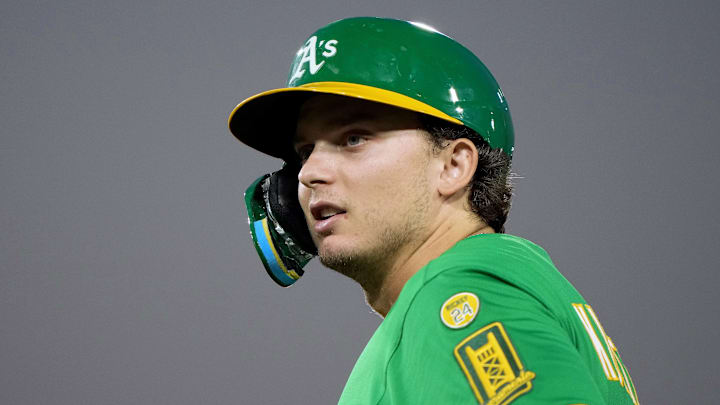
The A's have locked up just about every other member of their promising young core. But the crown jewel is Kurtz, who wasn't just great as a rookie last season — he put together one of the best first seasons in the Majors we've seen in recent history, including 36 homers in just 117 games.
No doubt the team would love to sign him to an extension as well. But there's just one problem: It's almost impossible to find a first baseman this good, this fast who signed an extension that could serve as a starting point. Murray surveyed agents around the league to try and find out what a deal might look like, and the responses ... well, let's just say A's fans shouldn't hold their breath.
“Kurtz is 22 with a year of service,” one agent opined. “He has five more years until free agency. He would be a 28-year-old free agent. They’d have to do a monster deal, IMO. No way you let the Rookie of the Year give away ages 29, 30, 31 for cheap. I would say if it’s not a 10-year deal, kick rocks.”
Said another agent: “If he waits, he could get a Juan Soto type deal.”
Soto is obviously hyperbole; that was a black swan event that likely won't come around again, and Kurtz still has a way's to go to prove he's at that level as a hitter. But it does reinforce the idea that the A's are going to have to blow his camp out of the water in order to get him to sign away any of his free agency years. Julio Rodriguez signed a seven-year, $119.3 million extension after his sensational rookie season that could be worth north of $200 million if he opts into the final five years. We'll use that as a rough comp, with some taken off the top because Rodriguez is an excellent defender at a premium position.
OF Pete Crow-Armstrong, Chicago Cubs

Potential extension: Seven years, $125 million (club option for year eight)
Likelihood: 6/10
Rodriguez was a more proven player (and a better prospect) when he signed his extension. Corbin Carroll signed an eight-year, $111 million extension with Arizona before the 2023 season, but he'd played just 32 MLB games at that point. Jackson Merrill had played just one full season before the Padres locked him up for nine years and $135 million (with a team option for year 10 that would bring it north of $150 million).
PCA, by contrast, has played 280 games over the last two years. Something in between those two numbers seems right: Crow-Armstrong's defense gives him a high floor, but he also wasn't the prospect that Carroll was and comes with some question marks about his bat. The above deal buys out two or three free agency years while still allowing him to hit the market before he's too old to cash in. And unlike Kurtz, he has enough uncertainty in his game that he might be more willing to consider signing now rather than playing the waiting game.
SS Konnor Griffin, Pittsburgh Pirates

Potential extension: 10 years, $130 million (opt out after year eight)
Likelihood: 4/10
Our own Zach Rotman recently pegged a Griffin extension at 10 years and $130 million, with the ability to opt out after eight years. The record for a player yet to make their MLB debut belongs to Jackson Chourio, a former uber-prospect himself who inked an eight-year, $82 million deal with the Milwaukee Brewers ahead of his rookie season that also included a pair of $25 million options in years nine and 10.
Griffin is a better prospect than Chourio, one of the best we've seen in recent memory. So we'll tack on some more money, and instead of club options, we'll give him the power to opt out and hit free agency after eight years — at which point he'll still be just 27/28 and more than capable of landing another huge deal if he becomes the sort of player we expect. This deal allows Griffin to have his cake and eat it too, making plenty of money up front without sacrificing a ton on the back end. The only real question is whether the Pirates want to spend that kind of money.
RHP Hunter Brown, Houston Astros

Potential extension: Six years, $140 million
Likelihood: 1/10
The two most important words to consider here? Scott Boras. Brown is now represented by MLB's preeminent super-agent, which means he's pretty unlikely to eschew free agency just three years away from hitting the market (and with arbitration payments about to kick in).
Houston will no doubt try, because Brown has become that good and is that important to the team's future. But even the deal above, while bigger than extensions to comps like Sandy Alcantara (five years, $56 million one year before winning the NL Cy Young) and Logan Webb (five years, $90 million), probably won't be enough to convince him to sign away his market value.
As one agent told Murray: “Jose Berrios signed for seven years, $131 million with four years of service. Boras would laugh at that.”
3B Junior Caminero, Tampa Bay Rays

Potential extension: Nine years, $175 million (opt out after year seven)
Likelihood: 1/10
"Multiple league sources to believe that Caminero’s eventual extension would likely start at roughly $400 million," Murray writes, adding that an extension does not seem to be in the cards any time soon.
If that's the price tag, he's certainly right. But Caminero is still two years away from the start of arbitration and five years away from free agency; it's going to be a long time before he sees significant money, no matter how good he was last season. A structure similar to the Rodriguez extension, which gets him big cash up front and includes an opt-out that gives him flexibility in the future, could make sense. Then again, he might just keep betting on himself, confident that a third baseman with 40-homer power hitting the market ahead of his age-27 season could cash in the way Bo Bichette ($42 million AAV), Kyle Tucker ($55 million AAV) and Vladimir Guerrero Jr. ($500 million guaranteed) did.
 Add us as a preferred source on Google