
Key Points
Bullet point summary by AI
- The Boston Red Sox made a bold decision by trading their star slugger last offseason, surprising many fans.
- Recent performances have highlighted challenges the former designated hitter faces, impacting his new team's start.
- This rough beginning validates the front office's strategy and shifts focus away from Boston's current roster decisions.
Boston Red Sox fans are jumping with glee right about now, and it’s not about the team itself after a 1-2 start to the season. It’s about the foresight Boston’s leadership had to realize enough was enough with Rafael Devers. The shockingly sudden move to send the $300 million slugger to San Francisco reeked of desperation … at first. Now, almost a year later, Red Sox fans feel vindicated. They no longer feel mixed emotions about losing Devers; they’re content.
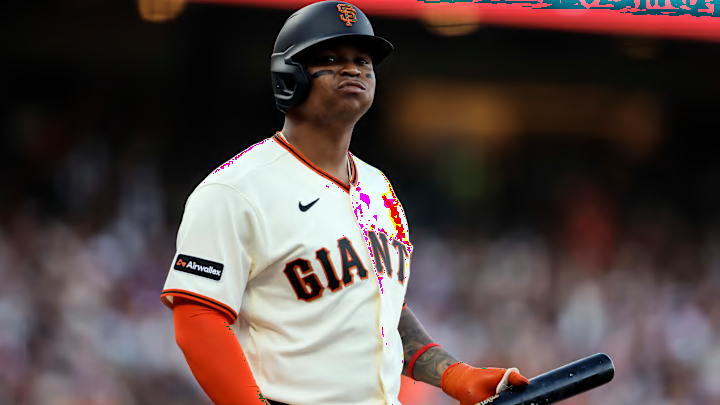
Devers started the season as designated hitter while he’s dealing with hamstring tightness. First-year Giants manager Tony Vitello said they’re in no rush to get Devers back in the field, meaning that the one position he didn’t want to play in Boston is what he’s been reduced to — and that could end up being full time. Either Devers is extremely unlucky, or it’s karma in the worst way.
Rafael Devers’ slow start to 2026 proves why Boston was right to trade him
One of Devers’ most alarming stats this season is his zone contact rate. According to FanGraphs, about 52 percent of the pitches Devers is seeing are inside the strike zone. Yet, he’s only making contact on 57.9 percent of them. The contrast to that? He’s making contact with 77.8 percent of the pitches outside the zone. Essentially, he’s taking a lot of bad swings. He could probably get away with that if he was a field player. But his only job is to hit the ball, and he’s not swinging it particularly well.

These are things Boston fans don’t miss, the inconsistent batting and cold stretches which are starting to become a trend for Devers. He’s the Giants’ problem now, and Red Sox fans couldn’t be happier.
Devers is slashing .250/.250/.333 with three hits in three games. The Giants have scored one run all season, and Devers is partly to blame for that. He doesn’t have any home runs and just one extra-base hit, a double on Saturday night. Devers arrived in San Francisco as a potential savior for a team on the cusp of contending for the NL West race. Now, Giants fans are wondering if he’ll ever have the impact they wanted him to.
Can Devers break his rough stretch?
The good thing for Devers is the season’s long, and in just three games, it’s hard to truly say a trend is setting in. His time as a designated hitter should give him all the time he needs to focus on better contact in the zone. His problem isn’t identifying pitches to attack, as he’s swinging at 76 percent of pitches in the zone. The problem is he’s not making contact.

It also should be of note that Devers usually punishes the New York Yankees, but struggled in the Opening Weekend series. That’s not to say he’s doomed, but if he can’t hit against the one team that probably fears him the most, it’s a sign he’s going through some struggles.
Time is on his side; after all, he had a slow start when he arrived in the Bay Area before he finally found his footing. He just might need that luxury again this time around to get back to his usual fierce hitting ability. One of his strengths through this slump is he’s still making contact with pitches outside the zone. But the fact that he’s been struck out (four) more times than he’s gotten a hit (three), that’s proof he needs better plate discipline. It’s the one thing the Red Sox can be happy about, it’s not their problem anymore. .
More MLB news and analysis
 Add us as a preferred source on Google