
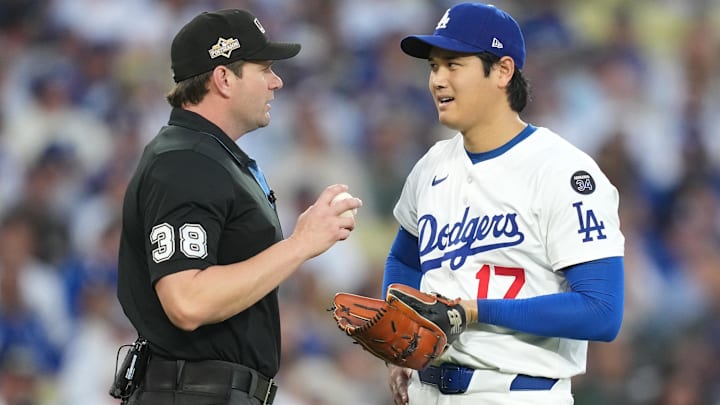
MLB home plate umpires missing calls behind the dish is as frustrating an event as any for fans, players and managers to deal with. With that, having an automated balls and strikes (ABS) system in place makes it so that fewer games are swung by bad decisions.
But how does this new ABS system work? We've seen it in Spring Training before, but now that it's set to be used in regular season action for the first time, let's dive into everything you need to know.
How MLB's new ABS system works

The vast majority of every game will be played the exact same way. There is still a home plate umpire standing behind the plate and calling every pitch a ball or a strike. What's changed is the new ABS system, which can now be used to challenge calls the umpire makes. Here's how that system works.
Who can challenge a call?
A hitter, pitcher or catcher can challenge any ball or strike call as long as the challenge attempt comes within a second or two of the original call. This is done by the player tapping his hat or helmet. From then, the home plate umpire will stop play and wait for the review to take place.
How does a challenge work?
The review will take place on the stadium's Jumbotron and show the ball crossing the plate against a strike zone customized to fit the height of whichever hitter is at the plate. The replay will show whether the call on the field was correct or not, and the count will adjust accordingly.
How many challenges does each team get?
Each team gets two challenges per game. If the call made on the field stands, the team that requested a challenge will lose one of them. If the call made on the field is overturned, the team that requested a challenge keeps it. A team can challenge as many times as it likes, so long as the challenges are successful, but it can only lose on two challenge attempts.
How does this work for extra innings?
An interesting wrinkle is that teams that are without a challenge will still gain an extra one for extra innings. The challenges will not accumulate, meaning teams will only have more than one challenge in extra innings if they had their original two challenges in place.
Is there any instance in which challenges can't be used?
Pitches cannot be challenged if a position player is on the mound or if a team has run out of challenges. Those are the only two instances in which a called pitch cannot be challenged.
Pros and cons of the new ABS system

Like any new implementation, nothing is perfect, but the ABS system offers the best of both worlds for both baseball purists and those who are searching for perfection.
For the former, home plate umpires are still in place with an important job to do. They will still call every pitch as they deem fit; nothing changes in that regard, and they'll still hold a ton of sway over a given game. The only real change is that on rare occasions, a call can be challenged. That doesn't feel like the end of the world.
For those searching for perfection, no, teams don't have an unlimited number of challenges. But if challenges are used strategically, the truly egregious calls in high-leverage spots will go by the wayside. That's a huge win.
Perhaps the best part of the ABS system is that replays won't take too long. According to MLB.com, there were an average of 4.1 challenges per game in the Minors last season, and those challenges took an average of 13.8 seconds. This means games saw roughly 57 seconds of added time. That extra minute sure feels worth it.
More MLB news and analysis:
 Add us as a preferred source on Google