
Key Points
Bullet point summary by AI
- The Los Angeles Dodgers face questions about Roki Sasaki's control ahead of the season opener against Arizona.
- Despite a rough spring showing, the pitcher's camp insists these results don't reflect his true potential or readiness.
- And Sasaki isn't the only impact player who has struggled through Spring Training for easily explainable reasons.
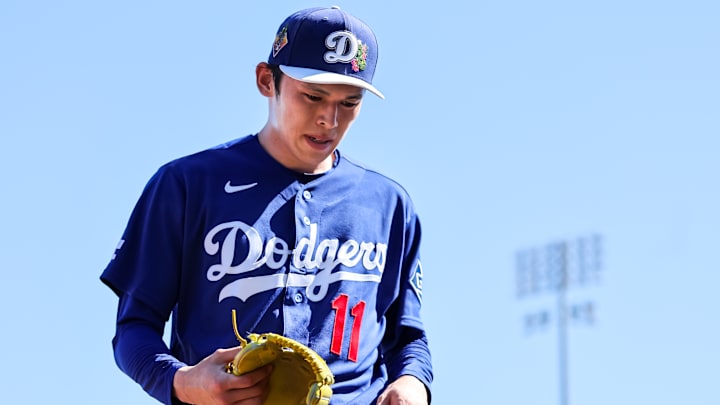
In Los Angeles Dodgers pitcher Roki Sasaki’s eyes, a difficult spring training isn’t at all a big deal, even following a frustrating rookie season.
After his first big-league campaign was marred by injuries and control problems, Sasaki has again failed to hit the strike zone this spring. He gave up three earned runs and four walks in Tuesday’s 10–4 victory over the Kansas City Royals, his final spring start before the Dodgers open the season against the Arizona Diamondbacks next Thursday.
“I have a lot of things I need to work on,” Sasaki told reporters. “But it’s just Spring Training, so just keep continuing to work on that. The results in Spring Training don’t really matter.”
If I’m a Dodgers fan, that’s the last thing I want to hear Sasaki say. He’s essentially dismissing and excusing his poor stats and continued lack of control when he doesn’t have the established resume — at least, at the MLB level — to do so. A veteran pitcher, even those who are a No. 4 or No. 5 starter, can get away with saying that. Sasaki can’t, nor should he.
An optimist, though, might agree with Sasaki and his point that spring training struggles don’t matter. We’re sure that some of the other noteworthy players having a difficult time in Florida or Arizona might agree, but are they justified?
For this list, I’ve ranked players alphabetically, included their stats, and asked a simple question: Should we be worried? I’ve also included one player who participated in the World Baseball Classic for reasons I’ll explain momentarily.
Bryce Harper, 1B, Philadelphia Phillies

Stats: 3-for-8 (.375) with a home run, four RBIs, a 3–3 K–BB ratio, and a 1.500 OPS in 12 plate appearances (Spring Training); 5-for-28 (.214) with a home run, three RBIs, an 8–1 K–BB ratio, and a .624 OPS in 30 plate appearances (World Baseball Classic)
Should we be worried? No. Harper looked fine early in spring training, and his WBC wasn’t as bad as social media would have you believe. Granted, the narrative slightly changed after his two-run homer in the title game loss to Venezuela, but I’m not concerned.
Although he missed a significant part of the spring while at the WBC, I felt that it was important to include Harper here given the added pressure he’ll face this season. Not only have the Phillies failed to win a title since he arrived ahead of the 2019 season, but the club ensured Kyle Schwarber and J.T. Realmuto stayed put. Add in Harper’s public war of words with Phillies lead baseball executive Dave Dombrowski last offseason, and you’ll understand why the heat in Harper’s kitchen is as hot as it’s ever been.
Dylan Crews, CF, Washington Nationals

Stats: 3-for-28 (.107) with no home runs, two RBIs, a stolen base, and a .295 OPS in 32 plate appearances.
Should we be worried? Yes. The Nationals are poised to be among the league’s worst teams, and I’m gradually losing hope in Crews becoming the next face of the franchise. It feels like Washington rushed Crews, the No. 2 pick in 2023, to the majors too early, and his inability to reach base this spring is especially concerning.
There haven’t been any credible reports about Crews potentially starting the season at Triple-A, but it’s a thought the Nationals must consider. Maybe Crews needs a harsh reminder of what happens when one doesn’t produce at the big-league level, regardless of their pedigree or status as a top draft pick.
Josh Naylor, 1B, Seattle Mariners

Stats: 2-for-21 (.095) with no home runs, one RBI, a 5–1 K–BB ratio, one stolen base, and a .231 OPS.
Should we be worried? No. Naylor has hit .275 with an .801 OPS since becoming a full-time player with Cleveland in 2022. He provided the Mariners with 1.4 fWAR in 56 games after arriving during last season’s trade deadline. Although he turns 29 in June, Naylor may just be hitting his stride as a reliable middle-of-the-order bat.
Even if you believe that Naylor is due for some regression, I’m skeptical things will be that bad. Don’t read too much into his slow spring, especially considering that teammate Cal Raleigh was competing in the WBC.
Luis Gil, P, New York Yankees

Stats: 2–1 with a 6.28 ERA (10 runs allowed in 14 1/3 innings), a 17–4 K–BB ratio, and six home runs allowed.
Should we be worried? Maybe. The good news is that there haven’t been any reports about Gil being injured, and he still has minor-league options. If Carlos Rodón and Gerrit Cole return by mid-May as expected, then the Yankees can demote the 2024 AL Rookie of the Year if needed.
However, the six homers allowed definitely gives me pause. In April alone, Gil runs the risk of facing Junior Caminero, Mike Trout, Salvador Perez, Bobby Witt Jr., and Yordan Alvarez, among other terrifying power hitters.
With that said, the Yankees’ priority should be having Gil in the Opening Day rotation. From there, the Yankees simply need him to be healthy and competent.
Roki Sasaki, P, Los Angeles Dodgers

Stats: 1–0 with a 13.50 ERA (10 earned runs in 6 2/3 innings) and a 10–9 K–BB ratio.
Should we be worried? Yes. When I watch Sasaki, I feel like I’m watching a younger Kei Igawa. For those unfamiliar with Igawa, his path was somewhat similar to Sasaki: Both were impressive Japanese pitchers who, while they weren’t established Japanese superstars the way Daisuke Matsuzaka or Yoshinobu Yamamoto were, nonetheless arrived in the U.S. with high expectations.
With Igawa, though, it became apparent that the Yankees had buyers’ remorse only a few weeks into the 2007 season. Igawa struggled with control and was demoted to the minors in early May. He made it back to the majors later that year but never regained his spot in the rotation. Igawa pitched a couple games in 2008 and spent all of 2009 through 2011, the final years of his contract, in the minors and refusing to return to Japan.
Both Igawa and Sasaki were extremely prone to walks, and both looked uncomfortable on the mound. Talent is one thing, but lack of confidence and control is another conversation entirely. I’d like to be wrong about Sasaki, though I don’t believe he’ll succeed as a starter. Whether or not he’d be better off out of the bullpen remains to be seen.
More MLB news and analysis:
 Add us as a preferred source on Google