
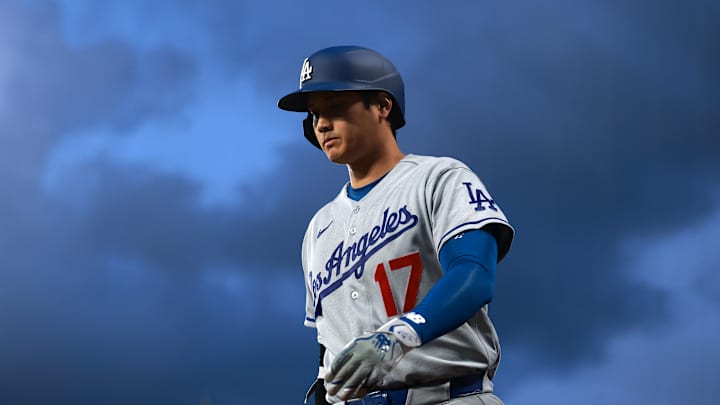
GOAT debates are a form of high art (and occasional trench warfare) in sports media. But you really have to call in the artillery when there are calls for a current player to be named the Greatest of All Time. Right now? We have Shohei Ohtani, and I’m rolling out the heavy rhetorical guns.
There is a simple question every prospective GOAT has to answer: when you retire, will everyone unanimously agree that you were the Greatest of All Time? If Ohtani retired right now, frankly, nobody would say that. I think it’s possible, but we need to look to history (and other sports) to see what Ohtani would actually have to numerically accomplish to get this done. Spoiler alert: it’s not going to be a slam dunk. Or a … home run. That’s probably a better analogy for this situation.
Historical GOAT debates are often unclear, especially in baseball

We have had, by my estimation, approximately four GOAT debates in American sports in the last 30 years — in order: Wayne Gretzky, Barry Bonds, Tom Brady and LeBron James. One (LeBron) is ongoing, and Shohei is looking to become the fifth member of this exclusive group. So how did each one go, and what can we learn for Ohtani’s case?
First and foremost, Gretzky was the all-time no-brainer — the NHL literally retired his number 99 across the entire league and bypassed the mandatory waiting period for the Hall of Fame. Pack it up. Brady was also mostly a no-brainer, especially in football, the sport where the greatest player must be a quarterback and winning Super Bowls are considered the most important measure of a quarterback’s success. There were (and still are) some people who tried to hang on to Joe Montana for a while, and some who like to point to Jerry Rice’s receiver stats being out-of-this-world, but nobody serious denies Brady is the GOAT.
LeBron is a bit of an awkward case. When he retires, there will be plenty of people who declare him the greatest player of all time — and he probably had the best career. But I don’t know if he ever did something sufficiently spectacular to break the assumption barrier that Michael Jordan has held since he retired. And if anything, the lack of unanimity when he retires is a knock against his case.
The MLB's GOAT is the least settled in sports

Then there’s Bonds, the most useful for our Shohei purposes and also the worst possible outcome for a GOAT debate. There really isn’t any statistical case that anyone not named Barry Bonds is the greatest hitter of all time, but plenty will make the pharmaceutical case. Even those who don’t try to export the whole steroid era as a PDF and then drag it into their laptop’s garbage can, very few earnestly refer to Bonds as the GOAT, given the baggage associated with him. He is not (and perhaps never will be) in the Hall of Fame, and Joe Posnanski’s recent book ranking the best MLB players of all time “The Baseball 100,” had Bonds at number three behind Babe Ruth and Willie Mays.
Bonds is a test case in how numerical achievement doesn’t actually guarantee you anything. People also have to respect you and venerate the things you’ve achieved. Nor does winning, like it did for Brady and Jordan, given that it would be quasi-impossible for a modern player to pass Yogi Berra’s 10 World Series rings. Baseball is too old and has had too many seismic shifts to rely on many statistical categories. For Ohtani to catch Cy Young’s complete game record of 749, he would have to pitch 748 more complete games.
If Bonds is out, then by my official calculations, Ohtani currently has three guys he needs to contend with to be considered in the MLB’s GOAT conversation: Hank Aaron, Babe Ruth, and Willie Mays. Ruth is the classical answer to this question and was (still is, but less so) a legitimately mythical figure in American sports and culture, while Aaron is generally held up as the greatest hitter of all time by those who reject Bonds. Willie Mays (Posnanski’s number one, though he pretty firmly refuses to call him the GOAT in the entry) perhaps defined baseball more than any player ever, and captured everything it means to be a baseball player in one career.
Ohtani is already a mythical figure like Babe Ruth, Hank Aaron and Willie Mays before him

Shohei is most often compared to Ruth because they both pitched and hit, and I don’t think that’s where the comparison stops. Baseball, despite advances in color television technology, is still a fundamentally local product. Unless you live in Los Angeles County, you probably don’t watch a lot of live Ohtani outside of the postseason. This makes his exploits, chiefly when he hit 50 home runs and stole 50 bases, pieces of folklore and myth, not unlike Ruth’s home run hitting which revolutionized baseball forever.
Ohtani is someone you hear about more than you see him. You imagine what is possible and what he could achieve. But he isn’t just like Ruth. He’s like Hank Aaron in that his swing looks like a Mack Truck hitting a baseball rather than a bat. He is like Willie Mays in that he is everything every kid wants to be on the baseball diamond, but has even redefined that — how many little leaguers think they can one day throw 100, strike out every batter, hit 50 home runs and steal 50 bases then win the World Series in the same year? How many thought they could do that before they heard about Ohtani?
The simple answer to the question of “what does Ohtani have to do to become the GOAT” is this: he needs to play for another 10-15 years until his mid forties and get his career stats up there with the all-timers, all of whom played for a shockingly long time. If Ohtani manages to pitch and hit at an elite level until he’s 45, he will probably retire the GOAT. The physiological possibility of that, though, seems almost incalculably low. In terms of numbers, it would be almost impossible for Ohtani to be statistically the GOAT — our existing stats don’t do a good enough job capturing how impactful a pitcher with a 0.28 ERA that hits the ball 500 feet is. That’s all true, it’s all fair, but it’s also boring.
Ohtani may already be the greatest to whoever wants him to be

The real answer is that he’s … kind of already the greatest? If not of all time (if such a thing is possible in baseball, the lack of agreement suggests it probably isn’t), then the greatest, at least, to some people. To me, maybe. He’s the greatest player I’ve ever seen. He’s what I think of when I think “baseball,” and the first player I’ll tell my kids about. Pretty soon, nobody alive will have seen Ruth in 1927 and so Ohtani will be the magical pitching-and-hitting impossibility that we can all look back on.
He is also one of baseball’s greatest international ambassadors, and will likely go down as the man who — even more than Ichiro Suzuki — brought baseball to more parts of the world and the world to American sports. Any lingering American chauvinism in sports cannot possibly survive Ohtani, who is so undoubtedly the greatest and so undoubtedly the coolest. That is a credit that is uniquely his.
I wouldn’t go around telling people on the street that Ohtani is the GOAT, but the fact that you can do that and nobody will get too angry at you is a testament to his already-cemented legacy. He is perhaps the most talented human ever to play baseball, and the length of his career will determine his position on the all-time charts — if talent alone were a measure of greatness, we would have many more GOATs. But Ohtani can already be the greatest to whoever wants him to be. In a sport that’s over 150 years old, that is a titanic achievement in its own right.
More MLB news and analysis:
 Add us as a preferred source on Google