
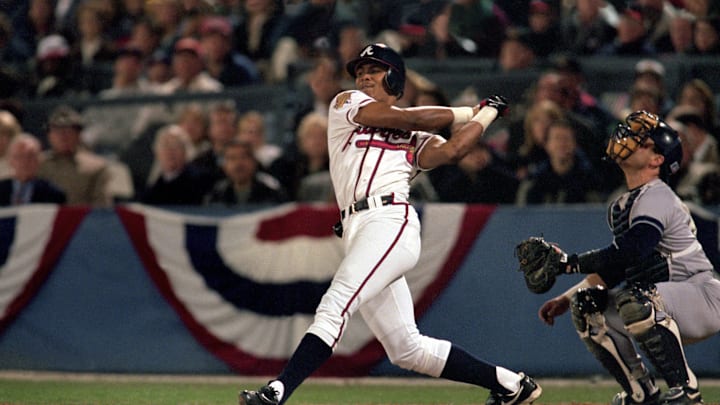
Next week, the Baseball Hall of Fame will announce which greats, if any, have made it to Cooperstown on the 2026 ballot. And as seems to be the case every year, the voting has done nothing but start arguments — both among fans and among BBWAA members themselves.
Which makes sense. The Hall is the sport's preeminent honor, and it matters who gets to call themselves a member of baseball's most exclusive club. Everyone has a different definition of greatness, and the game has changed so much over more than a century that comparisons can be brutally difficult.
Which is why we're here to help. Or, more accurately, why cold, hard data is here to help: Because what better way to determine which players at each position belong in the Hall? Just what numbers do make a Hall of Famer, and how has that changed over time?
Catcher

Total number of Hall of Famers: 20
Median bWAR: 53.7
Median WAR7 (the sum of a player's seven best seasons by WAR): 34.9
H: 1,740
HR: 197
RBI: 985
OPS+: 126
All-Star appearances: 8
It should come as no surprise that catcher has the lowest counting-stat (and WAR) benchmarks of any position on the field: Given the physical demands that come with playing behind the plate, and the fact that teams don't even let their primary catchers play every day now, it's simply hard to stay on the field for 15 years. It's also a position that lends itself to two-way greatness, with defense particularly valued.
Mike Piazza, Ivan Rodriguez and Joe Mauer are the only three catchers currently in the Hall to have played later than 1993. It's been a while here, and modern trends will only make it tougher. Piazza was a Hall-worthy hitter no matter where he played. Pudge was a legendary Iron Man, whose ability to hang around forever allowed him to clear certain statistical benchmarks (his 2,844 hits lead all catchers by a country mile). Mauer would seem to offer a more achievable blueprint: His time as an impact player was pretty much done by 30, but his MVP peak in his 20s was enough to earn him induction.
Two modern-day legends at the position, Yadier Molina and Buster Posey, will be eligible for induction in the near future. Neither of them meet the current WAR threshold at the position. Will it matter in the end? Or will Molina's all-around reputation and the heights Posey reached in his prime win out, as voters adjust their expectations for a new age?
First base

Total number of Hall of Famers: 28
Average bWAR: 64.9
Average WAR7 (the sum of a player's seven best seasons by WAR): 42
H: 2,313
HR: 331
RBI: 1,365
OPS+: 136
All-Star appearances: 5
No matter what era of the sport you played in, first base was a place where players mashed. And that leaves players with a much higher bar to clear, offensively speaking: Even guys who surpassed 400 homers in their careers, from Carlos Delgado to Paul Konerko to Mark Teixeira to Jason Giambi, have fallen off the BBWAA ballet without leaving much of a mark.
What does that mean moving forward? With over 500 homers and 3,000 hits, Miguel Cabrera will be a slam dunk as soon as he's eligible in 2028. But what about Cabrera's peers, players who were stars in their own rights but might not have the shiny statistical benchmarks to fall back on? Joey Votto won an MVP Award, but he currently sits with just 356 homers. Paul Goldschmidt might be in the same boat, unless he can really pick up his pace (he's at 372 right now).
Then again, Goldschmidt and Votto (and Freddie Freeman, who feels like a bit of an easier case given his postseason heroics) fare better when judged by a more holistic offensive metric like OPS+ — all three are at or above the Hall average the position, which wasn't true of Konerko, Teixeira and Ryan Howard. In this day and age, voters can be counted on to at least have the basics down.
Second base

Total number of Hall of Famers: 21
Average bWAR: 69.1
Average WAR7 (the sum of a player's seven best seasons by WAR): 44.1
H: 2,461
HR: 162
RBI: 1,133
OPS+: 116
All-Star appearances: 7
As we shift to the middle infield, the offensive benchmarks all lower a bit. If you stick at second base for an extended period of time, the defensive value that represents makes up for a lot — especially with a catch-all metric like WAR — and you can build a reasonable Hall case for yourself without clearing even 300 (or 250) homers.
Look no further than a couple of recent examples. Jeff Kent, inducted via the Contemporary Baseball Era committee this year, posted a 123 OPS+ for his career — very good, certainly, but hardly extraordinary in the history of the game. But it's so far above the baseline at second base that it was enough for the voters to overlook his iffy defense. Chase Utley only enjoyed five or six years of a true offensive prime, and yet he's surged in this third year on the BBWAA ballot, as voters rightly recognize that his spectacular defense makes his WAR case pretty open and shut.
That should mean good things for Jose Altuve whenever his time on the ballot rolls around. In a lot of ways, his candidacy mirrors Kent's: His career OPS+ of 127 is almost identical, and that should carry the day despite the fact that he was never really considered one of the best defenders at his position (and his career bWAR will likely fall short of the Hall average).
Third base

Total number of Hall of Famers: 19
Average bWAR: 68.9
Average WAR7 (the sum of a player's seven best seasons by WAR): 43.4
H: 2,234
HR: 234
RBI: 1,273
OPS+: 125
All-Star appearances: 7
Third base, meanwhile, is something of a middle ground: You don't have the truly big boppers like you do at first base, but the offensive bar is certainly higher. And that might cost a couple of players from this generation who felt like stars during their careers but may not have done enough to earn induction.
Manny Machado and Jose Ramirez should both earn their way in, as long as they can put up at least a couple more seasons like they have recently. But what about guys like Nolan Arenado and Evan Longoria? While Machado and Ramirez have remained valuable two-way players into their mid-30s, both Arenado and Longoria's offense fell off a cliff after their 30th birthday, and their offensive profiles might fall short as a result.
Arenado and Longoria each have a career OPS+ of 119 (and in Arenado's case, that number might keep sliding if he continues to play in 2026 and beyond). That's below the baseline at the position, and neither player stayed valuable enough in the second half of their careers to carry their WAR numbers across the finish line. They figure to wind up in the David Wright camp — though in Wright's case, it was simply injuries that derailed a Hall of Fame career.
Shortstop

Total number of Hall of Famers: 26
Average bWAR: 67.7
Average WAR7 (the sum of a player's seven best seasons by WAR): 43.2
H: 2,297
HR: 78
RBI: 927
OPS+: 114
All-Star appearances: 6
Shortstop is in the midst of a sea change, and it could radically alter the composition of Hall of Famers at the position. For decades, it looked a lot like second base above: Defense was the name of the game, and if you just held your own at the plate, you'd probably wind up in Cooperstown.
Now, though, shortstop is home to the sport's true unicorns, spectacular athletes who are stars both offensively and defensively. Exhibit A: Gunnar Henderson's 134 OPS+ is better than all but four current shortstops in the Hall. Of course, you do still need to stay on the field, and guys like Corey Seager, Carlos Correa and Trea Turner have seen Hall of Fame trajectories likely derailed by injuries (much like Nomar Garciaparra before them). But if players like Henderson, Bobby Witt Jr. and Francisco Lindor can continue their current two-way production while staying on the field in their 30s, their cases look pretty rock-solid.
Left field

Total number of Hall of Famers: 23
Average bWAR: 65.3
Average WAR7 (the sum of a player's seven best seasons by WAR): 41.7
H: 2,639
HR: 195
RBI: 1,208
OPS+: 133
All-Star appearances: 6
Left field has, in recent years, been home to players who are excellent hitters but maybe not such great defenders; think the likes of Albert Belle, Lance Berkman and Matt Holliday, all of whom had OPS+ marks at or above the 133 benchmark. And ultimately, that one-dimensionality, combined with great but not all-world offensive numbers, left them just short of making it to Cooperstown.
The reality is that, if you want to make it into the Hall solely on the strength of your bat, your bat needs to be incredibly good. That matters a great deal when thinking about active players like Yordan Alvarez and Christian Yelich, both of whom have already started the transition to full-time DH duties.
Center field

Total number of Hall of Famers: 24
Average bWAR: 71.3
Average WAR7 (the sum of a player's seven best seasons by WAR): 44.6
H: 2,253
HR: 111
RBI: 1,036
OPS+: 140
All-Star appearances: 5
Historically, center field has been sort of like what shortstop is today: It's where your best athletes play, and as such the bar is higher for Hall consideration than anywhere else. In fact, the WAR average is so high that only six of the 24 center fielders currently in Cooperstown have actually cleared it. Willie Mays, Ty Cobb, Tris Speaker and Mickey Mantle — all of whom cleared 100 career bWAR — have fully ruined the curve for everybody else.
In that context, someone like Andruw Jones, up for induction on this year's ballot, starts to look a lot more compelling. Jones' 62.7 bWAR is better than Kirby Puckett, and pretty much right alongside Duke Snider. The physical demands of the position made longevity difficult; just ask Ken Griffey Jr. or, more recently, Mike Trout. But the peaks are higher here than any other position.
Right field

Total number of Hall of Famers: 29
Average bWAR: 69.7
Average WAR7 (the sum of a player's seven best seasons by WAR): 42.2
H: 2,712
HR: 183
RBI: 1,305
OPS+: 134
All-Star appearances: 6
Again, there's a bit of a warping effect happening here, thanks to some guys named Ruth and Aaron and Musial. But as a general rule of thumb, you want to make sure that your OPS+ winds up somewhere north of 130. Players like Bobby Abreu, Dwight Evans and Bobby Bonds fell just short of that number and therefore just short of the Hall. For context: Bryce Harper's currently at 142, Juan Soto at 160 and Giancarlo Stanton at 137 (with the latter closing in on 500 homers). Even if Harper and Soto don't reach a round number like that, their cases will likely be fine as long as they don't fall off a cliff any time soon.
Designated hitter

Total number of Hall of Famers: 3
Average bWAR: 54
Average WAR7 (the sum of a player's seven best seasons by WAR): 33.4
H: 2,528
HR: 411
RBI: 1,552
OPS+: 136
All-Star appearances: 7
Granted, the sample size is awfully small here. Only three players are in the Hall as designated hitters: Harold Baines, Edgar Martinez and David Ortiz. And Baines should come with an asterisk, given that his 38.8 career WAR leaves him as quite possibly the least qualified Hall of Famer of all time.
Taking Martinez and Ortiz as road maps moving forward, it's safe to say that the bar is very high for players who rarely play the field. Both players have career OPS+ marks over 140; Ortiz is a member of the 500-homer club, while Martinez was still cranking out .400 OPB seasons as he approached his 40th birthday. You pretty much need to be elite at the plate for 15 years or so, and precious few players have that sort of consistency and longevity in them.
Starting pitcher

Total number of Hall of Famers: 67
Average bWAR: 72.9
Average WAR7 (the sum of a player's seven best seasons by WAR): 49.8
Innings: 3,940.2
Wins: 260
ERA+: 125
SO: 2,212
All-Star appearances: 5
Top-five Cy Young finishes: 4
Nowhere is the change we've seen in how the sport is played more clearly seen than on the mound. Exactly six players not currently in the Hall have managed to clear the current bWAR average. Two of them, Roger Clemens and Curt Schilling, haven't been voted in for reasons that have nothing to do with on-field performance. The other four: Justin Verlander, Clayton Kershaw, Max Scherzer and Zack Greinke.
Beyond that ... it's grim for any modern arms. Let's use Chris Sale as an example. The lefty has won one Cy Young and finished in the top five in voting a whopping six separate times. He's been an ace for the overwhelming majority of his 15-year career, and any accounting of hte best pitchers of his generation would have to feature him pretty prominently.
And yet, his 57.3 career bWAR is well shy of the Hall's average, and he almost certainly won't make up that ground unless he finds the fountain of youth entering his age-37 season. The primary reason is simple: He's "only" thrown 2,084 innings, more than 1,900 shy of the current Hall average. And he's far from alone. Tarik Skubal threw 195.1 innings in 2025, tied for the fourth-most in baseball; he'd need to match that for the next 16 years in order to reach that 3,940 mark.
Of course, if Skubal keeps pitching like he has the last couple of years, no one in his right mind would argue that he's not a Hall of Famer. We're going to have to throw out the old paradigm; guys like Tom Seaver and Lefty Grove aren't coming back ever again. The game, and how it's pitched, is simply different now, and how many years you can count yourself among the game's aces should matter more than any round numbers.
Relief pitcher

Total number of Hall of Famers: 23
Average bWAR: 37.8
Average WAR7 (the sum of a player's seven best seasons by WAR): 25.3
Innings: 1,289.1
Saves: 390
ERA+: 136
SO: 1,251
All-Star appearances: 7
We've already started to see a similar shift in how Hall voters treat relievers. Billy Wagner was just inducted last summer, despite the fact that his 903 innings are by far the fewest of any pitcher in the Hall. But there's no doubt that Wagner was among the very best relief pitchers of his generation, and of any generation in the modern history of the sport — at least since managers started using relievers for one inning at a time on a regular basis.
In the wake of Wagner's induction, plenty more are likely to follow. Kenley Jansen hasn't been as dominant as Wagner, but he'll be tough to keep out if he does indeed reach 500 saves this season. And players like Craig Kimbrel and Aroldis Chapman, whose innings totals would've been previously unthinkable (821.2 and 821.2, respectively) look a lot better if you simply look at how great they were on a per-inning basis.
More than just statistics go into making a Hall of Fame case
The power of narrative

Of course, we know that numbers aren't everything when it comes to who makes the Hall of Fame and who doesn't. Voters are human, after all, and all humans are prone to biases and conventional wisdom — even now, with much more information at our disposal than we've ever had before. Sometimes a player's greatness isn't understood in his own time; just ask Tigers fans about second baseman Lou Whitaker, a Hall-worthy player if ever there were one who nevertheless has been shut out because so much of his defensive value was unquantifiable at the time.
And sometimes, outside forces have a way of making things more complicated. The Steroid Era of the 1990s and early 00s saw a slew of the best hitters in baseball break or bend the rules (or the spirit of them) in order to gain an advantage at the plate. Absent clear guidance on how to solve that problem, voters have been left to their own devices, and all-time greats like Barry Bonds and Alex Rodriguez have been frozen out as a result.
The power of luck

As if all that weren't enough, sometimes these things just come down to dumb luck. The BBWAA only allows its voters to select 10 players in any given year, meaning that some worthy players have faced an unfair squeeze — especially recently, as Steroid Era stars received enough support to remain on the ballot but not enough to actually earn induction.
In a perfect world, each player would get full and fair consideration based on the merits of their careers. In reality, though, that's not how it works. Amid a ballot featuring names like Bonds, A-Rod, Clemens and others, there wasn't a ton of oxygen left for someone like Bobby Abreu, a player with a career that sure seems to support an argument for enshrinement but who most voters likely didn't have the space to fully consider.
And this year, the opposite seems to be true. In fact, there might not be anyone inducted in this year's class, and a weak crop of first-timers has allowed holdovers like Utley and Andruw Jones to receive more focus and potentially more support.
More MLB news and analysis:
 Add us as a preferred source on Google