
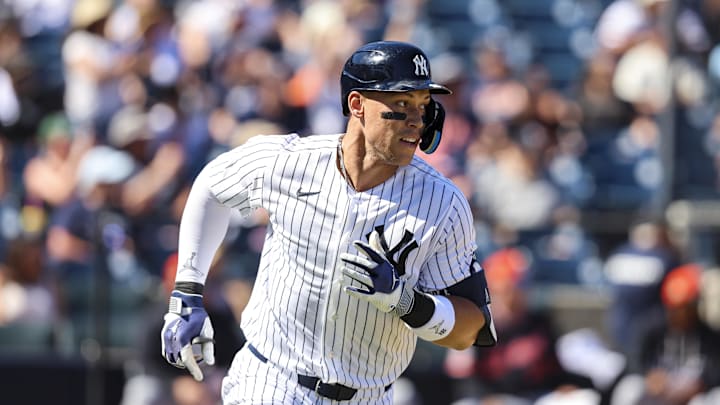
MLB is officially back, and fans everywhere are thrilled to lay eyes on real, actual baseball games beginning this weekend at spring training. So exciting, in fact, that this time of year can often lead to some ... let's just say "questionable" takes.
It's understandable, really. We haven't gotten to watch baseball in months, and hope springs eternal as everyone's record gets reset to 0-0. You can't blame people for wanting to run with the first data points they get — even if at-bats in late February don't have all that much to do with what happens from April through October.
But just because most of spring is a glorified exhibition in between tee times doesn't mean that fans should ignore it entirely. Players have been working all offseason, and year-to-year improvements, of course, happen all the time. It's just a matter of knowing which information to focus on, and that's where we can help.
The stats worth paying attention to during MLB Spring Training
Strikeout and walk rates

Two things make spring training data so hard to parse: 1) the uneven level of competition (and the uneven level commitment) and 2) the small sample size. Which is why you should always gravitate towards stats that are both 1) opponent-independent (i.e., they don't rely on anyone else but the player in question) and 2) are proven to stabilize as quickly as possible.
Strikeout rate and walk rate check both of those boxes. They don't depend on batted-ball luck, or on the batter nearly as much. And thanks to Piper Slowinski's work at FanGraphs, we know that they both stabilize (read: are less susceptible to small sample noise) pretty quickly: 120 plate appearances in the case of walk rate, 60 plate appearances for strikeout rate. The bottom line is that these are arguably the two steadiest metrics you'll see this spring.
What does that mean in practice? If a pitcher or hitter starts showing substantial improvement in how frequently they're striking out (or striking batters out), there's a real chance that might stick once the games start counting. Of course, even strikeout and walk rates aren't immune to all variables. The later innings of spring games are full of guys who don't have much of any future at the big-league level, and striking them out doesn't say too much. Which is why you should also pay attention to ...
Opponent quality
Shouts out to Baseball-Reference for this one. B-R attaches a numerical value to each hitter a pitcher faces (or each pitcher a hitter faces) during spring training: 10 if that player was a big-leaguer the previous season, eight if they were in Triple-A, seven for Double-A, five for High-A, four for Single-A and anywhere from 1.5 to 3 for Rookie and short-season ball.
If you're wondering whether a given player's numbers can be trusted, this is a good place to start. If the average is 8 or higher, that's a good sign — it means they've competed against something close (or closeish) to MLB competition. If the number is down around six or seven, add another heaping helping of salt.
Exit velocity

Exit velocity is another stat that checks the two boxes we're looking for. In this Statcast age, we've learned that the likelihood of a batted ball winding up as a hit of some sort is highly correlated with how hard that ball was hit. And like K and BB rates, exit velocity is pretty sticky: How hard a player is capable of hitting a ball is how hard a player is capable of hitting a ball, regardless of level of competition or anything else, and small sample size isn't as much of an issue here.
It's important to note that we're not talking about max exit velocity here. That stat winds up being pretty noisy: While it's obviously impressive to hit a ball 117 mph, doing that once doesn't mean as much about a hitter's ability as hitting the ball really hard repeatedly. But if a young player starts hitting the ball much harder than they did the season prior, there's a good chance that's indicative of real, positive change. After all, how hard a line drive comes off the bat isn't susceptible to luck or anything else — it just means they're making powerful contact and will probably continue to do so.
For an example of this phenomenon in action, we only have to look back to last spring. Yankees youngster Ben Rice struggled mightily in his first taste of the majors in 2024, but he came to camp in 2025 tearing the cover off the ball. That carried right on over into the regular season, when he broke out en route to an .836 OPS.
Launch angle

Of course, how hard you hit the ball is only part of the equation; even the fastest ground balls on record don't go over the fence. Hitting the ball hard in the air is where the real money is, and that's something you should be keeping an eye on even amid meaningless games in February and March.
Again, the answer comes down to stability. Ground ball and fly ball rates normalize very quickly: If a hitter's launch angle in the spring is much higher than it was last season, there's a real chance that's due to a change in swing mechanics rather than simply a matter of chance. (Likewise, if a pitcher is suddenly forcing way more ground balls than they did previously, it's most likely because of a change in repertoire or pitch characteristics.)
The canonical example here is Christian Yelich, who went from talented yet frustrating with the Marlins to 2018 MVP with the Brewers simply because he started hitting the ball in the air more often. That change was due to a change in his swing path, which first manifested itself in spring games. Not every spring training venue has access to Statcast's batted-ball data, but it's worth paying attention to the ones that do; some breakouts candidates could be hiding in plain sight.
Changes to pitch characteristics (or a new pitch entirely)

Okay, so this isn't one specific statistic. But at this point, it's clear that in MLB, stuff is king: Look no further than Dylan Cease, who landed a seven-year, $210 million contract from the Toronto Blue Jays in free agency despite posting a 4.55 ERA last season because teams could see that the quality of his pitches was far better than that number would suggest.
These days, every team's spring camp is full of reports of pitchers who spent their offseasons at places like Driveline and came back throwing harder than ever. But it's not just velocity: We know more about what types of movement make each pitch most effective — the rise on a fastball, for example — and the smartest teams have learned a lot about how to make those changes happen.
Velocity is definitely worth keeping an eye on, but you shouldn't stop there. Stuff+, like the one calculated by Eno Sarris and The Athletic, is a holistic measurement of each pitch type's physical characteristics. If a pitcher's slider is showing more horizontal break, or a new arm slot has allowed a pitcher's sinker to have more ride, that's worth taking very seriously.
The stats you can ignore during MLB Spring Training
The traditional slash line
Say it with me: The results don't matter in spring training. It doesn't matter how many hits a player records, or how many doubles, or really anything at all. All of those things are reliant, at least to some extent, on getting lucky — and all of them are susceptible to wonkiness over small samples.
Let's pick just one example from this weekend's games. Kristian Campbell was credited with an extra-base hit against the Minnesota Twins, when in reality this is exactly the sort of weak opposite-field fly ball that resulted in him getting demoted to the Minors last season.
Kristian Campbell with a bloop double into right-center. He's back in CF this afternoon. pic.twitter.com/zWPTbTheGr
— Tyler Milliken (@tylermilliken_) February 21, 2026
At this point, we know what will lead to the most success over the long run. Don't sweat it if a top prospect doesn't have a sparkling slash line in spring, because his team sure isn't. Instead, focus on the process: How hard is that prospect hitting the ball, in which direction, and how high? In short, is he doing the stuff that other successful MLB players are doing? If the answer is yes, the results will follow.
ERA
The same holds true for pitchers. Really, it holds even more true, because pitchers often use their inning or two during a game to work on one specific pitch type or location — and none of them are throwing at max effort at this point in their ramp-ups. Do they have a deep and balanced repertoire? Have they improved the characteristics of a given pitch? Are they locating better than they have in the past? If the answer is yes, the results will follow.
 Add us as a preferred source on Google