
Key Points
Bullet point summary by AI
- A veteran Yankees second baseman is on track for the worst offensive season of his career, with metrics showing steep declines across the board.
- His struggles against high-velocity pitches and increased pop-up rates have left managers and analysts searching for solutions.
- The team's front office now faces a critical decision on whether to stick with the underperforming star or turn to internal alternatives before the trade deadline.
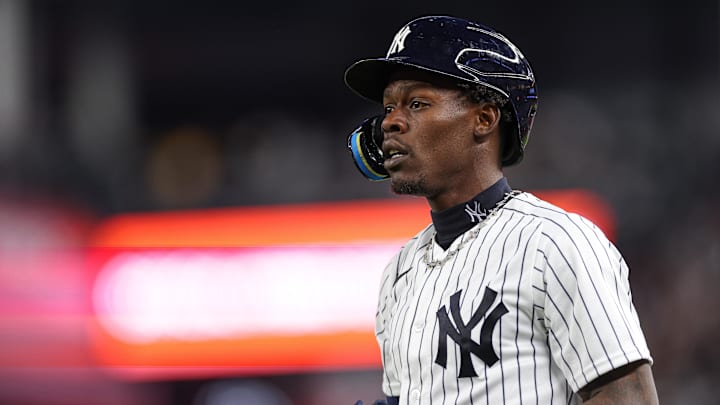
Jazz Chisholm Jr. started the year with an ambitious goal: to slug 50 home runs and swipe 50 bases. At this point of the 2026 season, the New York Yankees would be happy to see the veteran second baseman produce like a league-average starter.
The 28-year-old has been the weakest member of manager Aaron Boone's lineup this year; his -0.1 WAR to date ties third baseman Ryan McMahon as the lowest mark on the roster. That's a far cry from the production Chisholm gave New York last season, when he became the third Yankee ever to post 30 homers and 30 stolen bases.
Some Yankee fans might hope to find some optimism in Chisholm's underlying metrics. Unfortunately, there's very little positive data to report on that front. The second baseman's poor performance at the plate is backed up by a number of statistics tied to his swing.
What do the underlying metrics say about Jazz Chisholm Jr?

One of Chisholm's most concerning issues on the year is the decline in his swing speed. That's not a perfect indicator of success, but swinging harder does tend to produce more substantial contact. Chisholm's "fast swing" rate has dropped from 41.9 percent in 2025 to just 27.4 percent this season. Predictably, that's led to a prodigious drop in his OPS and other offensive statistics.
Regular viewers of Yankee games have undoubtedly noticed that Chisholm is struggling mightily to square up pitches. He is popping the ball up with alarming frequency, and that sort of contact does not help power Chisholm's average or power numbers.
The player's struggles to handle high velocity are also contributing to his struggles at the plate. His .731 OPS against fastballs this season is the lowest mark of his career. Opposing pitchers have no fear when challenging Chisholm when they are down in the count.
Should the Yankees give up on Jazz Chisholm Jr?

Chisholm is headed towards free agency this winter, which complicates matters for New York. On one hand, the Yankees might be able to sign him on a below-market deal if his struggles continue. That sort of contract can only provide value if his current struggles prove to be a temporary issue, especially given his two-way track record.
If the Yankees don't believe Chisholm is set for a rebound, they do have internal options they might explore. Anthony Volpe could be shifted from shortstop to second base if GM Brian Cashman and his staff believe he possesses the superior future. George Lombard Jr. is also a candidate to move over to the right side of the infield if the Yankees want to rush him to the Majors this season.
The most likely path forward for the Yankees will be to stick with Chisholm at second base for as long as possible. Their coaching staff should be exploring every way possible to improve his swing velocity. His poor performance is much more likely to be a product of a swing deficiency as opposed to age-related regression. Time is ticking for the Yankees to unlock the former All-Star's potential at the plate.
 Add us as a preferred source on Google