
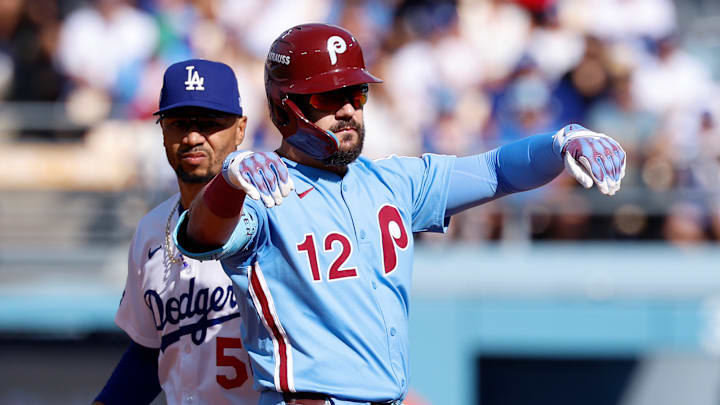
Sports fans love a good underdog story, but there were none to be found on Tuesday at the 2025 MLB Winter Meetings. Despite interest from the Cincinnati Reds and Pittsburgh Pirates, All-Star slugger Kyle Schwarber opted to remain with the Philadelphia Phillies on a five-year, $150 million extension. Just an hour or so later, word broke that Edwin Diaz was heading to the Los Angeles Dodgers on a three-year, $69 million deal that set a new AAV record for a reliever.
Few, if any, should fault Schwarber — who turns 33 in March and is essentially a full-time DH at this point in his career — for taking the money and staying in Philadelphia. The idea that Schwarber would bypass the Phillies to link up with the Reds, his childhood team, or Paul Skenes and the Pirates was nothing more than that: an idea, one that died before it had any chance of even becoming a possibility.
More than anything, though, Schwarber re-signing with the Phillies tells us what we already knew: Major League Baseball is headed for a lockout, largely because the lack of a salary cap means that teams like the Phillies never truly have to worry about cutting costs to retain their best players.
Kyle Schwarber and the Phillies just proved that a lockout is inevitable

Schwarber wasn’t the only premier free agent to cash in on Tuesday. Díaz became the latest All-Star to join Shohei Ohtani and the Los Angeles Dodgers, reportedly agreeing to terms on a three-year, $69 million contract. After six seasons in Queens, Díaz will serve as the two-time defending World Series champion’s closer.
Major League Baseball owners want a salary cap, and the players, understandably, want nothing of the sort. Without a salary cap, Schwarber, Díaz and any other free agent can sign for as much as a team is willing and able to giving them. And while that arguably is true in other sports, the Phillies didn’t need to worry about trading Bryce Harper or Zack Wheeler to ensure that they’d fit under the cap next season.
Neither Schwarber nor the Phillies are the bad guys here, and the same principle applies to Díaz and the Dodgers. How can anyone fault championship contenders for wanting to spend in free agency? We can’t exactly blame teams for taking advantage of baseball’s flawed financial system. Don’t let the Pirates’ reported four-year offer to Schwarber fool you, though; they’re the same organization that hasn’t signed an external free agent to a multi-year deal since giving Ivan Nova a three-year contract in December 2016 — and there’s a reason why we keep bringing that stat up, because it illustrates just how broken baseball is.

Arguments about market size only go so far, and we’d be making a very similar argument had Schwarber signed with the Pirates or Reds. The Phillies went into the offseason knowing that they wanted to re-sign Schwarber, and that’s exactly what happened. Had Schwarber signed elsewhere, we’re sure that the Phillies would have turned their attention to another top free agent. Who knows? Maybe they would have signed Pete Alonso and given the full-time DH role to him or Harper.
The truth is, all signs point to a lockout regardless of what happens this offseason. Schwarber could have signed an eight-year, $400 million deal with any of the smaller-market teams — or those who have reputations for low payrolls — and it wouldn’t matter. There is no indication that the league or the players’ association intends to compromise on the salary cap and the salary floor.
So, in the end, Schwarber is back with the Phillies, and the Pirates struck out on their top target. Now, the Pirates can go bargain hunting over the next two months and, when asked about the offseason at spring training, they can defend things by saying, “Well, we tried to get Schwarber.” Not that will be much consolation if the Pirates waste another year of Skenes’ career, of course.
 Add us as a preferred source on Google