
Key Points
Bullet point summary by AI
- The San Diego Padres made a controversial trade last year, swapping their top-ranked prospect for a young closer showing promising but inconsistent results in 2025.
- After a full season has passed, this acquisition has evolved into one of baseball's most dominant stretches ever recorded, rewriting expectations for late-inning relief pitching.
- With conventional metrics rendered almost meaningless by his otherworldly performance, the entire league now faces the dilemma of how to approach a pitcher whose presence alone seems to guarantee zero chances of scoring.
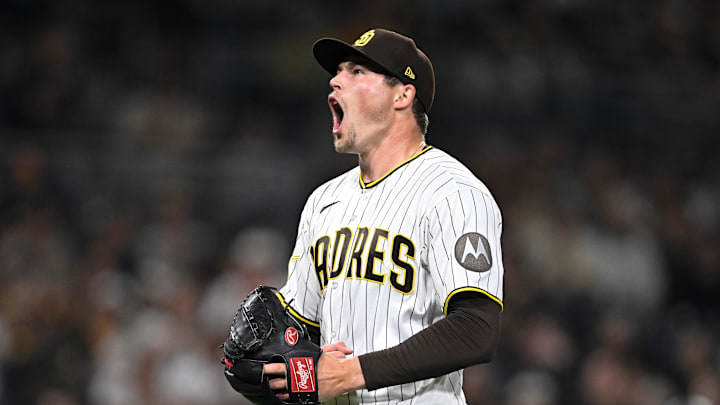
When the San Diego Padres traded Leo De Vries, the No. 4 prospect in baseball and a potential future superstar at shortstop, to the Athletics for Mason Miller at last year's trade deadline, reactions were mixed-to-negative. Miller, while dominant, was still just a closer, and the value didn't seem to line up.
A year later … man, oh man. De Vries could still very well turn into Alex Rodriguez, in which case sure, San Diego would have "lost" the deal. But right now Miller is authoring one of the greatest stretches by a relief pitcher the sport has ever seen: Through 6.1 innings pitched this year, the righty has struck out 16 of 21 hitters while giving up a single hit and a single walk. He is now scoreless through hist last 27.2 innings overall, a streak that dates back to last August and spans both the postseason and this spring's World Baseball Classic.
At this point, merely calling Miller "a closer" doesn't do him justice. He's making professional hitters look foolish at a rate we've literally never seen before, to the extent that the question isn't when his scoreless streak will end — it's whether anyone ever score on him again.
Mason Miller is breaking the league over his scoreless streak

I’m only half kidding. Conventional pitcher stats are all essentially useless, because Miller is just destroying everyone. His ERA is, obviously, 0.00, and his WHIP is a hysterical .316. My favorite, though, is Miller’s FIP, or Fielding Independent Pitching, a stat that is adjusted to have the same scale as ERA (i.e. below 3.00 is really good, sub 2.00 is god-like) but only calculates what pitchers can independently control: walks, home runs, hit by pitch and Ks. Miller’s FIP right now? -1.43. Yes, that is negative 1.43. No other pitcher with at least one inning pitched has a FIP below zero, which (kind of) mathematically implies that Miller is spiritually scoring runs for his team. That is the level of dominance we are talking about.
Category | 2026 numbers | MLB rank* | Next closest pitcher |
|---|---|---|---|
FIP | -1.43 | 1st | Cam Schlittler (0.51) |
Expected ERA | 0.45 | 1st | Erik Sabrowski (0.74) |
K% | 76.2% | 1st | Jeff Hoffman (48.4%) |
There is also an aura, a presence, something you can’t particularly calculate about Miller that puts him in a special category of pitchers against whom you simply don’t have a chance. Of course, you do; even Mariano Rivera blew saves every once in a while. But it sure feels like you don’t. If you're trailing entering the eighth or ninth inning, you’re cooked. It is over.
In the pantheon of great scoreless stretches, we aren’t particularly close to the Orel Hershiser’s record 59 straight innings without allowing a run — hallowed ground. But when dealing with relievers, we have to think in terms of years rather than innings; think Dennis Eckersley (who posted a 0.62 ERA in 1990 and won both the Cy Young and the MVP as a closer in 1992) and Craig Kimbrel (four straight 40-save seasons). Relief pitchers can go a long time without giving up a run, and while I’m not saying that Miller is in Rivera's class just yet — Mo didn't give up a run in the playoffs for two years, while Miller is doing this in April — it's not unfair to start asking the big questions. Because, put simply, hitters do not have a chance right now.
While it isn't there yet, Miller's streak could extend to legendary territory
Miller is also leading the league in a new stat I’ve just invented called WDYED (What Do You Even Do), which measures to what extent the batter is already screwed when they step up to the plate. Because for all the real metrics — and I will be throwing many metrics at you, don’t worry — Miller simply asks hitters a question they can’t be expected to answer: Will this pitch be a 104-mph fastball or an 88-mph slider?
Mason Miller.
— Rob Friedman (@PitchingNinja) April 10, 2026
10 pitches. 3 strikeouts.
103 with THAT slider isn’t fair. 😳 pic.twitter.com/FDjiKmx3jE
We are in the age of the super slider, and while revolutionaries like Jacob Misiorowski average 93.8 mph on theirs (hello), Miller’s main breaking ball might actually be better specifically because it’s slower. It’s not … slow, mind you, but it is a full 13 mph slower on average than his fastball, which comes in at 101.2 mph (no, that's not a typo). Miller’s slider breaks hard, and with excellent command and placement. And it breaks on hitters that are gearing up for 102-104 on the outside corner. That’s not hyperbole. Watch this:
104 MPH 🔥
— MLB (@MLB) October 1, 2025
Mason Miller is bringing the heat pitching on back-to-back days! #Postseason pic.twitter.com/S6TyC8G3iB
I was watching that live last year and did not understand what I had seen the first time around. That pitch was some sort of theoretical maximum, the Platonic ideal of a pitch. No hitter could ever hit that, because no hitter thinks that kind of pace and placement are possible at the same time. That makes his slider, as well as his (casually) 95.5 mph changeup, feel like getting stabbed in the back when you’re bracing to get hit by a train.
From a Statcast perspective, this is just sheer ridiculousness. I know you don’t have to see the Savant percentiles to understand that Miller is dealing, but I think you should see them anyway:
Anyone check out Mason Miller's Savant percentiles lately? pic.twitter.com/xunqcUKinm
— Oliver Fox (@oliversfox) April 10, 2026
In short, Miller is a fire-breathing bartender who has mixed a statistical cocktail that tastes something like a Mojito with notes of never-giving-up-another-run-ever. In one inning, with the game on the line, there is simply no pitcher alive you’d rather have out there than Mason Miller. But it’s worth wondering if his value is perhaps, somehow, overrated.
Is Mason Miller still somehow overvalued?
The value of a closer is capped by their position. Sure, if you’re winning in the ninth inning, there is no one more valuable, but even the best teams top out at the mid-80s in save opportunities per year. Miller already has four saves in the Padres' first 13 games, and if he were to continue this pace, he would finish with about 48 — an incredible year, but still 14 saves shy of Francisco Rodriguez’s ridiculous 62 back in 2008.
This also is, probably, totally unsustainable. Miller is completely unhittable right now, but any dip in his velocity or command will have him back in his 2025 form —Good, but not worth a top-five prospect in baseball who can impact your team every day if he hits.
Miller is, fundamentally, a weapon of the present. He helps the Padres win right now, with a team that is constructed to do just that. They have the lowest ranked farm system in baseball and couldn’t honestly care less. They have power hitting, starting pitching and, yes, a closer in Miller who will send hitters to the shadow realm. Not a bad thesis.
 Add us as a preferred source on Google