
Key Points
Bullet point summary by AI
- The NBA's 65-game rule for awards eligibility is causing major headaches this season for top contenders.
- Key players like Anthony Edwards, Luka Dončić and Cade Cunningham are falling just short of the requirement due to injuries and suspensions.
- Changing the rule to minutes played instead of games could better reflect player value and avoid unfair exclusions.
Three years ago, the NBA came up with a rule that's currently blowing up in its face.
In an attempt to combat load management, the league began requiring players to play in at least 65 games — and play 20-plus minutes in at least 63 of them — to be eligible for end-of-season awards such as Most Valuable Player, Defensive Player of the Year and the All-NBA teams. That rule claimed two more victims on Thursday, and possibly a third.
Detroit Pistons guard Cade Cunningham was cruising toward his second straight All-NBA nod until he suffered a collapsed lung in mid-March. He's played in only 61 games, so he'd have to play in four of the Pistons' final five regular-season games to be eligible for those awards.
The Pistons announced Thursday that Cunningham will be out for at least one more week. The regular season ends next Sunday. The math isn't mathing for him.
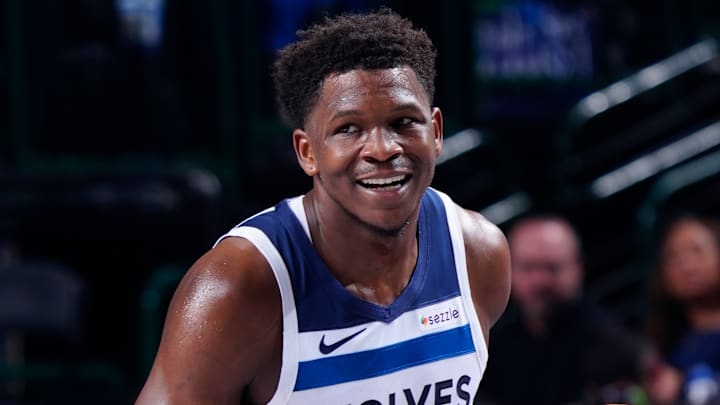
The same goes for Minnesota Timberwolves guard Anthony Edwards, who missed his 17th game Thursday. He played only three minutes in one game earlier this season, which does not count for awards purposes, so he is also ineligible for the All-NBA team this season. As Sam Quinn of CBS Sports noted, he would have become eligible for a 35% supermax extension in 2027 had he made an All-NBA team this year.
Los Angeles Lakers guard Luka Dončić, who's been hovering around the periphery of the MVP conversation this year, also may be in danger of becoming ineligible. He left his team's blowout loss to the Oklahoma City Thunder on Thursday night with a hamstring injury, and judging by his reaction, he doesn't seem likely to return before the playoffs.
Thursday was Dončić's 64th game of the season. He missed Monday's win over the Washington Wizards due to a one-game suspension that he earned for racking up 16 technical fouls. Had he not gotten suspended, Thursday would have been Dončić's 65th game for awards purposes. (He had two games between 15-20 minutes earlier this year, both of which would have counted.)
Cunningham, Edwards and perhaps Dončić missing the All-NBA teams could have leaguewide ramifications. If Pistons center Jalen Duren sneaks onto an All-NBA team because of their absences, he'll be eligible for a max contract from the Pistons this summer beginning at 30 percent of the 2026-27 salary cap rather than the usual 25 percent.
The National Basketball Players Association, which agreed to the 65-game rule as part of the CBA negotiations, recently cited Cunningham's case when arguing for the need to change it.
"Cade Cunningham's potential ineligibility for postseason awards after a career-defining season is a clear indictment of the 65-game rule and yet another example of why it must be abolished or reformed to create an exception for significant injuries," the union said, per ESPN. "Since its implementation, far too many deserving players have been unfairly disqualified from end-of-season honors by this arbitrary and overly rigid quota."
It's clear that the 65-game rule sucks. What's the fix, though?
How the NBA could fix awards voting
One solution would be abolishing the 65-game requirement entirely. Awards voters should be able to decide whether 64 games from Dončić, Cunningham or Edwards are more valuable than 70-plus games from Duren, Karl-Anthony Towns or Brandon Ingram. (Spoiler: They are.)
If the NBA wants to keep some requirement in place to continue deterring teams from aggressively load-managing their stars, it could always lower the cutoff to 55 or 60 games instead. That still would have cost Giannis Antetokounmpo and Stephen Curry a shot at an All-NBA nod this year since both have played fewer than 40 games, but they likely wouldn't be in consideration anyway given how much time they've missed.
Alternatively, as one Reddit user proposed Friday, the league could tweak the requirement to either 65 games or 2,000 minutes played. Here's a list of stars who are currently ineligible for end-of-season awards — although Kawhi Leonard, Nikola Jokić and Victor Wembanyama still have time to qualify — and whether they would be eligible if the 2,000-minute rule was in place this season.
Player | Games Played | Minutes Played | Eligible? |
|---|---|---|---|
Luka Dončić | 64 | 2,289 | YES |
Nikola Jokić | 61 | 2,128 | YES |
Cade Cunningham | 61 | 2,096 | YES |
Anthony Edwards | 59 | 2,083 | YES |
Deni Avdija | 62 | 2,054 | YES |
Kawhi Leonard | 61 | 1,957 | NO |
LeBron James | 56 | 1,870 | NO |
Zion Williamson | 60 | 1,785 | NO |
Victor Wembanyama | 62 | 1,784 | NO |
Austin Reaves | 51 | 1,762 | NO |
If the 2,000-minute rule was in place this season, all three of Dončić, Edwards and Cunningham would be eligible for an All-NBA nod despite playing in fewer than 65 games. Leonard is only 43 minutes away from topping that mark, while Jokić is well above it. LeBron James has zero chance of topping 65 games, but he's only 130 minutes away from 2,000 minutes, so he could have qualified that way as well.
Edge cases would inevitably continue to pop up — imagine someone who played 1,995 minutes across 64 games — but expanding the eligibility criteria would help combat some of the exclusions that will drastically shake up the All-NBA teams this year.
As long as the NBA continues to tie supermax eligibility to those end-of-season awards, it's critical for the All-NBA teams to better reflect the best 15 players in the league that season. Otherwise, teams could be stuck between overpaying their stars or engaging in combative contract negotiations that sours their relationship with some of their best players. That's a lose-lose situation created by an arbitrary cutoff.
Teams need to be more cautious than ever about handing out big-money deals in the NBA's second-apron era. One misstep can set a team back years. The current 65-game rule increases the chances of fringe All-Stars earning All-NBA nods because better players fall short of the requirement, which could have major financial ramifications.
The sooner the NBA fixes this problem, the better.
More NBA news and analysis:
 Add us as a preferred source on Google