
Is there anything more magical than an unknown taking the leap? An unknown or underdog transforming, seemingly instantly, into one of the all-time greats. Sometimes it sticks — a second-round pick like Nikola Jokić methodically works his way into the pantheon of NBA big men. A raw, pass-first point guard like Shai Gilgeous-Alexander resets our understanding of what's possible as an isolation scorer.
But more often than not, these sudden supernovas burn out quickly. Circumstances changes, hot shooting goes cold, injuries rear their ugly head and these propulsive seasons blink out — short-lived sneak-peeks at an alternate timeline where everything was different. We may never get to see Jeremy Lin or Tyreke Evans inducted into the Hall-of-Fame, but we'll always get to relive those moments when they were at the top of the NBA world.
And they're not even the biggest one-hit wonders in NBA history.
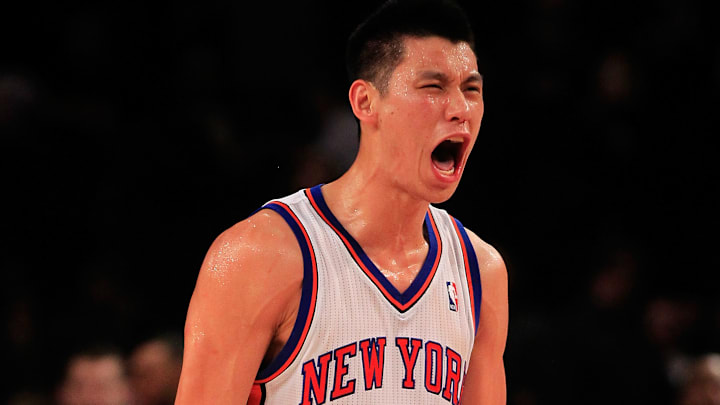
8. Jeremy Lin, 2011-12
At first glance, Lin may not fit your definition of a one-hit wonder. He averaged 11.6 points and 4.3 assists across nine NBA seasons — by most measures, he was a solid rotation player. But for a few weeks, he was a sensation, one of the most unstoppable players in the NBA. And the fact that he played for eight teams in nine seasons, speaks to how much his career was about chasing the success of Linsanity.
Lin went undrafted out of Harvard but caught on with the Warriors after a strong Summer League performance with the Dallas Mavericks. But he played just 285 minutes across 29 games and was cut loose after one year, catching on as a deep bench, backup point guard with the Knicks. Injuries and a floundering guard rotation opened an opportunity for him, and he seized it.
On Feb. 4, played 35 minutes off the bench in a win over the New Jersey Nets — the first time in his career he'd played 30+ minutes — and put up 25 points and 7 assists. Two nights later, he was in the starting lineup and scored 28 points with 7 assists in a win over the Jazz. Then it was 23 and 10 in a win over the Wizards. Then 38 and 7 in a win over the Lakers. For the month of February, the undrafted rookie with 340 minutes over previous NBA experience averaged 22.3 points, 9.0 assists, 4.2 rebounds and 2.3 steals per game, leading the Knicks to a 10-3 record and setting New York City on fire.
Lin was a sensation, but it didn't last long. His numbers came back to earth and the Knicks went 6-7 in March, and he missed the rest of the season with a torn meniscus. Again, he went on to have a very solid career — but of his 57 career games with 20+ points, nine of them came in that magical March run. He was always solid, but for one month, he was unstoppable.
7. Tyreke Evans, 2009-10

Like Lin, Evans had a respectable career with multiple solid seasons — he played for a decade and retired having averaged 15.7 points, 4.8 assists and 4.6 rebounds per game. But we're sliding him into this list because he peaked as a rookie and then slide into irrelevance.
Evans was the No. 4 pick in the 2009 NBA Draft, after leading Memphis to a 33-4 record in his one season in college. He was a big, powerful point guard, and he dominated as a rookie — averaging 20.1 points, 5.8 assists, 5.3 rebounds and 1.5 steals per game, winning Rookie of the Year and joining Oscar Robertson, Michael Jordan and LeBron James as the only rookies in NBA history to average 20-5-5.
Injuries took their toll in his second season, he played in just 57 games and his numbers fell across the board, beginning a dispiriting trend — his points, rebounds and assists per game all declined in each of his seasons in Sacramento. Four years into his career, he was averaging 15.2 points, 4.4 rebounds and 3.5 assists per game for a 24-win team and had been forced into a position change with Isaiah Thomas taking over as the primary point guard.
He had a brief resurgence after a trade to the Pelicans, but never again approached the numbers he put up rookie season and went from Jordan/LeBron comparisons to rotation guy on a progression of bad teams.
6. Flip Murray, 2003-04

No one saw Flip Murray coming.
He spent a year at Meridian Community College and two years at HBCU Shaw, before the Milwaukee Bucks took him with the No. 13 pick in the second-round of the 2002 NBA Draft. He barely played in his first season and ended up a throw-in to the blockbuster trade that sent Ray Allen to Seattle and Gary Payton back to Milwaukee.
But when Allen was injured to start the following season, Murray stepped into the starting lineup and went supernova. He scored 24 in the season opener and went on to score 20+ in 10 of his first 11 games. By the time Allen returned to the lineup, Murray was averaging 18.6 points, 3.4 assists and 3.2 rebounds per game. Remember, this was a relatively unknown second-year, second-round pick who had played just 62 minutes across 14 games in his rookie season.
Murray slowly came back to earth as the season went on and finished averaging 12.4 points per game. He had his moments over the next few years, but never again reached the heights of that first stretch, and never averaged more points per game than he did in that first breakout season. He was out of the league six seasons later, having played for eight different teams.
5. Larry Sanders, 2012-13

For one season, Larry Sanders was a foundational building block, one of the most feared rim-protectors in the NBA. A lottery pick from VCU, he was a solid rotation piece in his first two seasons but only played 13.5 minutes per game, averaging 4.0 points and 3.0 rebounds per game. But then Andrew Bogut was traded to the Warriors and Sanders got a chance to take over in the middle.
In the 2012-13 season, the Bucks made a surprising run to the playoffs. Sanders averaged 9.8 points, 9.5 rebounds, 1.2 assists and 2.8 blocks per game, even earning votes for Defensive Player of the Year and a four-year, $44 million extension. But injuries and mental health issues took their toll — he played just 50 games over the next two year, sat out all of the 2015-16 season and appeared in five games with the Cavs in 2016-17 before leaving the NBA for good.
4. Tony Delk, 2000-01

Delk was a collegiate star who settled into a long career as a role-player at the next level. He won a national championship and averaged 17.1 points per game across his final three seasons at Kentucky. In the NBA, he played for eight teams in 10 seasons, starting in less than a fifth of his games, and averaging just 9.1 points per game.
But he's famous for being one of the unlikeliest 50-point scorers in history, after he dropped 53 points against the Sacramento Kings in January 2001. That happened to be the high-point of what was, by far, the best season of his career.
That year, Delk appeared in all 82 games for the Phoenix Suns, averaging 12.3 points, 3.2 rebounds and 2.0 assists per game. In addition to his 53-point explosion, he had 10 other games of 20+ points. Over the next five seasons, he had just 25 games of 20+ points and never topped 30 again.
3. Aaron Brooks, 2009-10

The Yao Ming-Tracy McGrady pairing in Houston was completely derailed by injuries. But in the chaos, fans were treated to several fun and highly competitive teams headlined by unexpected stars. The 2009-10 team was led by Aaron Brooks, an undersized point guard and late first-round pick who exploded in his third season, averaging 19.6 points, 5.3 assists and 2.6 rebounds per game, leading the league in 3-pointers made and attempted, shooting 39.8 percent from beyond the arc and winning Most Improved Player.
But he was traded the next season for Goran Dragic and a first-round pick, sending into a spiral of journeyman stops. He signed to play in China during the early days of the 2011 lockout and missed the shortened NBA season, playing out that contract. He played for five more teams and only averaged double-digit scoring in one other season.
2. Michael Carter-Williams, 2013-14

The Philadelphia 76ers were chaos incarnate during the early years of The Process era, cycling through fringe players at lightening speed looking for anyone who might have value. And, as often as not, that value was immediately cashed in with a trade that turned them into a future asset.
Michael Carter-Williams played exactly one full season with the Sixers, averaging 16.7 points, 6.3 assists, 6.2 rebounds and 1.9 steals per game, winning Rookie of the Year. The next year, at the trade deadline, he was flipped to the Bucks as part of a three-team deal that netted a future first-round pick for Philly. (Four years later, that pick was used by Philly to select Mikal Bridges, who was then immediately traded for Zhaire Smith and a 2021 first-round pick. Philly later flipped that pick to the Clippers as part of the deal to acquire Tobias Harris, and it ultimately ended up in the hands of Oklahoma City as part of the Shai Gilgeous-Alexander trade).
Carter-Williams' numbers were obviously inflated playing with the messy 76ers, who only won 19 games during that rookie season. His size (six-seeeeeven) was as an asset as a point guard, but he was a really poor shooter and never finished a full season shooting better than 30 percent from beyond the arc. That rookie season ended up being his career-high in games, minutes, points, steals and rebounds. He played for five other teams over seven seasons after leaving Philadelphia, and will be remembered mostly as an example of how weird this 76ers era was.
1. Isaiah Thomas, 2016-17

To be fair, Thomas had multiple extremely solid seasons and made two All-Star teams as a member of the Boston Celtics. But he had exactly one year as an MVP-level player — a shocking leap when it happened and a level of performance he was never able to recover.
That Thomas even stuck in the NBA was sort of a surprise. He was a 5-foot-9 point guard and taken with the final pick of the 2011 draft. The odds were always stacked against him, but he carved out a niche as a microwave scorer in his first four seasons, averaging 15.6 points and 4.7 assists per game for Sacramento, Phoenix and Boston. In his first full season with the Celtics, 2015-16, he made his first All-Star team, averaging 22.0 points and 6.2 assists per game. But that was just a prelude.
In the 2016-17 season, he averaged 28.9 points and 5.9 assists per game on a 62.5 true shooting percentage, leading the Celtics to a 53-29 record, the best in the Eastern Conference. Thomas finished fifth in the MVP voting that season, behind Russell Westbrook, James Harden, Kawhi Leonard and LeBron James.
Thomas was rewarded for his breakout season with a trade to the Cleveland Cavaliers for Kyrie Irving. He played just 15 games for the Cavs before he was traded to the Lakers. After that 2016-17 campaign, he played six more seasons for eight different teams, never appearing in more than 40 games. Injuries robbed him of his quickness, and his lack of size put him at a huge disadvantage.
He went from unstoppable scorer and MVP candidate to unplayable in basically one year — playing fewer minutes over the next six years than he did in that one season in Boston. It was a tragic turn but most players, and certainly no one else on this list, ever touched his career peak.
More NBA news and analysis:
 Add us as a preferred source on Google