
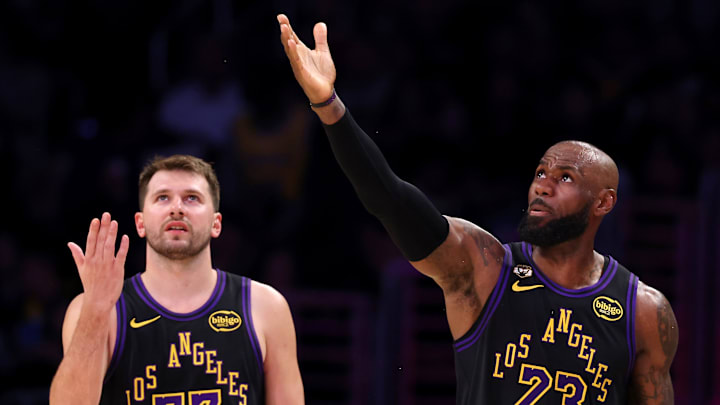
This season, Los Angeles Lakers star Luka Dončić is averaging a league-high 32.5 points to go with 8.6 assists and 7.7 rebounds per game. Despite that, he's viewed as a long shot to win his first NBA Most Valuable Player award.
Dončić has finished in the top five of MVP voting three times in his career, but he's never been higher than third. He figures to win at least one before he retires from the NBA — after all, he just turned 27 at the end of February — but he isn't the only all-time great without that honor on his mantlepiece.
Bill Russell and Wilt Chamberlain spent most of the 1960s dominating the MVP race. Kareem Abdul-Jabbar took the torch from them in the 1970s, while Magic Johnson and Larry Bird won three apiece between 1984 and 1990. Mihael Jordan won five during his heyday, and LeBron James (four) and Nikola Jokić (three) have hogged the award in recent years.
That's left plenty of all-time greats without the NBA's most prestigious individual honor.
Here, we've sorted through the best of the best by weighing not only their longevity and career accolades, but the caliber of their peak. Dončić might not be in the top 50 in all-time lists quite yet, but his peak is undeniably in that range.
He isn't the only top-50-of-all-time player among this group, either.
Dwyane Wade

Dwyane Wade became a Miami Heat legend in his third season when he helped his team win its first-ever championship by beating Dirk Nowitzki and the Dallas Mavericks in the 2006 Finals. Dirk and the Mavs got revenge five years later, but Wade, LeBron James and Chris Bosh combined to win the next two NBA championships.
Although Wade took a backseat to LeBron during the Heatles era, he was one of the league's top players in the late 2000s. Wade led the NBA with 30.2 points per game in 2008-09 while shooting an impressive 49.1 percent overall. He also tied his career high with 7.5 assists per game that season, and he had a career-high 2.2 steals and 1.3 blocks per game as well.
That wound up being Wade's only top-three MVP finish.
Wade went from averaging 26.8 points, 7.0 assists and 5.0 rebounds per game before LeBron and Bosh's arrival to 22.2 points, 5.3 rebounds and 4.7 assists per game in their four-year tenure together. He went from back-to-back top-five MVP finishes in 2008-09 and 2009-10 to never finishing above seventh in voting again.
Wade did get a Finals MVP in 2006 along with 13 All-Star nods and eight All-NBA selections. Throw in his three All-Defensive team appearances, and his spot on the NBA's 75th Anniversary Team was well-deserved.
Chris Paul

Don't let the ignominious end of his NBA career fool you. Chris Paul was arguably the single greatest point guard of his generation.
CP3 kicked off his career with the 2005-06 Rookie of the Year award and didn't look back. Starting in his third season, he was named an All-Star for nine straight years, and he finished his career with four top-five MVP finishes and seven top-seven finishes.
The closest that Paul ever came to winning MVP was in 2007-08, when he finished as the runner-up to Kobe Bryant. CP3 averaged a league-leading 11.6 assists and 2.7 steals per game for a 56-26 New Orleans Hornets team that season, but Bryant finally got over the MVP hump after three previous top-three finishes and five top-five finishes.
Paul wound up with six steals titles and five assists titles across his 21-year (!) NBA career. He lost a step or three over the years, but he still managed to average 7.4 assists in only 28.0 minutes per game while playing all 82 games with the San Antonio Spurs in his age-39 season, because of course he did.
Paul didn't have the playoff success that Wade did, although he did finally reach the NBA Finals with the Phoenix Suns in 2020-01. As it tradition with Paul, injuries wound up short-circuiting that potential title run.
Although Paul retired without either a championship or an MVP award, he's still going to be a first-ballot Hall of Famer when he becomes eligible in a few years. He'll go down as one of the league's all-time great point guards.
Kawhi Leonard

Kawhi Leonard won Finals MVP twice while playing for two different teams in the 2010s. Enough said.
Not convinced? He also won Defensive Player of the Year in back-to-back seasons with the San Antonio Spurs in 2014-15 and 2015-16.
In the latter season, Leonard finished second in MVP voting after averaging a career-high 21.2 points to go with 6.8 rebounds, 2.6 assists, 1.8 steals and 1.0 blocks per game. The following year, he finished third in MVP voting after again setting a career high with 25.5 points per game.
Leonard was fortunate to stay healthy enough through two playoff runs to earn those championships and Finals MVPs, but the same can't be said in the regular season. Ever since he played only nine games in 2017-18 amidst a dispute with the Spurs about his health, Leonard has missed at least 14 games every season.
The retooling (or rebuilding?) Los Angeles Clippers aren't going to provide Kawhi with a clear path to a championship anytime soon. The Clippers should expect every team in the league to at least place an exploratory call with them about Leonard this offseason, especially since he's proven he can help push a team over the championship hump.
Jerry West

The player known as The Logo never won a regular-season MVP award, but it wasn't for lack of effort.
West was named an All-Star in every season of his 14-year NBA career. He also had five straight top-five MVP finishes beginning in his second season. After a brief three-year hiatus in the MVP race, he rattled off back-to-back-to-back second-place finishes.
West lost out on MVP to the likes of Chamberlain, Russell, Abdul-Jabbar and Willis Reed. There's no shame in being unable to top any of those all-time greats. Even being in the conversation with them is an accomplishment in and of itself.
West averaged 30.8 points, 7.9 rebounds and 5.4 assists per game in only his second season, although that was back when players were routinely playing more than 40 minutes per night. (West averaged 41.2 that season.) Eight years later, he led the league with 31.2 points per game in his age-31 season.
West wound up winning the 1971-72 championship with the Lakers alongside Chamberlain, but he never won another.
Elgin Baylor

Elgin Baylor made his NBA debut in 1958 with the then-Minneapolis Lakers and hit the ground running. He averaged 24.9 points, 15.0 rebounds and 4.1 assists in 40.8 minutes per game as a rookie en route to the Rookie of the Year award and a third-place finish in the MVP race.
That was the first of six straight top-six MVP finishes for him.
In 1961-62, Baylor averaged a career-high 38.3 points (!) along with 18.6 rebounds and 4.5 assists, yet he finished only fourth in the MVP race behind Russell, Chamberlain and Oscar Robertson. The following year, he averaged 34.0 points, 14.3 rebounds and 4.8 assists per game, and he finished second behind Russell in the MVP voting.
For his career, Baylor averaged 27.4 points, 13.5 rebounds and 4.3 assists in 40.0 minutes per game. Baylor and Chamberlain are the only two players in NBA history to average at least 27 points, 13 rebounds and four assists across their entire careers.
Unfortunately, Baylor ruptured his Achilles only two games into the 1970-71 season. He returned to play nine games the following year before retiring. The Lakers wound up winning the championship with West and Chamberlain that season.
Isiah Thomas

Isiah Thomas only had one top-five MVP finish in his 13-year NBA career, but he did receive MVP votes in each of his first 10 seasons.
The No. 2 overall pick in the 1981 NBA draft earned All-Star nods in each of his first 12 seasons and made the All-NBA team in five of his first six. He also had four seasons where he averaged at least 20 points and 10 assists per game, including a league-leading 13.9 dimes per game in the 1984-85 season.
Thomas and the Detroit Pistons were the last roadblock between Michael Jordan and permanent glory. They won back-to-back NBA championships in 1988-89 and 1989-90 before giving way to Jordan and the Chicago Bulls in the 1990s.
Thomas, who averaged 20.5 points, 8.2 assists, 5.5 rebounds and 2.2 steals per game throughout the latter championship run, was named Finals MVP in 1990. He won two All-Star Game MVPs as well throughout his career, but he never came particularly close to winning the regular-season MVP award.
He'll just have to settle for being named to the NBA's 75th Anniversary Team as one of the greatest players in NBA history.
Scottie Pippen

As it turns out, it's tough to win MVP when you're teammates with arguably the greatest player of all time.
Scottie Pippen's best chance to win MVP came during the two seasons when Michael Jordan first retired. In 1993-94, Pippen averaged a career-high 22.0 points, 8.7 rebounds, 5.6 assists and 2.9 steals per game en route to a third-place MVP finish. The following year, he was seventh.
Pippen did land fifth in the 1995-96 MVP race after Jordan's return, but that was his final top-five finish. He was 11th in 1996-97, 10th in 1997-98 and never cracked the MVP ballot again after that.
Since MJ was the Chicago Bulls' No. 1 option throughout the 1990s, Pippen didn't put up the huge scoring numbers traditionally associated with an MVP. His well-roundedness wasn't enough to prop him up over the likes of Hakeem Olajuwon or David Robinson.
If nothing else, Pippen did win six championships alongside Jordan and finished his career with seven All-NBA nods, seven All-Star selections and 10 All-Defensive team appearances. He'll go down as arguably the greatest No. 2 option in NBA history, but an MVP was not in the cards for him.
John Stockton

Much like Scottie Pippen, John Stockton's MVP chances were dead on arrival due to a star teammate.
Stockton didn't get to play with the GOAT, but he did spend virtually his entire career playing alongside Karl Malone with the Utah Jazz. Malone won two MVPs in the late 1990s and finished in the top five of the MVP race seven other times, as he averaged 27.2 points, 10.6 rebounds and 3.6 assists per game over the 12-year stretch from 1988-89 to 1999-2000.
Since Malone shouldered the majority of the scoring load, Stockton never averaged more than 17.2 points per game in any of his 19 NBA seasons. He did, however, lead the league in assists for nine straight years from 1987-88 through 1995-96. During that span, he finished in the top 12 of the MVP race every single season.
Stockton wasn't just a prolific playmaker, though. He also wreaked havoc defensively. He led the NBA in steals twice, and he averaged at least 2.5 takeaways per game in five straight seasons from 1987-88 through 1991-92.
That combination of passing and defense helped Stockton earn 10 All-Star nods, 11 All-NBA team selections and five All-Defensive appearances throughout his Hall of Fame career. Although he and Malone never won a championship together in Utah, he was also named to the NBA's 75th Anniversary Team.
Jason Kidd

Just as Stockton began to fade, Jason Kidd rose to prominence as one of the greatest point guards of his generation.
Kidd split the Rookie of the Year award with Grant Hill in 1994-95 and was named an All-Star the following season, but the Dallas Mavericks traded him to the Phoenix Suns midway through the 1996-97 campaign. From there, Kidd's career took off.
The California product earned an All-Star nod during his first full season with the Suns and proceeded to lead the league in assists for five of the next six years. He was named either to the All-NBA first team or All-NBA second team in each of those six seasons.
The closest Kidd ever came to winning MVP was 2001-02, his first season with the then-New Jersey Nets. He averaged 14.7 points, 9.9 assists, 7.3 rebounds and 2.1 assists per game, but he finished second in voting that year to Tim Duncan, who averaged 25.5 points, 12.7 rebounds and 3.7 assists per game. (Not helping matters: Kidd shot only 39.1 percent overall and 32.1 percent from three-point range that season.)
Kidd had only one other top-five finish in the MVP race throughout his 19-year career, although he did crack the top 10 five times in total. Although he was well past the peak of his powers in 2010-11, he did play a big role in helping Dirk Nowitzki and the Mavericks win their first-ever championship that year, too.
Luka Dončić

Let's wrap up by going from one Dallas legend to another. (Too soon?)
Dončić has been putting up MVP-caliber numbers ever since his second season in the NBA, when he averaged 28.8 points, 9.4 rebounds and 8.8 assists per game. He finished fourth in the MVP race that year behind Giannis Antetokounmpo, LeBron James and James Harden.
That marked the first of five straight top-eight MVP finishes for Dončić. He topped out at a third-place finish in 2023-24 when he led the league with 33.9 points per game to go with 9.8 assists and 9.2 rebounds.
Unfortunately for Dončić, team success tends to be a tiebreaker in MVP voting, and the Mavericks never finished higher than fourth in the West during his six full seasons there. The Lakers currently sit sixth in the West, so that trend could be hurting him once again in this year's MVP race. (His incessant complaining to officials can't help, either.)
With that said, there's exactly one person in NBA history who has averaged at least 29 points, eight rebounds and eight assists per game across his entire career. If Dončić doesn't wind up winning at least one MVP award before he retires from the NBA, it could wind up looking like a historic outlier in retrospect.
More NBA news and analysis:
 Add us as a preferred source on Google