
Key Points
Bullet point summary by AI
- The NBA's major awards face intense debate this season due to ambiguous criteria and multiple deserving candidates.
- Contenders like Shai Gilgeous-Alexander and Victor Wembanyama highlight the struggle to define "value" for MVP.
- Coaches like Joe Mazzulla and JB Bickerstaff present compelling cases for Coach of the Year amid varied interpretations of the award.
Despite being the ones to decide the results of the (inhales) NBA’s Most Valuable Player, Defensive Player of the Year, Rookie of the Year, Sixth Man of the Year, Most Improved Player, Coach of the Year, and uh … Clutch Player of the Year, NBA media often have no idea what any of these awards are specifically meant to recognize.
Squabbling about who deserves each of these prestigious honors thus deteriorates into competing definitions about what “valuable” actually means, if we value “winning” enough for … Rookie of the Year (?) groupthink about how of course Keldon Johnson was the Sixth Man of the Year and what in the world Clutch Player of the Year is supposed to mean.
The FanSided NBA talent will have a group ballot next week which will include all our picks under one roof. Here, we lay the groundwork for these discussions by evaluating who the contenders for each award are, the discussions we need to have to figure them out and if it’s actually possible to have a debate about Clutch Player of the Yea — I can stop.
Most Valuable Player
Contenders: Shai Gilgeous-Alexander, Victor Wembanyama
The Problem: What does “valuable” mean?

Probably the single most prestigious award in American sports. There are only five people on the court, and so each individual person is so important in the NBA; this is the “Best Individual Player” award. Unfortunately, the “BIP” doesn’t have the cultural staying power of “MVP,” and thus we’re stuck with one of the worst words in the English language: valuable.
Between Gilgeous-Alexander and Wembanyama, one can manipulate the definition of valuable to give a huge edge to one or the other. If scoring — you know, the way to win basketball games — is the most valuable thing, Shai has a major edge, outsourcing Wemby per game by seven entire points. He’s also playing almost 34 minutes per game and shooting a preposterous 55 percent from the floor, hallowed ground for a guard. His team is the defending champion, probably going to be the number one overall seed and he is statistically and visually unstoppable.
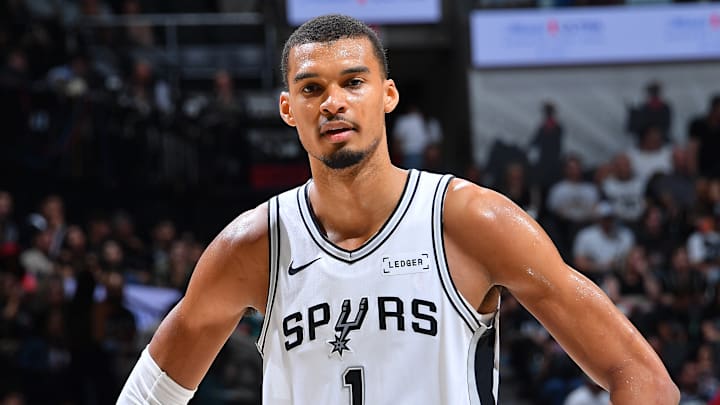
Wembanyama, also statistically and visually unstoppable, has a different case for the word “valuable,” a fairly good one at that. The Oklahoma City Thunder won 68 games last year, and are on pace to win about 65. The San Antonio Spurs, conversely, won 34 games last year and are on pace to win 64, or a 30 game improvement. That’s preposterous; it wasn’t all Wemby, but he was easily the biggest part of it.
He’s also easily the biggest part of the NBA. Literally. He is the largest person on the court at all times, and his size and athleticism make him simply one of the most disruptive defensive players in the history of basketball. Shai is a good defender, but Wemby is the best defender; he’s the philosophical ideal of defense, what you’d create in a laboratory if the email approving your government funding simply said “make a basketball player that won’t let anyone else score.”
Coming out of the draft, much was made about Wembanyama’s ceiling (and that it did not exist), but his floor was more interesting: even if he was barred from touching the ball on offense by an act of congress, he would still be the number one pick because of how game-wrecking his defense was as a baseline. Some may say that’s his MVP silver bullet.
Then again, we have an award for defense, one that Wembanyama is going to win (see below). Is it fair to double-count Wemby’s defense for multiple awards, when Shai’s offensive brilliance won’t have some “offensive player of the year” thing to win? Maybe that’s what Clutch Player of the Year is—I’m joking, it’s a joke.
Defensive Player of the Year
The Contenders: Victor Wembanyama
The Problem: There’s … no problem

There is zero argument to be made that Wembanyama isn’t the defensive player of the year. I could not find a single person on the internet advocating for a different person — the only possible outcome that could mess this up is if Wembanyama somehow doesn’t get to 65 games, but there is no reason to believe he won’t. Put simply: if Wembanyama plays 65 games in a season, he will be the defensive player of the year. He might win 15 straight.
It will be interesting to see how voter fatigue sets in if Wemby snags the next five DPOYs. In any case, by the time I turn 40, this might be named “the Victor Wembanyama Defensive Player of the Year Award,” with some corporate sponsor affixed. Next question.
Rookie of the Year
The Contenders: Kon Knueppel, Cooper Flagg
The Problem: “Who would you rather have?”

Kon Knueppel is a pretty heavy favorite to take the award right now, but it’s worth wondering if he should be given the situation Cooper Flagg has found himself in. Knueppel has been a supernova shooting the basketball, sniping at a 43 percent clip from beyond the arc on insane volume; he is going to easily lead the league in made 3-pointers as a rookie. That is pretty “valuable” if you ask me, though this award isn’t called “Most Valuable Rookie” for some dumb reason.
Cooper Flagg was the early runaway who has tailed off into a tanking team and will barely reach 65 games, a rule which doesn’t officially apply to Rookie of the Year but might still calculate into voters’ minds who may erroneously think it matters. Just a hunch. Knueppel, however, has missed one game the entire season. Flagg is scoring more but has shot the ball poorly all year. He is shouldering a much more significant burden as a creator, and is playing more minutes per game than Shai Gilgeous-Alexander. Knueppel, though, has been part of a winning turnaround in Charlotte that is one of the stories of the season. He has been one of its key pieces.
It’s a compelling statistical case for Knueppel, and one that is likely to carry the day. But Flagg is an incredible player, one who showed rare 19-year-old maturity that might carry him to All-NBA levels. To make the classic, slightly logically unsound argument: if the Mavericks called the Hornets and offered them Flagg for Knueppel, the Hornets say yes.
That’s not how awards work and not how the NBA works, but it’s the only case that Flagg has given his deteriorating team situation. He had a spectacular season in rough circumstances; quite the accomplishment for a teenager.
Coach of the Year
The Contenders: Joe Mazzulla, JB Bickerstaff, Mitch Johnson
The Problem: Is this just the “who was the coach of the team that improved the most in the win column” award?

We’re going to rip through these last few because I think they’re so volatile I can’t capture the debates as cleanly. I think everyone has their own, perfectly legitimate view on this award — some believe it is the “coach of the one seed” award, others the “who improved the most award,” and still others who think it’s the “who bucked our expectations the most” award.
All three have great cases, but Mazzulla and Bickerstaff are probably the most interesting. The Pistons went from a complete laughingstock to a one seed in just two years under Bickerstaff, while Mazzulla took a team that lost three starters, one to a torn Achilles, to injury or trade and won 50 games while all his players got way better. It’s a dead heat.
Sixth Man of the Year/Most Improved Player/Clutch Player of the Year
The Contenders: Lots of People
The Problem: I do not feel comfortable voting for these awards

These three awards imply such a high level of basketball interpretation that it's hard to know what to do with them.
1. 6MOY: Always feels weird because that player often doesn’t close the game in the fourth quarter, so we’re giving out an award to someone who … isn’t one of the best five players on their team? Also, it’s not like bench players are playing a different sport than starters. This award feels more like a “who has the best/deepest bench” award rather than some individual accolade.
2. Most Improved Player: This award services such a thin stratum of players I hardly know what to think. Sure, Jalen Duren and Nickeil Alexander-Walker improved a lot, but who’s to say a castoff like Luka Garza who is now playing huge minutes for the Celtics didn’t improve more relative to where he started? Honestly, I think Wembanyama was the most improved player, but he’s too good to get the award. Jayson Tatum went from a torn Achilles to a triple-double against the Miami Heat last week. Is he most improved?
3. Clutch Player of the Year: I’m no longer kidding, we should rename this award “offensive player of the year.” I know we have clutch stats and everything but I just think awarding a player for their performance in the last five minutes of a game is supremely reductive of how basketball is played. The MVP or the scoring champ is going to take the most shots in that situation, shockingly they wind up being “clutch.” Just make an OPOY like the NFL.
More NBA news and analysis:
 Add us as a preferred source on Google