
Key Points
Bullet point summary by AI
- The Spurs lost Game 2 to the Portland Trail Blazers and may have lost Victor Wembanyama for the next few games.
- Medical staff have confirmed that Wembanyama is currently undergoing mandatory recovery procedures after a head injury sustained during competition.
- The timeline for his potential return could significantly impact the team’s strategy and odds in the tightly contested best-of-seven matchup.
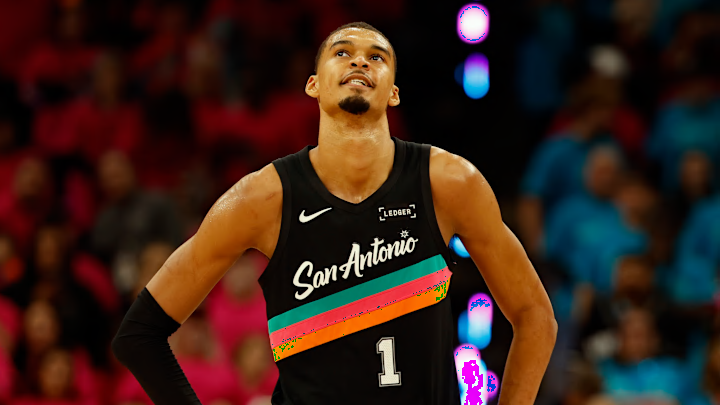
Early in the second quarter, Victor Wembanyama caught the ball at the top of the arc, drove left, crossed right, and then spun back left before getting fouled. What seemed to be a routine instance of Wembanyama's overwhelming size causing a defender to have to concede a foul turned into a harsh that sidelined Wembanyama for the rest of the game.
Victor Wembanyama (concussion protocol) is OUT for the remainder of the game after hitting his head on the court. pic.twitter.com/qP8tAf6osN
— NBA on NBC and Peacock (@NBAonNBC) April 22, 2026
Soon after, it was reported that Wembanyama had sustained a concussion and would be out for the remainder of Game 2.
San Antonio's Victor Wembanyama has been diagnosed with a concussion and will have further testing on Wednesday. pic.twitter.com/d1kqbzOZMn
— Shams Charania (@ShamsCharania) April 22, 2026
What is the NBA's Concussion protocol?
Given the widespread increase in sensitivity toward concussions, the NBA has an entire policy written out regarding the guidelines about returning to play after sustaining one.
The first thing to note is that no matter how a player is feeling, they can not return to participation for 48 hours after sustaining a concussion. Since the San Antonio Spurs don't play again until Friday, this is not really that big of a deal.
For the player to start clearing concussion protocol, they must wait 24 hours after the diagnosis before starting the return-to-participation exertion process. From there, if a team physician clears them, they can begin this process. This process involves several steps, with each step involving more exertion than the previous one (from a stationary bike, to jogging, to agility work, to non-contact team drills). Each step must be monitored by a team physician, who will conduct a focused neurological examination. If the player is symptom free, they move on to the next step. If they are not, they must wait until they are symptom free and then re-do the exertion step. Once all steps have been completed and the 48 hour window has passed, a player may return to play.
The guidelines emphasize that there is no specific timeframe for these injuries, as each player is different in our their body recovers from the concussion.
What does this mean for the Spurs against the Blazers?
In the regular season, this wouldn't be the end of the world, as you can typically expect to miss your star player for parts of the season anyway (Wembanyama missed 18 this season). But in the postseason, the stakes are much more dire.
As it stands, the Portland Trail Blazers have proven to be quite the foe. In Game 1, with Wembanyama healthy, they managed to stay competitive, only losing by 13 points. Then, in Game 2, they came back from a 14-point deficit in the fourth quarter to triumph over the Spurs.
With the series now knotted at one game a piece, San Antonio has a real chance of losing without Wembanyama in the lineup. And if historical precedent is any indication, that is exactly the kind of situation they may be dealing with.
Victor Wembanyama Injury Update: There is no mandatory timeframe to complete the league's mandated protocol, primarily due to the variability associated with concussions. This season the average time lost for a concussion was 9.3 days (median = 7.0 days).
— Jeff Stotts (@InStreetClothes) April 22, 2026
If Wembanyama misses nine days, that means we wouldn't see him again until Game 7, if there is one. Even if Wembanyama was to recover quicker than average, say it only takes him six days, that still means he would be out for Games 3 and 4.
This season, the Spurs are 12-6 in games without Wembanyama. And in 2,080 minutes with him off the floor, they still boast a slightly positive (+0.6) net rating (per PBP Stats). With De'Aaron Fox, Stephon Castle, Dylan Harper, and Luke Kornet (among others), San Antonio still has enough to win this series, but it is going to be a lot trickier than they originally anticipated it would be.
More NBA news and analysis:
 Add us as a preferred source on Google