
Key Points
Bullet point summary by AI
- The top-seeded Detroit Pistons faced a stunning upset loss in Game 1 against an underdog opponent at home.
- A critical offensive limitation for the Pistons was brutally exposed by a team known for its defensive pressure.
- This early misstep raises major concerns about Detroit's ability to contend with higher-scoring opponents in upcoming rounds.
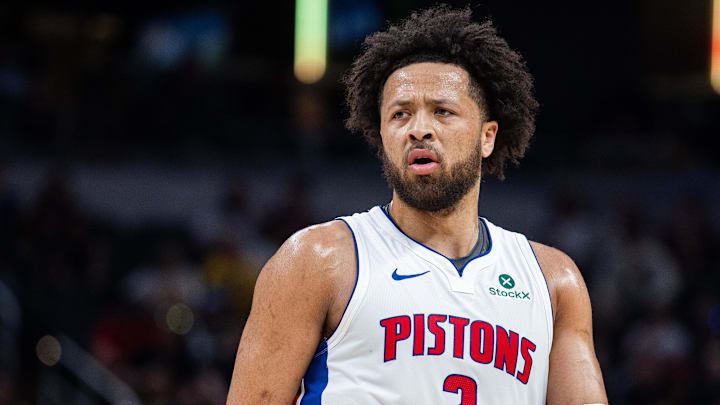
At the tail end of what was a largely chalky opening weekend of the NBA playoffs, we finally got our first upset. And it was a doozy: The No. 8 seed Orlando Magic came into Detroit and outmuscled the top-seeded Pistons, leading wire-to-wire in a 112-101 win to take a 1-0 series lead.
Which likely came as a shock to pretty much anyone who watched these teams during the regular season. Orlando was arguably the East's single biggest disappointment this year and looked dead in the water during a Play-In Tournament loss to the Joel Embiid-less Sixers just a few days ago. Detroit, meanwhile, was the clear class of the conference thanks to Cade Cunningham and a truly hellacious defense.
Perhaps we shouldn't be so surprised, though. Because while Detroit ran up a gaudy record over 82 games, that shiny resume masked a glaring flaw — one that got exposed for everyone to see on Sunday night.
The Pistons' lack of shooting is a potentially fatal flaw

For all the things the Pistons did well this year, there was one thing they very much didn't. And it just so happens to be the most foundational thing of all: shooting. Their overall numbers were propped up by a relentless ability to get to the rim — either via dribble penetration or crashing the offensive glass — but if you made Detroit settle for jumpers, they typically struggled.
Shot distance | Shooting percentage | League rank |
|---|---|---|
10-14 feet | 42.3% | 23rd |
15-19 feet | 37.7% | 26th |
3-pointers | 35.5% | 20th |
Perhaps unsurprisingly, the Pistons took just 30.6 3s per game during the regular season, the second-lowest total in the NBA. Only the Sacramento Kings attempted fewer shots from deep, and that's never company you want to be keeping. Of Detroit's eight core rotation players — the guys you're even more reliant on come playoff time, when rotations shorten — only three shot better than 35 percent on 3s, and of that trio, only Duncan Robinson took more than 3.5 per game.
It is, put simply, not the Pistons' game. And you can get away with that during the regular season, when teams are traveling to different cities on an almost-daily basis and effort and physicality can be separators. But when the playoffs begin, when the competition level rises and whistles get swallowed and you have tough defenses focused on you and only you, it becomes a much harder way to live.
Which is why shooting tends to correlate so closely to playoff success. According to research from Kirk Goldsberry at The Ringer, 21 of the 26 teams to win a title in the 21st century ranked in the top five in effective field goal percentage during the regular season, and all but three of those 26 ranked in the top seven. The Pistons, by contrast, ranked 15th in that metric this year, and their low 3-point volume was also well below the usual championship range.
Detroit learned that painful lesson on Sunday, when a Magic team full of long, switchable defenders clogged up the paint and forced Cade Cunningham to spray passes to shooters — shooters who were decidedly not up for the task. The Pistons shot a woeful 10-of-32 from deep on the night, including 4-of-18 from everyone other than Cunningham and Robinson. It was a perfect encapsulation of why shooting tends to be a prerequisite skill at this time of year; with the intensity and the scouting turned up, quality shots are simply harder to come by, and if you don't have a means of spacing the floor, you can wind up in a lot of trouble.
None of which means the Pistons are doomed, of course. They're the No. 1 seed for a reason, and there's still plenty of series left. And besides, the version of the Magic we saw on Sunday has only shown up in fits and starts all year. But even if Detroit rights the ship and makes it through to the conference semis, this loss feels like a bad omen.
Even if Detroit recovers against Orlando, better competition awaits

It's one thing to struggle offensively when your opponent is Orlando, a team that also can't shoot — the Magic somehow posted an even worse mark from 3 than Detroit did on Sunday despite the win, making just 10 of 34 attempts. Paolo Banchero and Co. have been incapable of coming up with consistent half-court offense all year, and that gives the Pistons much. more margin for error in this series.
The road only gets tougher from here, though. If the Pistons do advance, they'll likely see the Cleveland Cavaliers in the second round, a team that ranked fourth in the league in effective field-goal percentage during the regular season and took the seventh-most 3s — and boasts two upper-echelon isolation scorers in Donovan Mitchell and James Harden. Get past that test, and your options in the conference finals could be the Boston Celtics, whose entire ethos is generating and taking as many open 3s as possible.
Against either of those teams — or even, heck, against the New York Knicks, a team that Detroit punked during the regular season but has a far more battle-tested playoff offense than Orlando — it'll be much tougher for the Pistons to simply grind their way to wins while scoring somewhere between 100 and 110 points. You can only defy math for so long; eventually, as you climb up the ladder, teams will make you play left-handed, and shooting is unique as a force multiplier, a skill (or lack thereof) that touches every other skill.
 Add us as a preferred source on Google