
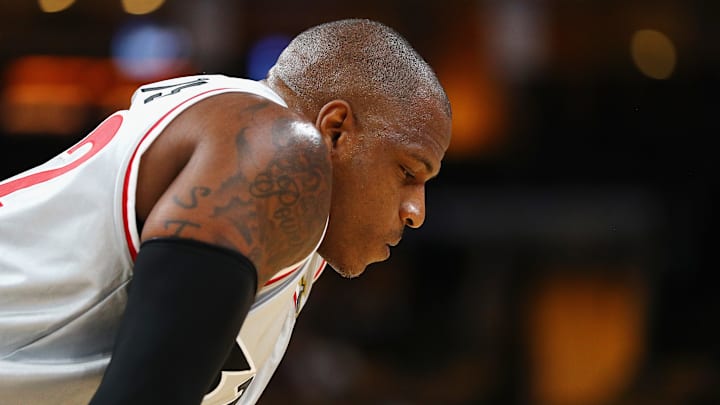
If hindsight is 20/20, Rashad McCants might have the best vision in basketball. "These kids don't understand how much of a mental toll it takes on you when you have to go out in public, and you're not hitting people's parlays, the team's not winning, you're injured or you're just playing bad. A lot of things I don't think the kids growing up these days are prepared for."
He was a McDonald's All-American, top-ranked shooting guard in his high school class, and led the North Carolina Tar Heels in scoring as a freshman. After three years and a National Championship, he was selected No. 14 in the 2005 draft by the Minnesota Timberwolves. Just four years later, he'd already played his last NBA game. By the end of 2015, he'd played in the Philippines, China, Brazil, Lebanon and Venezuela, grinding through short-term contracts and hard-earned perspective.
What started as a dream come true, a rocketship to fame and fortune, turned into something much more utilitarian — a job to pay the bills. McCants is now using that perspective and his platform to warn players about the mental, financial and emotional cost of chasing the NBA.
The NBA dream doesn’t last long for most players

"When you start to see the business aspects of it," McCants told FanSided, "you got to start making decisions based on, you know, how to feed your family, how to keep money on the table, and how you're going to survive."
McCants doesn't give the impression of someone bitter about the way things worked out, or pining for missed opportunities. McCants is now using his platform to warn players about the mental, financial and emotional cost of chasing the NBA.
"It's just about telling the stories about how a lot of the kids, a lot of the older players suffer in silence. And trying to get them to understand that the process to a strong mind, is understanding the accountability, planning and mapping out strategies to get stronger mentally through opportunities, through using your fan base, through using your skill set and being open-minded about learning new things. "
Rashad McCants found a second act as basketball sage
It's been years since you saw him making posters in a Timberwolves jersey, but McCants is still a fixture on your social feeds, served up in clips of his regular appearances on Gil's Arena, the eponymous NBA podcast hosted by Gilbert Arenas. The show has a rotating cast of returning guests, with plenty of former players, but McCants brings something different and authentic.
"I have a basketball mind deeper than most, and I think that just showing the world that you don't need to be a Hall-of-Famer to talk sports, and that if you study the game, and you master it, you can really speak with the best of them."
On the show, he often fills two lanes: master tactician breaking down the finer points of the game, and veteran journeyman, offering insight into what a life in basketball looks like for everyone besides the top one percent.
The landscape is crowded with podcasts hosted by current and former players, but McCants cuts against the grain. He's as likely to be heard talking about the pinch post and nuances of the pick-and-roll as he is about generic platitudes like heart and hustle. You won't find him lamenting the failings of the younger generation, or regularly carrying on beefs. His takes can be spicy — he understands the business, after all — but they are fully formed and fully supported, by experience, data, insight.
And McCants takes pride in his ability to offer something different from your average talking head. "You think that if you were ever to ask Skip Bayless or Stephen A. Smith during a game, 'Hey, why did they run that set? Why did they just run that play?' They would not be able to tell us why," said McCants.
"And if you can't, then it's to the detriment of this specific conversation that you are screaming about."
Why every basketball conversation needs all three sides

"Skip Bayless or Stephen A. Smith, they're always going to have an opinion of the game, and the fans love the opinion, because the fans are coming from their perspective," he said.
But McCants is careful to make clear that his approach is not the only one. There is room for what Bayless and Smith do, but they're often having a very different conversation than the ones he is trying to have. And even among retired players, there is room for different perspectives and ways of talking about the game.
"You have players like the Magic Johnsons, Isaiah Thomas, the Michael Jordans, that lived in certain experiences beyond the four-year player, the five-year player. They can tell you what happened in the Finals, they can tell you what it felt like in Game 7, and what the game plan was. That's a deeper insight, that's a deeper dive. And I think all of those aspects are needed very much so."
"But like I said, it doesn't mean that that player who played in that Game 7 can dissect the game more than that guy who only played one year, because that guy played one year actually might have been a real student of the game."
"And sometimes those players who played in the Game 7 don't really care about how the game is played. They just remember what it was like in the locker room, what it was like in the game, 'yeah, I was sweating. I just post, catch the ball and shoot it.'"
"And I think that is the greatest part of content now," finishes McCants, "being able to have all three sides up against each other, the fan, the mediocre player, and then the expert elite Hall of Famer."
So often, hard lines are drawn between those groups — fans, players, traditional media — it's refreshing to hear someone acknowledge the value of all three in the media landscape. And while he knows he's in the entertainment business, he's also adamant about the real-world impact of what he offers; for fans but also for aspiring players at all levels.
"I think the adversity that I went through, the opportunities that I've been recently been given to give back to the game, give back to life, has been monumental."
When the business side of basketball takes over

The way his playing career ended was an intensely frustrating. Injuries took their toll during his first few years in Minnesota, but he appeared to have broken out in 2007-08, averaging 14.9 points, 2.7 rebounds and 2.2 assists in a bench role across 75 games. But he was traded to Sacramento midway through the following season. He posted similar numbers for the Kings but in a smaller role and was no re-signed when his contract ended after that season.
He signed with the Rockets that offseason, but the contract was rescinded because of an abdominal injury that kept him out of training camp. From there, serious NBA opportunities didn't really present themselves. He played with the Cavs' Summer League team in 2010 and then joined the Mavericks for training camp before being released and moving to their G League team. In 2012, he began moving through a series of international leagues, paying the bills and hoping for a way back in, but increasingly not expecting one.
McCants isn't really sure why those NBA opportunities dried up so suddenly. But he has some ideas. In the past, he has talked about his short relationship with Khloé Kardashian and the impression executives seemed to form about him not being serious about basketball. In 2014, he also spoke candidly with ESPN's Outside the Lines about his experiences at UNC and a deep culture of academic fraud that surrounded him.
"I think the UNC scandal pretty much cemented the fact that I would be sacrificing making it back into the NBA," McCants told FanSided, "since it's so heavily tied to collegiate sports."
"I think that really drove the love of the game away from me, so I really heavily focused on playing for as much money as I can get, and never really got my true value overseas. And I just pivoted to being more of a creative instead of a more of a competitor."
It took McCants a while to settle into his current niche. He began training younger players. In 2021, he started a podcast called The Transition, which "highlights personal, professional and spiritual growth in individuals that embody the perseverance, inspiration and dedication to overcome obstacles and challenges in today’s society."
At some point, Gilbert Arenas approached him about his new podcast venture. McCants wasn't sure that he was a good fit or would bring in the kind of audience that Arenas was looking for. But they tried a test episode, it worked well, and he has been a recurring guest ever since.
And as the show has evolved over the years, McCants has found his voice and felt increasingly comfortable speaking out on the issues that matter to him. Not just skillsets and strategy, who's winning and why, where it all fits into the historical context of the game. But also mental health, personal growth and how the league does or does not take care of the players who aren't stars, aren't featured in commercials and earning hundreds of millions of dollars. The NBA has never been bigger, but that doesn't mean everyone is reaping the rewards.
The illusion the league sells young players

"I can say that from the outside looking in, it's not really benefiting the players. It looks like it is a thriving League, but inside and internally, the life expectancy is a lot shorter. It used to be four years that the average player can last in the league, and I believe now is maybe one and a half or two years. And with that being said, you look at how much money is being made, they've cut the money down for the regular player."
"I'm talking about the guys who get a one-year, two-year deal, they're getting minimum money, and with that minimum money, they only have minimum years, so they're forced into going overseas or going to the G League, just getting a fraction of what they envisioned themselves making when they actually pursued this dream. So I believe they are selling the illusion that you can be making money like Kevin Durant or Paul George," said McCants. "When in reality, you're all going to be shuffled into the G League making hundreds of thousands instead of hundreds of millions."
Many fans would happily trade places with players making hundreds of thousands and battling to surface in the G League for a longshot NBA roster spot. But the reality of life for these types of players is largely invisible to the average fan. And even the advantages they do have don't wipe away the struggles they face or the emotional and physical costs of this lifestyle. Especially in the modern era, where privacy is nonexistent, fans are empowered to put their opinions directly into your face and the backdrop of sports gambling adds stakes to every possession.
"I think now we've seen that being judged is a lot easier than it's ever been before," said McCants. "As far as players are concerned, your personal lives are now being pulled into your professional landscape, and I think that is a more intrusive aspect to the sport than anything, because now players have to look over their shoulders. Have to be wary of everything that they do. You live under a microscope."
"With the amount of money that you're making, it should be fair that you do the right thing at all times, just like anybody else in any other business. And if anything does go wrong, you're going to be scrutinized for it. You're going to be criticized for it. But they're not being taught media training, they're not being taught the ethics of business."
Making sure the next generation knows the truth
Rashad McCants thought he was going to be an NBA star, he ended up (briefly) as a journeyman. And now he's found his calling, speaking for the players like him and to the players who may be on a similar trajectory without realizing it. Professional basketball looks glamorous, but it's a business like any other — with winners, losers and an endless grind to make it work.
Rashad McCants has seen it all, and he's going to make sure you do to.
More NBA news and analysis:
 Add us as a preferred source on Google