
Key Points
Bullet point summary by AI
- Shai Gilgeous-Alexander has emerged as a dominant force for the Oklahoma City Thunder, blending acrobatic plays with a sharp competitive edge.
- The reigning MVP is redefining the efficiency of midrange shots, outperforming league averages by a significant margin in key areas.
- This surge in midrange accuracy positions him as a potential heir to a legendary player’s throne, sparking debates among analysts and fans alike.
Ever since he retired, everyone has been looking for the next Michael Jordan. And it makes sense why. There's the mid-air acrobatics. The one-of-a-kind competitiveness. The silky smoothness of his game. The rings. The list goes on and on.
But part of what made His Airness so divine from an impact perspective was his ability to make midrange shots (a pretty easy shot to manufacture) an efficient form of offense.
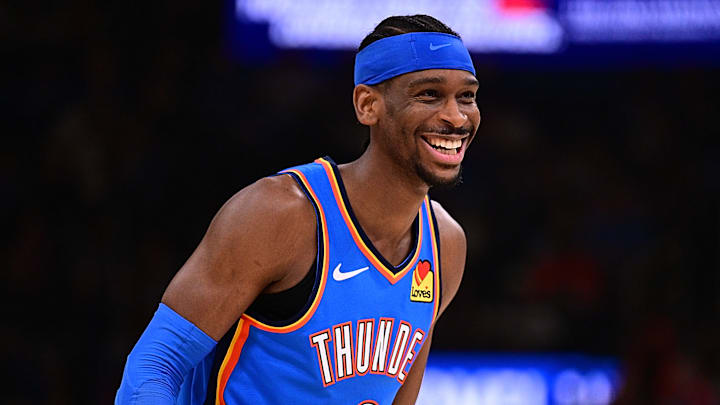
After nearly three decades, we may have finally found his true successor. Shai Gilgeous-Alexander's acrobatics aren't as mesmerizing and his snarl isn't nearly as menacing, but when it comes to the midrange, the reigning MVP may be the new king of the block.
Shai is catching up to MJ
Unfortunately, a majority of Jordan's career took place before we had access to play-by-play data. So, we don't have the full palate of numbers on his midrange efficiency. However, the information we do have is pretty illustrious.
According to Basketball Reference, Jordan shot 49.0 percent on shots from between 16 feet and the 3-point line while attempting 30.4 percent of his field goals from that range in his last two seasons with the Bulls. Those season,s the league average on those shots was 45.5 percent meaning that Jordan was 3.5 percentage points above the league average on that shot type.
This season, Gilgeous-Alexander is shooting 50.4 percent on these shots with a much lower volume (10.1 percent of his field goal attempts). But the NBA has gotten far worse at converting on this shot (mostly because the best shooters have replaced these long 2s with 3s). So, Gilgeous-Alexander is 10.1 percentage points better than the league average.
Players today still attempt midrange shots. They just take them from a shorter distance (from between 10-16 feet) than players did during the deadball era.
This is the region of the floor Gilgeous-Alexander really makes his money in. Over the last four years, Gilgeous-Alexander has never shot under 51.2 percnt from that range. And this season, he is hitting an astonishing 58.6 percent (14 percentage points above the league average) of those shots, despite that geography of the floor operating 27.3 percent of his shot chart.
On the flip side, Jordan was just 49.2 percent from this area, which, at the time, was 10.9 percentage points above the league average (with 30.4 percent of his shots coming from there).
Again, this is a limited sample from the tail end of Jordan's prime. So, it isn't a true depiction of how good Jordan was at his apex (his 2-point percentage was also much higher in the early 1990s). A true comparison of the two would require hand tracking all Jordan's jumpers from those seasons (which would be a fun thing to do, but is way outside the scope of this specific exercise). Still, it is safe to say that Gilgeous-Alexander is on the same stratosphere as a midrange assassin at this point in time.
By the way, for all the Kobe Bryant truthers out there, he doesn't come particularly close in this regard. He never had a season where he shot over 50 percent on long 2s (his highest was 46 percent), and only one time did he manage to shoot over 50 percent on short twos (2010-11) in a season where he played at least 20 games. Sorry, Black Mamba-ians.
More NBA news and analysis:
 Add us as a preferred source on Google