
Key Points
Bullet point summary by AI
- The Detroit Pistons and Orlando Magic have showcased a fascinating battle of contrasting styles in their Eastern Conference first-round series.
- Despite the Pistons' superior regular season record, the Magic have seized a 3-1 series lead by leveraging their depth and two-way capabilities.
- The Pistons' reliance on players who excel on one side of the ball has been exploited by the Magic's more balanced lineup, highlighting a critical flaw.
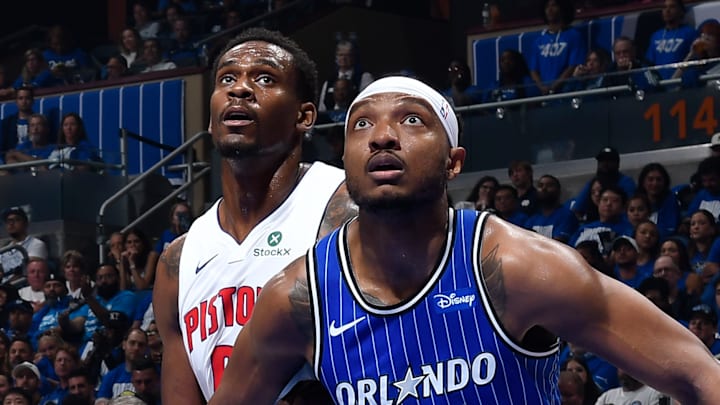
While normally a snooze fest matchup, the No. 1 vs. No. 8 slot in the Eastern Conference has been one of the most entertaining series of the first round. With the exception of Game 2, all of the games have been in peril until late in the fourth quarter. And now, the Orlando Magic hold an improbable 3-1 lead over the best regular season team in the conference, the Detroit Pistons.
We always knew that this series was going to be a clash of matching styles. What we got wrong was who was the superior prototype.
Why the Pistons and Magic are so similar
Before the postseason started, we discussed how the Detroit Pistons and Magic had a similar team DNA. Both teams are predicated on a strong defense (the Pistons were second in defensive rating, the Magic 11th) and physicality, while possessing serious questions on offense because of their shaky spacing (both in the bottom 10 in 3-point attempt rate).
Ironically enough, their starting fives even experienced similar levels of success in the regular season. According to Cleaning the Glass, the group of Cade Cunningham, Duncan Robinson, Ausar Thompson, Tobias Harris, and Jalen Duren outscored their opponents by 12.2 points per 100 possessions. Meanwhile, when Jalen Suggs, Desmond Bane, Franz Wagner, Paolo Banchero, and Wendell Carter Jr. were on the court together their point differential was a plus-11.1 per 100.
What we got wrong
Given that the Pistons had 15 more regular season wins than the Magic, we assumed that they were the superior model. However, it seems we overlooked how much injuries were keeping Orlando from reaching its full potential. Spotrac's man games lost to injuries measure says the Pistons lost 266 games to player injury this season. That sounds like a lot, but it is nearly 100 games less (348) than the Magic had to endure this season.
Now, both teams are relatively healthy (hopefully, Franz Wagner is okay), and we are seeing the clear strategic advantage this Magic team holds over the Pistons.
If you aren't picking up what we're putting down, we are talking about Orlando's ability to play two-way guys around their marquee stars. Jalen Suggs, Wendell Carter Jr., Tristan da Silva, Anthony Black, and even Jamal Cain have all found ways to not kill the Magic when they are on the floor.
Meanwhile, head coach J.B. Bickerstaff has had to continuously juggle different combinations trying to figure out what works best. Robinson, Daniss Jenkins, and Kevin Huerter can all shoot the ball and space the floor, but they provide easy targets for the big bad Magic to hunt. On the flip side, Ron Holland, Thompson, and JaVonte Green are all phenomenal defenders, but their questionable jumpers allow Orlando to shrink the floor and making driving lanes impossible for Detroit's All-Star guard to navigate.
This lack of a reliable rotation is evidenced by the fact that the Pistons have had to dish out meaningful minutes to 12 different players in this series, while the Magic have been able to play the same nine guys consistently.
Robinson, Jenkins, Huerter, Holland, Thompson, and Green have all played crucial roles in Detroit's 60-win regular season. When you have players who excel on one side of the ball and have some strong stars (Cunningham and Duren), you can eat a lot of innings and win a lot of games in the regular season.
But in the postseason, it is all about two-way players, and as of right now, it seems like the Magic have a lot more of those.
More NBA news and analysis:
 Add us as a preferred source on Google