
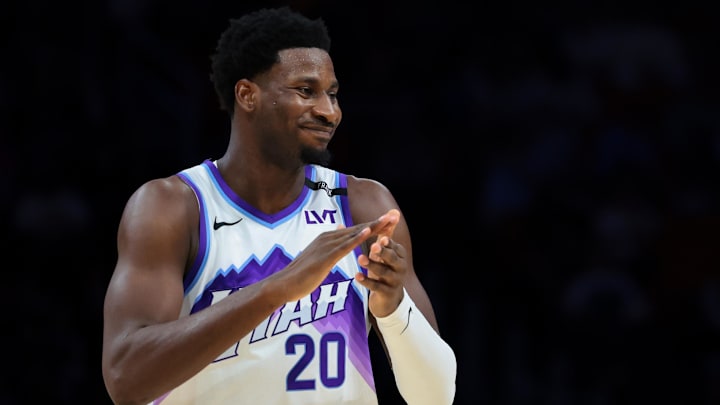
The Utah Jazz and Washington Wizards engaged in a competitive tank-off last season, but that's nothing compared to what's coming this year.
The Jazz and Wizards each owe their 2026 first-round picks to other teams if they land outside of the top eight. They'd need to finish with one of the four worst records in the league to ensure that their picks won't convey.
The Wizards are currently in a five-way scrum for one of those bottom-four spots. The Jazz aren't far ahead of that group. However, they swung a deal at the trade deadline that could complicate their rest-of-season tanking efforts.
The Jazz acquired Jaren Jackson Jr. in an eight-person blockbuster that also featured John Konchar and Vince Williams Jr. heading back to Utah. The Jazz only gave up the expiring contracts of Kyle Anderson and John Konchar along with two recent draft picks (Taylor Hendricks and Walter Clayton Jr.) who had become redundant.
On paper, that should be a clear upgrade for the Jazz. In practice, they're still doing everything reasonably within their power to increase their chances during the draft lottery.
In each of their past two games, they've limited Jackson, Lauri Markkanen and Jusuf Nurkić to roughly 25 minutes, including none of the fourth quarter. They closed out Saturday's loss to the Orlando Magic with Isaiah Collier, Ace Bailey, Brice Sensabaugh, Kyle Filipowski and Cody Williams on the floor.
Two nights later, the Jazz tried the same gambit against the Miami Heat. This time around, they went with Bailey, Collier, Filipowski, Williams and Brice Sensabaugh for the final few minutes. Despite their best efforts to lose, they walked away with a 115-111 win.
The Jazz are no stranger to these tactics. Neither are the Wizards, for that matter. They strategically rested Alex Sarr, Kyshawn George and Bilal Coulibaly against the Nets on Saturday. All three were back the following night against the Heat. They've also been pulling their starters in the third quarter, only for them never to return.
The Wizards traded for both Trae Young and Anthony Davis over the past month, but neither appears likely to make their Wizards debut soon (if at all this season). Young is currently sidelined with a sprained right knee and bruised quadriceps, while Davis is out with hand and groin injuries. The Wizards aren't likely to rush either one back, to say the least.
If the Wizards add a top-five pick to a core that includes Young, Davis, Sarr, George and Tre Johnson, they could make some noise as early as next season. But both they and the Jazz will first have to avoid the furor they're raising across the league.
"You've heard of Icarus and what happens when you fly too close to the sun," one team president told ESPN's Brian Windhorst. "I think some teams are in danger of flying too close to the ground."
The NBA's tanking plight

In late December, ESPN's Shams Charania reported the NBA had "begun to gather input from its owners and general managers on new ways to combat tanking." The league reportedly proposed solutions such as limiting draft-pick protections in trades, locking lottery positions after March 1 or prohibiting a team from drafting in the top four twice in a row.
However, none of these reforms will go into effect soon enough to stop the Wizards, Jazz and other tanking teams from making a mockery of the NBA over the final two months of the regular season.
To be clear: This is not a new phenomenon. The Wizards, Jazz and Toronto Raptors were the three worst offenders last season, but a number of teams in recent years have pivoted into youth movements late in a lost season to increase their draft-lottery odds.
It's unclear if any of the NBA's proposed fixes would actually solve the problem, either.
Locking lottery positions after March 1 would likely just make teams tank earlier; it might not stop it outright. Limiting pick protections would increase the disaster potential of trades moving forward. And banning teams from drafting in the top four twice in a row could help increase parity, although that might only help the rich get richer, too.
The league could look to impose more drastic reforms, from Mike Zarren's "Wheel" idea to "tombstone wins." Will Gottlieb of CHGO Sports recently suggested using a three-year cumulative record to decide lottery odds, which should also theoretically decrease the incentive to tank.
Under Gottlieb's system, teams in injury-imposed gap years—such as the Indiana Pacers this season—wouldn't stand to benefit as much, which is an added benefit. However, that system could wind up favoring teams on the ascent after a rebuild, too.
There's no perfect solution to the NBA's tanking problem without reworking the draft entirely. That isn't likely to stop the NBA from trying to combat it, though.
Can the NBA thwart would-be tankers?

The league already changed the draft-lottery odds beginning in 2019 to decrease the chances of the teams with the worst records. It also went from choosing the top three picks via lottery to the top four picks.
Since that change, the team with the worst record has not won the lottery. In each of the past three years, the team with the worst record has slipped all the way to No. 5 (Detroit in 2023 and 2024; Utah last year). The teams with the three worst records now have a roughly 50-50 shot of falling to at least No. 5, if not further.
That hasn't stopped rebuilding teams from pulling the plug on their seasons, though. Tanking isn't just about the ceiling; it's about the floor, too. Since the team with the league's worst record can't fall lower than No. 5, there's still major incentive for teams to quiet-quit once the playoffs are out of reach.
Evan Wasch, the NBA's executive vice president of strategy and analytics, told ESPN's Tim Bontemps and Kevin Pelton last season that he was "not aware of anyone making a serious push to eliminate our current philosophy of the draft, which is to award top picks to teams that are most in need of talent." He also said the NBA would not intervene in the rotation shenanigans that the Jazz and Wizards have again begun to engage in recently.
"We are not in the business of policing rotations in that way," Wasch said. "For the league to step in and say that a team chose to play one player over another player and that was the wrong decision, I think that's a bit of a slippery slope…
"And oh, by the way, some of those [younger] guys actually go win the game."
Those words proved prescient Monday in Utah's game against Miami, but the young Jazz players will likely wind up losing far more games than they win without veteran help in the fourth quarter. That not only has an impact on the lottery standings, but it also could influence which teams make the playoffs as well. Teams that get to feast on tankers late in the season will be far better off than those who face teams that are actively trying to win.
If the Jazz, Wizards and other lottery hopefuls continue to thumb their noses at the league by benching their starters in an attempt to throw games, they'll be daring the NBA to enact even more lottery reform.
More NBA news and analysis:
 Add us as a preferred source on Google